
Comment from Peter Saxon –
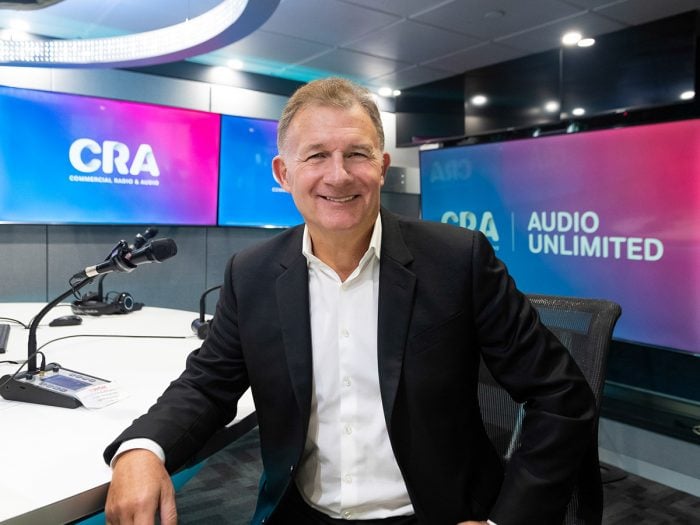
Today is a big day for Commercial Radio and Audio. A contingent from CRA, led by CEO Ford Ennals will descend upon the nation’s capital to deliver a:
SUBMISSION BY COMMERCIAL RADIO & AUDIO REGARDING
THE COMMUNICATIONS LEGISLATION AMENDMENT
(PROMINENCE AND ANTI-SIPHONING) BILL 2023
It is designed to draw the attention of our lawmakers to the tragedy that would befall our industry and our listeners (their constituents) if radio did not retain its prominent position in the car, the home and in the workplace as consumers migrate to smart devices on digital platforms.
I first spoke to Mr Ennals in May 2022, soon after he took up the position that heads up CRA. He told me, “What we do in the next two or three years will probably end up defining the future of radio.”
He wasn’t kidding. Here’s what’s at stake…
Prior to the advent of smart devices, the business model for radio and television was simple: A strictly limited number of stations were licensed by the government to erect an antenna that emits a linear program signal on an allocated frequency, over a specific area that could be picked up by a television or radio ‘set,’ purchased for the task. And those sets had to comply to Australian standards so that they could receive all the frequencies, and only those frequencies, that the government had licensed. That’s no longer the case.
Today, there’s a myriad devices through which one can listen to or watch content on live or on-demand, with or without a broadcast licence. Plus, there’s a bewildering amount of content available through hundreds of channels. Sorting through all this can be a consumers’nightmare – one that only a smart TV, smart speaker or smart dashboard can adequately address.
Suddenly, the way a car dashboard is configured becomes of vital importance to radio which is no longer a physical, stand alone. built-in device in modern vehicles but a virtual icon on a page of an infotainment system that it shares with streamed music, podcasts as well as audio from a variety TV and newspaper content via apps such as YouTube. The same screen also deals with maps, phone messages and parking cameras.
“Platforms like Google and Amazon are the gatekeepers…. access to platforms is something that we need to be across,” Ford Ennals
But the really smart thing about smart devices is that because they have limited screen space, meaning the demand is greater than supply, they can, and do, monetise access to it. So, now, instead of a direct connection between the transmitter and a listener through their radio – there is a third party in between, that’s happy to clip the ticket along the way.
Take my Apple TV, for example. It’s a small, easy to use interface that when plugged into the back of any TV turned it into a smart TV – before “smart” was even a thing in terms of devices. Through Apple TV one could rent or buy movies and watch or listen to content made by Apple as well as scroll through your photo library while you listen to music from your Apple Music playlists. The Apple TV was also an early aggregator of other channels such as Netflix, Stan and the RadioApp. For me, that little black box was a very useful bit of kit. It currently sells for around $240 but I doubt it’s selling like it used to.
A couple of years ago, I purchased a new 65” LG OLED Smart TV. I was about to upgrade to the latest 4K version of my Apple TV to take advantage of the improved picture quality when I realised that the latest Apple TV could be installed as an app on the LG for free. So, not only did Apple miss out on getting my $240 for its latest little black box, but it is asked to pay LG (and other major brands) a fee for the space they occupy on screen.
Australia’s RadioApp which is steadily replacing physical radio sets is also available on my LG TV and throughout the house on all three computers, an iPad, Apple Watch TV and smart speakers. It sounds great for radio to be so ubiquitous, but in reality, where it dominated the live to air audio space through a single purpose device, aptly called a “radio,” its presence is being diluted by the number of audio competitors on each device.
The real issue in the digital world is “prominence”. It’s not enough for a brand/product/business to be on the internet, you have to be on the first page of a Google search for full impact.
BTW: Next time you get one of those unsolicited emails about getting you a #1 ranking, tell them: I Googled you and still hadn’t found you after 6 pages. Come back when you’re #1 on Google and we’ll talk.
ABC Radio, SBS and CBAA have made separate submissions as has FTA Television. You can read all those submissions here.

You can read CRA’s full submission via the link below.
CRA submission on prominence FINAL 2 Feb 2024
Peter Saxon
Two remarks.
Firstly, the app that is installed on your smart tv may be incompatible in a few years after your purchase.
To illustrate a 2012 LG smart tv's last firmware update was in 2015. Since then, the. ABC's iView app has changed to registering and logging in.
The lesson is that FTA providers must provide backward compatibility for old apps which cannot be updateable because the firmware updates for the tv are not available. The iView situation is an example because the iView app of today requires registration and logging.
A workaround is to install an Apple chromecast which is compatible with the iView app.
https://help.abc.net.au/hc/en-us/articles/8552073990287-How-do-I-use-Chromecast-to-watch-ABC-iview
Of course the smart tv will have an hdmi connector.
A similar problem exists with DVD/Blu Ray players where firmware updates are not available a few years after purchase. Installed apps such as Netflix are not updateable.
Lesson for the FTA providers is that future apps are backwards compatible with old apps. The consequences of incompatibility are inoperable old apps edpecially if the device's firmware update is unavailable.
Secondly, even if if the "Prominence Bill" comes into effect including incorporating FTA radio and TV, will it stem the flow away from the FTA providers?
FTA is no longer the predominant source of media. FTA channels exist by dint of occupying the scarce electromagnetic spectrum. With IP delivered content, there are billions of IP addresses raising the opportunity for more channels that could never be accommodated on the scarce electromagnetic spectrum.
More IP content means more diversity. In fact, in Australia alone, more than $398 million was spent by the subscription services for drama compared to $298 million on the FTA broadcasters (2021 report to Screen Australia).
Also there has been a 68% decline in the amount of drama produced by the FTA providers from 1999 to 2019.
What posits as drama on the FTA services are rank amateur wanna be people acting in contrived and scripted reality shows.
When it comes to radio, particularly music, audience tastes may well differ than what is aired on FTA radio. Look at someone's Spotify public listing and it's guarantted that their favourite songs are not necessarily aired on FTA radio.
On the other hand, FTA apps allow one to listen to stations outside the listener's licence area in clear digital sound that was not available with ionospheric skip listening of yesterday OR even if the signal was impossible to receive.
Then again will a "Prominence Bill" stem the flow from FTA services for content who present alternative views to narratives on FTA TV and spoken word radio programs?
Whether one agrees or disagrees with the views expressed on non FTA services, it would be impossible for the FTA services to accommodate all the narratives and views presented on websites, YouTube, Rumble, BitChute and Patreon.
So much so that audiences for FTA services including subscription services such as CNN have plummeted. CBS including Network 10 have reduced their staff numbers. Network 10 is behind the ABC.
You have to question if the FTA services will give their audience what they want.
But what content to put on FTA networks? The horse has bolted in the ability of audiences to choose diversity.
Thank you
Anthony of criticsl Strathfield South in the land of the Wangal and Darug Peoples of the Eora Nation