
By Dave Charles, CEO of Media RESULTS Inc.
Marshall McLuhan’s famous line, “the medium is the message,” has always resonated deeply within radio. We’ve lived it. We’ve watched how every shift in technology — from AM to FM, from terrestrial to streaming, from linear to on‑demand — has reshaped not just what we broadcast, but how audiences behave. Today, artificial intelligence is emerging as the newest medium, and its impact on radio will be as profound as the arrival of the transistor or the smartphone. AI isn’t just another tool in the kit; it’s a new environment that is already redefining how audio is created, consumed, and valued.
For decades, radio has thrived on its ability to connect intimately and instantly. AI now extends that intimacy in ways we’ve never seen before. It adapts to each listener, learns their habits, and responds in real time. In McLuhan’s terms, the “message” of AI isn’t the content it generates — it’s the shift toward personalised, conversational media. When listeners can talk to their devices and receive tailored audio experiences, the medium itself becomes participatory. That’s a seismic change for an industry built on one‑to‑many communication.
AI also accelerates the pace of radio production. Tasks that once took hours — research, scripting, scheduling, music analysis, promo writing — can now be done in minutes. This doesn’t diminish the craft; it amplifies it. Programmers gain more time to think strategically. Producers can focus on storytelling instead of admin. Talent can sharpen their performance instead of drowning in prep. The message of this new medium is clear: creativity becomes the differentiator, not the mechanics behind it.
But perhaps the most transformative shift is how AI reshapes the relationship between stations and audiences. Radio has always been local, emotional, and human. AI doesn’t replace that — it reframes it. When used thoughtfully, AI can deepen engagement by helping stations understand listener behaviour at a granular level, anticipate needs, and deliver content that feels handcrafted for each individual. In this sense, AI becomes a co‑pilot for programmers and talent, enhancing the human connection rather than competing with it.
Of course, McLuhan would remind us that every new medium disrupts before it integrates. AI raises questions about authenticity, originality, and trust. It challenges traditional roles in programming, production, and sales. But radio has weathered every technological storm by adapting its strengths — immediacy, personality, community — to new platforms. The stations that thrive in the AI era will be the ones that embrace the medium’s capabilities while doubling down on the human elements that make radio irreplaceable.
If McLuhan were sitting in a programming meeting today, he might say that AI is not just another innovation — it’s a new media environment that rewires how audio is created and consumed. The message of AI is transformation: a shift toward personalised, interactive, and collaborative media. For radio professionals, this is not a threat but an invitation. An invitation to evolve, to experiment, and to shape the next chapter of audio storytelling.

Mobile: +1 289 242 8313.
Email: [email protected]
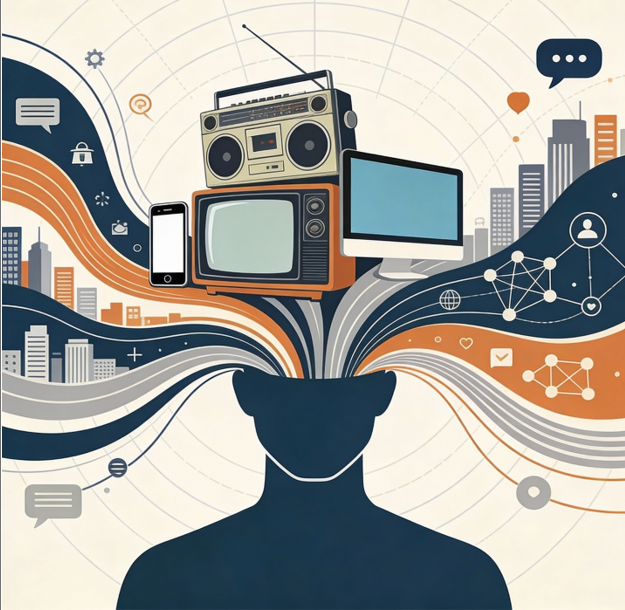
Image supplied.