
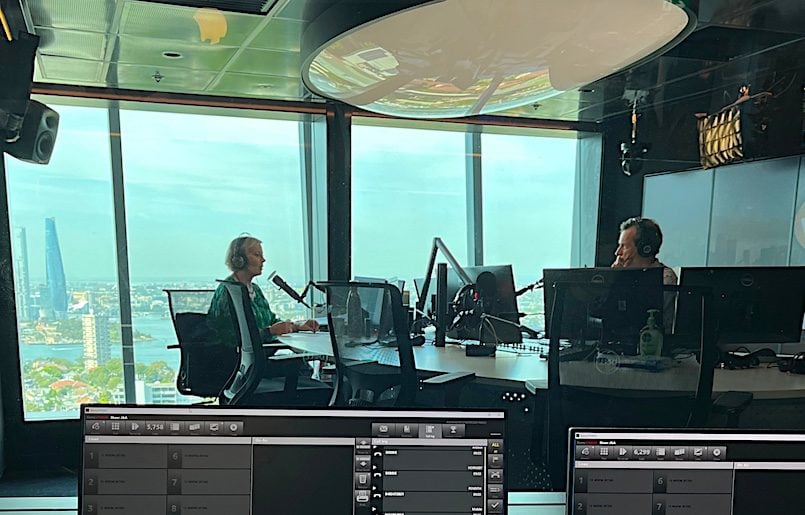
“Reimagining Radio Broadcast Infrastructure for AI, Cloud and Visual Integration”
Drawing on Bala Murali Subramaney’s nearly 30 years of experience in operating, managing, designing, and implementing radio studios across diverse markets in Malaysia, India, China and Indonesia, from entry-level community setups (10%), medium-budget commercial stations (20%), to premium broadcast facilities (70%), this article presents a forward-looking concept for the radio studio of the future.
1. Inside the Radio Studio
Tomorrow’s radio studio should be built around a multi-screen, touch-driven environment that merges production, presentation, and audience interaction into one seamless interface.
Core In-Studio Display setup:
- Dual Screens for Radio Automation. One for playlist and playout management, another for scheduling, logging, and real-time advertisement control.
- AI-Driven Script and Context Screen. Displays intelligent prompts, story context, fact checks, trending topics, or real-time translation to assist announcers on air.
- Telephone Hybrid Interface. Integrated screen for managing callers, contests, and remote interviews, complete with AI-based voice screening and auto-record logging.
- Touch-Panel Console. Modern digital console with touch workflow for routing, fader control, monitoring, and mix automation. It can be one or two screens.
- Backup Control Surface. Secondary touch panel or hardware control surface to maintain full functionality in the event of console screen failure.
- Backup Automation System. Redundant playout automation running in sync with the primary system to guarantee uninterrupted broadcast.
Visual Radio Features & Studio Aesthetics:
- Central Branding Display. A large TV screen behind the announcer featuring station branding, show titles, or dynamic graphics.
- Supplementary Monitors. One or two side screens displaying live social feeds, audience comments, or remote guest video.
- Lighting & Camera Integration. Adjustable lighting scenes and AI-controlled cameras (auto-tracking announcers or guests) to create professional, live-ready visuals for broadcast or streaming.
2. Future-Ready Workflow Beyond the Studio Walls
The modern radio ecosystem now extends far beyond the announcer’s desk. Supporting staff and producers play a vital role in multi-platform content creation and audience engagement.
Producer and Content Workstations (Outside the Studio):
- Caller & Contest Management Hub. Manages audience engagement, live phone calls, and promotional activities in real time.
- Social Media Command Center. Handles social media posting, audience feedback, and cross-platform engagement directly from live segments.
- Podcast & News Bulletin Production Desk. Dedicated workstation for repackaging on-air segments into podcasts, digital news briefs, and short-form content.
- Live Video & Visual Radio Station. Oversees multi-camera live streaming to social media platforms (YouTube, TikTok, Facebook, Instagram etc.) with live editing, graphic overlays, and sponsored product placement.
- Shared In-Studio Advertising Control Screen. Enables real-time management of visual branding, advertising cues, and product displays visible on-camera.
3. Intelligent Integration: Audio Meets Visual
One key innovation for future studios is full synchronization between radio automation system and visual systems. This ensures every on-air event, from music playback to ad insertion, is reflected across both audio and video channels
Whenever the on-air playlist reaches a commercial break, the radio automation system can send a trigger signal to the video server. This signal prompts the playback of corresponding product videos, brand slides, or live sponsor graphics on the in-studio screens or online video feed. This creates:
- A cohesive audio-visual ad experience for hybrid radio/streaming audiences.
- Enhanced advertiser value through visible brand presence.
- Simpler workflow — no need for manual video switching.
4. The Future Perspective: Radio as a Multi-Platform Content Hub
The radio studio of the future will not only produce audio — it will evolve into a multi-platform media hub, delivering synchronized, cross-channel content experiences.
- AI-Assisted Production — Automated transcription, highlight generation, and performance analytics to help announcers improve delivery. This significantly reduces announcer preparation time
- Cloud-Based Collaboration — Enables producers, editors, and voice talents to connect to live studios remotely and securely in real time.
- Immersive Audience Interaction — Incorporates augmented reality (AR) overlays, live polls, and interactive streaming elements to deepen listener engagement.
- Intelligent Audience Analytics. AI-powered analytics will transform how radio stations understand their listeners, providing real-time insight into audience behavior, engagement peaks, and content performance. This data allows broadcasters to make adaptive programming decisions and deliver more personalized listening experiences
5. Selecting a Virtual Console: Designing for the Next Generation
The future radio workforce will be dominated by Generation Z and Generation Alpha — digital natives who are comfortable with touchscreens, mobile-first interfaces, and gesture-based interaction. For digital native generation, traditional broadcast consoles with mechanical faders and bulky metal surfaces feel outdated, unintuitive, and overly complex.
To remain relevant and appealing to the next generation of radio professionals, broadcasters must transition to virtualized, touchscreen-based control surfaces. These new-generation consoles should offer:
- Intuitive and modern user interfaces (UI/UX)
- Customizable layouts adaptable to various programs or formats
- Software-defined routing, eliminating extensive cabling and patching
- Lower maintenance costs and reduced physical wear
- Native AI and metadata integration, enabling analytics and automation
Broadcasters should collaborate with manufacturers and system integrators to develop ergonomic, scalable, and AoIP-compatible virtual console systems that align with next-gen operational expectations.
6. Modern Audio Protocols for Future-Proof Radio Studios
In next-generation broadcast environments, Audio over IP (AoIP) will form the backbone of studio infrastructure. These industry-standard protocols offer exceptional reliability, synchronization, and sound fidelity. Having worked extensively with these protocols, I can attest to their reliability and performance in mission-critical environments.
AES67 — The Interoperability Standard. Best for: Modern IP-based radio studios using equipment from multiple vendors. AES67 ensures cross-compatibility between different AoIP systems, including Ravenna and Dante, making it the foundation for scalable, multi-brand integration.
- Ravenna — Enterprise-Grade Broadcast Performance. Best for: National broadcasters, large radio networks, and public service media. Ravenna is an open-source AoIP technology designed for mission-critical, high-redundancy environments. It delivers ultra-low latency and full AES67 compliance, making it ideal for complex broadcast networks.
- Dante — The Hybrid Studio Workhorse. Best for: Versatile studios that integrate radio, music production, and live streaming. Dante is widely used across broadcast, recording, and corporate AV It offers plug-and-play configuration and scales easily from small facilities to large enterprise installations.
Together, these AoIP protocols define the future of broadcast audio routing — enabling greater flexibility, interoperability, and efficiency while reducing dependency on traditional copper infrastructure. Broadcasters are encouraged to explore and adopt these technologies to remain competitive and adaptable in the evolving media landscape.
7. Best Practices for AoIP-Based Radio Studios
To ensure maximum reliability, redundancy, and regulatory compliance in modern broadcast environments:
- Adopt an AES67-compliant network for interoperability and future scalability.
- Deploy managed network switches with QoS and VLAN segmentation to isolate audio traffic.
- Implement full system redundancy, including dual NICs, failover servers, UPS System , and mirrored playout servers
- Synchronize AoIP devices via PTP-Precision Time Protocol (IEEE 1588) to maintain precise timing.
- Monitor network performance for packet loss, latency, and jitter using dedicated broadcast tools.
- Maintain analog backups (microphones, preamps, and monitors) for continuity in case of IP network issues.
Future radio studios must combine IT-grade reliability with broadcast-grade precision, bridging the worlds of technology and creativity.
8. Rethinking Studio Design for 2026 and Beyond
In the digital age, cluttered studios with visible cables, under-desk computer towers, and heat-generating racks are no longer acceptable. Such designs negatively affect both performance and aesthetics, particularly in visual radio or hybrid broadcast setups.
A next-generation studio should house only essential equipment such as microphones, monitoring systems, touch panels, and visual displays. All noisy or heat-generating components (servers, codecs, switchers, sound cards, and PC towers) should be relocated to a Master Control Room (MCR).
Benefits of a Clean, Minimalist Design
- Quieter working environments
- Streamlined visual appearance (important for video and streaming)
- Easier maintenance and upgrades
- Reduced heat within the studio
- Longer lifespan for sensitive hardware
A clean studio isn’t just visually appealing — it’s a mark of engineering excellence and operational efficiency.
Conclusion
The next generation of radio studios must go far beyond hardware, uniting broadcast engineering, IT infrastructure, and AI-driven content systems within a seamless, software-defined environment. By integrating automation, AI, visual media, and cloud collaboration over a flexible, IP-based foundation, radio will evolve into a multimedia command center that serves both traditional listeners and digital-first audiences.
This transformation is not purely technological—it is equally human and strategic. Future broadcasters from Gen Z and Generation Alpha will expect intuitive, touch-driven workflows and intelligent, virtualized consoles that reflect the digital ecosystems they already live in. At the same time, studios must embrace clean design, operational reliability, and sustainability, relocating noisy, heat-generating equipment outside the on-air space to create a focused and visually refined environment.
Ultimately, the radio studio of the future will be defined by integration, intelligence, and interactivity—a dynamic ecosystem where sound, visuals, and data converge to deliver richer, more connected experiences. Radio will continue to thrive, not as a legacy medium, but as a living, adaptive, and intelligent platform for storytelling and engagement in the digital age.
 By Bala Murali Subramaney
The author is a Malaysia-based radio engineering and technology consultant specializing in large-scale broadcast facility systems and digital transformation. Linkedin.
Contact: [email protected]
Previous article:
Why We Don’t Recommend Bluetooth Headphones for On-Air Radio Studio Use
Photo: S Ahern