
In his article of June 11th James Cridland asked if there is a “catch-all standards and services” radio that he could take on his travels.
Digital Radio Mondiale’s Ruxandra Obreja replies.
For those of us with a longer memory, James is asking for a digital radio equivalent to the traveller shortwave receiver that I remember buying for many pounds at the BBC shop many years ago.
His logical question can be split into two?
Is there such a receiver and then, if so, who needs it exactly?
You could even dismiss such questions on how many digital radio receivers you need to cover the various digital radio flavours across the globe, by simply seeing how many electric plugs globe-trotting travellers need, in Asia or even Europe? And we have not even mentioned the Americas yet.
As there are at least three main ITU recommended digital broadcasting standards (DRM for all bands, not just AM), DAB and HD, the solutions for car, standalone and even mobile receivers are diverse and very often geographically specific. Recently there have been also countries going not just for one digital standard but for more than one. They have opted for both DRM (in all bands, including band III, and not just AM) and DAB+ (like Australia, Indonesia or South Africa, other African countries etc.) or CDR and DRM (in China). Receivers need to accommodate all these standards and variations or pairings.
The good news is that at the level of chipsets and core modules there are already several solutions.
There are single chip SDR radios which can receive all of the above standards with the appropriate software (One example: Si469xx/xxC Product Summary which shows how they make the same processor loaded with different firmware for different markets). Similarly: NPX Hybrid Radio & Audio
The snag is that even if the chipset solutions exist there will be a complication with HD radio because the Xperi® royalty will be applied even if the radio is not used in North America.
So, what we have seen practically is the CDR DRM options for cars, with a real implementation in a car shown at a big event in Beijing in the spring.
Significantly, a prototype module including DRM (in band II and band III) and DAB has been recently tested with excellent results in Indonesia. With Indonesia adopting DRM and DAB+ it would be the ideal market for a DAB+/DRM in the HF and band III.
And then to the second question: who needs such a complex and expensive catch-all receiver?
As we have seen the global all-digital singing and dancing modules and prototypes exist now (analogue is a feature of all digital receivers, by the way), as do dongles, apps and SDR options.
The question remains: how many people need such receivers, who can order them in significant numbers so this makes business and profit sense and who can pay for such a Rolls-Royce digital radio.
About the Author

Ruxandra Obreja is Consortium Chairman of Digital Radio Mondiale (DRM)
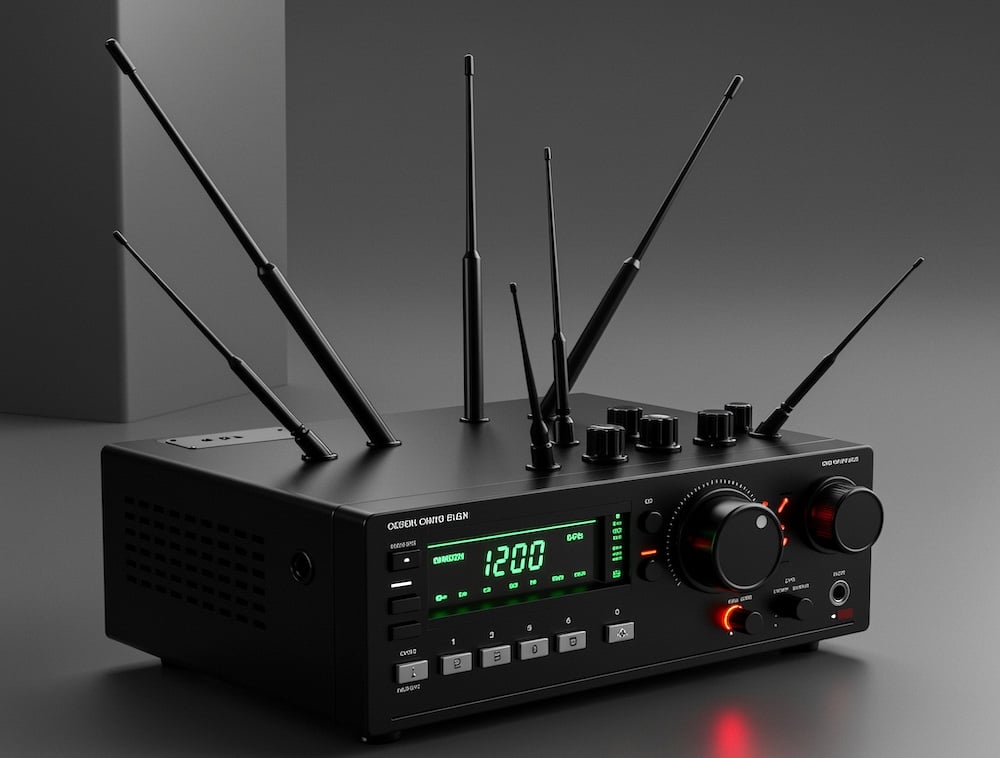
Main Pic: An AI generated ‘multiple antenna’ fake radio receiver. Composite pic by radioinfo
In all our publications, we employ real people with professional industry understanding, deep connections and long memories, who write real, researched stories. We don’t use AI or automated bots to generate stories. If we use AI for summaries or picture montages, we declare it. You can support our journalism by paying for deep access to our reporting via an annual subscription that supports our independent audio industry trade publication.