
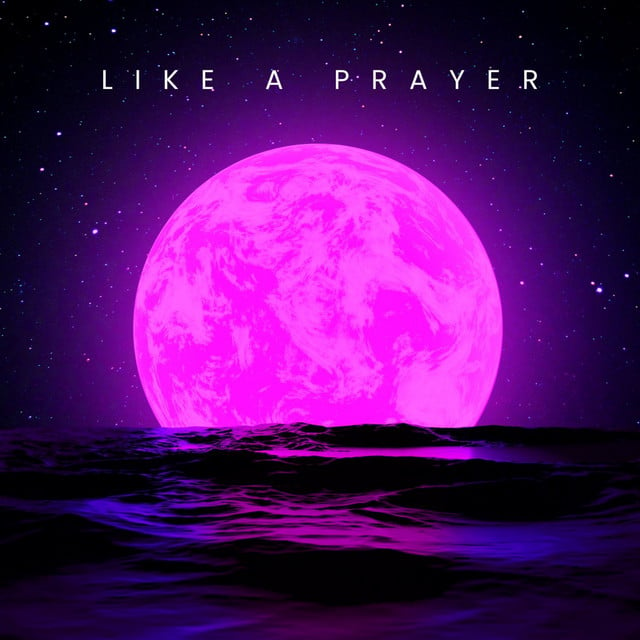
I felt like I’d been caught up in a scam when it was pointed out to me that Australian DJ and music producer Josh Fawaz‘s remix of Madonna‘s Like a Prayer does not credit a vocalist.
Josh has not said yet that the voice is synthetic, or the whole song for that matter, but Reddit have said this “spray and pray“ piece has still somehow captured commercial radio’s attention. It is currently its most played song, with more than 1000 spins last week.
On the 1st of July The ACMA‘s revised Commercial Radio Code of Practice 2026 came into effect. It has new safeguards for listeners where commercial radio broadcasters must disclose when a synthetic voice is used to host a regularly scheduled program, or news broadcast.
There are also updated commercial radio guidelines for content production, to help networks identify and classify their station format correctly under the Australian music obligations as to what percentage of Australian music they are required to play. I did a deep dive into that below.
Within the guideline it says:
“Where more than one performer is involved in a musical performance, the Musical Items concerned shall be regarded as being performed by an Australian if the performance is predominantly by one or more Australians.”
While I appreciate that Josh Fawaz produced this version, and is credited further for ‘synthesizers’, with AI vocals and as a US composition, I do not feel that this justifies in any way being an Australian music recording. This kind of churn and burn needs to have its own special category.
What is further disappointing is that as people have clocked what this piece of music is, they have blamed commercial radio for its promotion to mainstream success. Radio used to be the place where you hoped to hear your song played for the first time to be discovered by new fans, and now it’s serving you mindless AI mixes.
It’s like getting a microwave meal (without stated ingredients) at your favourite restaurant.
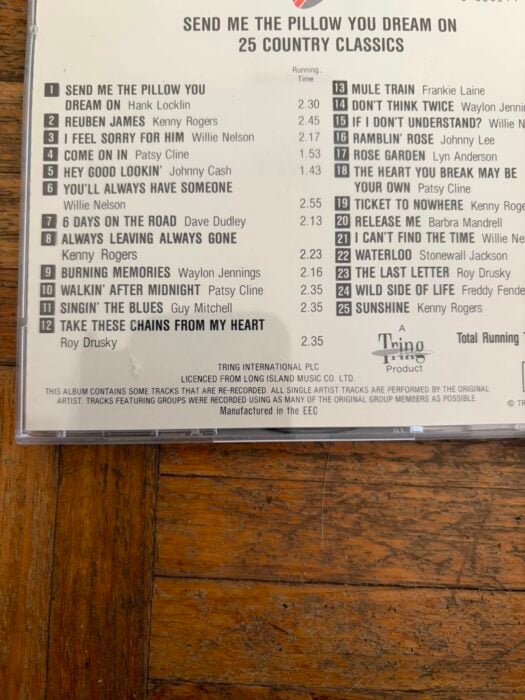
Years ago, and I apologise for my crappy photo but it felt appropriate, there were companies that would sell CD compilation albums at a budget price. I’d spend my hard earned money from my part time job, go home and put it on, only to realise that what I was listening to sounded totally different to the version I’d heard on the radio.
Then, I’d note the fine print that would say something like, rerecordings not by original artists, or this beauty above – ‘tracks featuring groups were rerecorded using as many of the original group members as possible.’
This was the original fake copy.
I’d curse myself for being so stupid to not realise and I suppose that is the point of this story today. It is a warning to commercial radio that we are better than that, and Australian musical artists deserve better than having a portion of a radio station’s Aus percentage taken up by an AI remix of something that wasn’t Aussie in the first place.
Want to discover new Australian music – check out the AMRAP charts, across multiple genres: https://amrap.org.au/charts
Additionally, this is ARIA’s open letter from Australian creatives asking for their work to be paid for and not used without permission. You can sign in support here.
I wonder what Madonna makes of all this?
Jen Seyderhelm is a writer, editor and podcaster for Radioinfo. Email: [email protected]. You can subscribe to this publication for just $199 per annum (less for community stations, students and pensioners) and support local media. Celebrate Radioinfo in its 30th year.
Need an new Aus music recommendation? I’m listening to Adelaide band Oscar the Wild‘s Sunrise: