
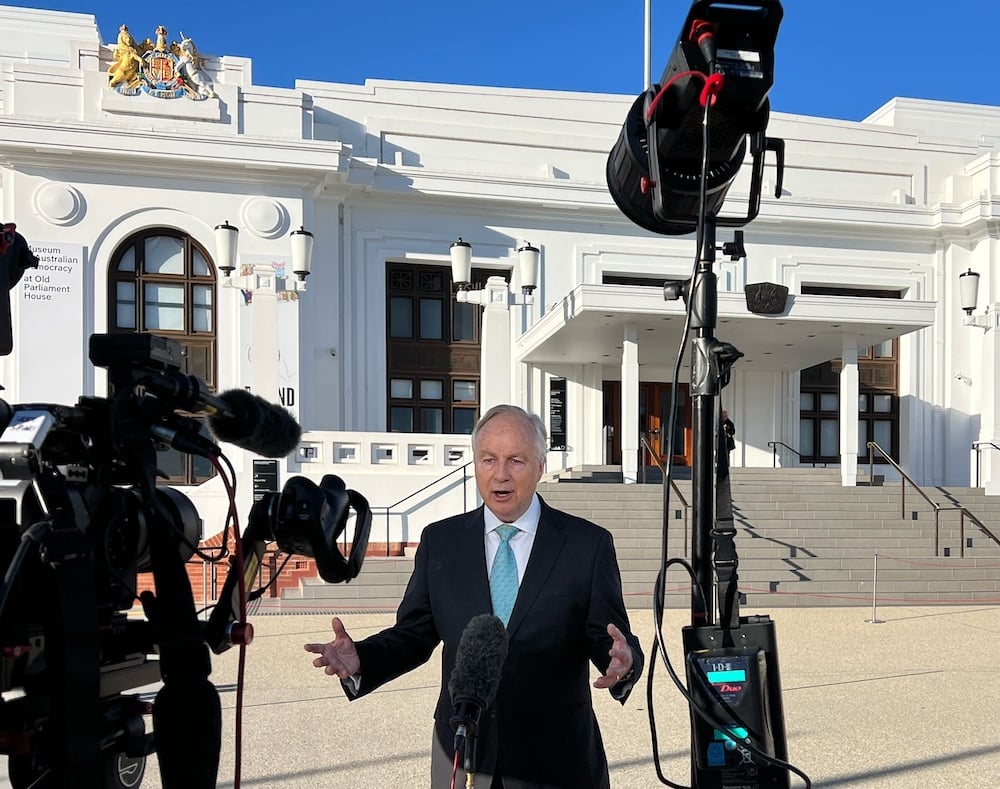
Fifty years ago today the Whitlam Labor government was dismissed by the Governor General John Kerr for its inability to pass the federal budget and guarantee supply. It is one of the few reasons an Australian government can be dismissed from government by the monarch’s representative, the Governor General.
Leigh Hatcher was a reporter for the Macquarie Radio Network that day. Radio was the first medium to break the news of the dismissal to the public after weeks of coverage of the Liberal dominated Senate not passing the budget bills and precipitating the ‘supply’ constitutional crisis.
Leigh tells radioinfo’s Steve Ahern how it all unfolded on the day from the moment his cadet burst through the door of his small radio press gallery office shouting ‘Gough sacked!”
Steve: Tell me where you were in the Press Gallery and what you were doing when you heard the news of Gough’s dismissal.
Leigh: I was in my pokey little broom cupboard of an office on the Senate side of Parliament house writing up a story for the 2 o’clock news that Gough Whitlam had gone to the Governor General and was seeking a half Senate election to break the deadlock that had happened in 1975 when Malcolm Fraser’s opposition blocked the budget in the Senate.
My cadet, Tony Ritchie, came bursting through the door and shouted out, expletive deleted, ‘Gough sacked!’
I was so shocked, the Governor General had sacked the Prime Minister.
So I sent a quick flash up the line to the Macquarie network, some of which believed it and some which didn’t would you believe. Then Tony and I took off through Parliament House down to Kings Hall.
I’ll describe Kings Hall. It’s in the middle of the two chambers, the Senate and the Reps in the old Parliament House. That was a silent kind of space where you would glide through and whisper little bits of political tips and gossip. On this day people were shouting and running and yelling, running every which way like chooks without heads.
Tony’s source was Alan Reid the old red fox and the doyen of the Press Gallery at the time. So I ran back up and filed a news story for the 2 o’clock news that Gough Whitlam had been sacked. I’ve only found out recently that our Brisbane newsroom didn’t actually believe the initial flash that I put up the line, can you believe it? So they didn’t run it.
Steve: How did you do a flash in radio in those days from the gallery?
Leigh: You just sent a message up the line, Gough sacked. It was just words at that stage, but that’s enough for radio to put on air. It was about 10 to 2 that I put that up and then finally got a piece filed for the 2 o’clock news.
That’s when people started hearing about it. It was one of those events where you remember where you were and what you were doing.
So many [people who remember it] still say ‘I was listening to the radio.’
Three quarters of my career has been spent television, but radio is my first love and remains my greatest love actually because of its speed, because of it’s immediately, but mostly because of how personal it can be to a broadcaster the audience.
Steve: Yes, that’s so true. Did you then continue to file? Were you getting bits and pieces every hour in building the story?
Leigh: The job then was to head to the House of Representatives which had resumed after the lunch break. Malcolm Fraser was in the middle of a debate criticising the government and Gough Whitlam for its refusing to call an election, so Fraser was continuing that.
Very few people still inside Parliament house and certainly in the chamber knew what had happened. They didn’t know that Fraser had been commissioned as caretaker prime minister. It wasn’t until about 2:25 that Fraser finally declared that he been commissioned by the Governor General to be prime minister because the Governor General had sacked Gough Whitlam.
The house was in pandemonium and I’m sitting up there in my little perch in the press gallery above the opposition looking over the opposition and looking straight down at Gough, face on. That’s when the House of Representatives just erupted into chaos and when they learnt that Gough had been sacked and Fraser was now the caretaker Prime Minister.
At 2 o’clock in the other chamber, the Senate, the opposition, to everybody’s astonishment, got up and said Mr. President we want to pass the budget, bring the vote on. The labour party was caught basically with its pants down, caught by absolute surprise and astonishment that after this huge deadlock and this so-called constitutional crisis finally they caved in. But no, they hadn’t been told. Gough had come back from Government House after being sacked, had a celebratory stake at The Lodge, called together some of his comrades, but he never spoke to anyone in the Senate. So no one in the Senate where this supply bill had been held up, nobody knew. So Labor, of course, passes the budget and it was only then when it was passed about 2:25 that Fraser felt confident enough to get up in the Reps and say, ‘Mr Speaker, I’m now the caretaker Prime Minister.’
Steve: Not having a guarantee of supply of money in Australian government means that there really is no future for a government, so that was what brought it on of course.
Leigh: Yes, that’s what it was all about. So important constitutional question questions, important questions about convention, important questions about democracy, because democracy was brought to the brink that day.
Kerr acted because he thought it was his duty to make sure that the country didn’t run out of money, and the country was starting to run out of money. There was a prediction that by about 20 December there be no money for construction and infrastructure for the government, the defence force was worried. Would they get paid? Public servants were worried. Would they get paid? So the country was running out of money while these two big balls in the paddock fought it out in the media, in parliament, and ultimately on the front steps.
Steve: Beautiful description and that 2 o’clock bulletin and the flash you initiated earlier, how did that compare with other media, newspapers and television? Was radio first?
Leigh: Oh yes, absolutely. I mean there’s no doubt.
I had one journo say to me a few weeks ago, ‘how come the Press Gallery was caught so flat footed?’ I said, ‘hang on we we got it on at 10 to 2, fifty minutes after the deed was done at Government House. We were typewriters and telephones, no mobiles, no internet, no nothing. The communication was completely primitive compared to today. It was a miracle we found out as quickly as we did!
Yes, it was all about radio. Newspaper later. There was no Internet. Television made history at 6 o’clock that night when Channel 7 did the first ever live cross outside Parliament house, for which they are awarded.
Steve: Hours after radio. Do you remember who was on air in any of the Macquarie Network stations? Did you do crosses with them?
Leigh: Yes, it was Brian White, a doyen of broadcasting. I did crosses to them.
One thing I’ve always been grateful for, unlike the role of a journalist today, is that I was able to be there for the story. We sent the flash up, we sent the bulletin for 2 o’clock up, but then I was free to go into the Reps to witness it in person, for which I’m so privileged. This monumental political earthquake playing out in the House of Representatives and on the floor, with the two big men just dogging it out between them.
It was happening there in front of me and there was no pressure, as there would be today, to be stuck in the office filing for this station, filing for that station, filing this and that program, for television… these days the job of the television reporter is to be on the scene doing television rather than necessarily gathering the facts of the story. They are too very different things.
Steve: It’s the nature of how media has changed. It is so fast, multiple inputs and outputs now and yeah you’re right. Sometimes people have to wing it with little or no information and that sense of really doing your job and gathering the facts. It’s just not practical.
Leigh: I’ve been a very passionate believer in this Steve. You’ve gotta get the facts then get them to air.
There’s one particular instance at Sky, I was presenting the news at he top of an hour and there was some big story, I can’t remember what it was, and the journo had gone out. We didn’t put it up on the top of the bulletin and I’m agitating and saying we need to put it on now. They said, ‘we haven’t got a picture yet.’ I said, ‘get him on the phone!’ For an old radio guy, that’s a no brainer.
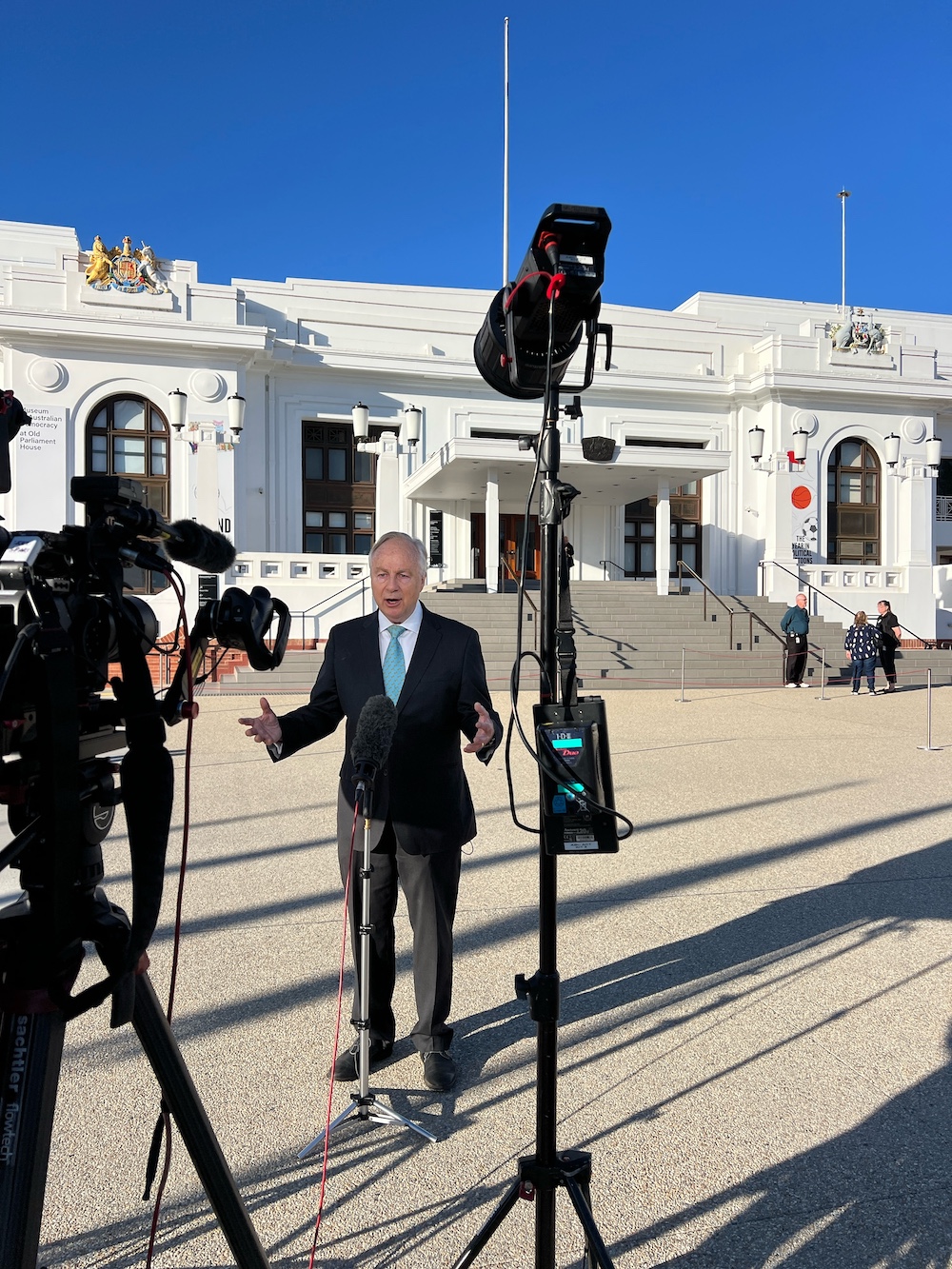
Leigh Hatcher is in Canberra this week to mark the anniversary.
Picture: Leigh doing a tv live cross this morning from Old Parliament House about the Dismissal.
Related report: