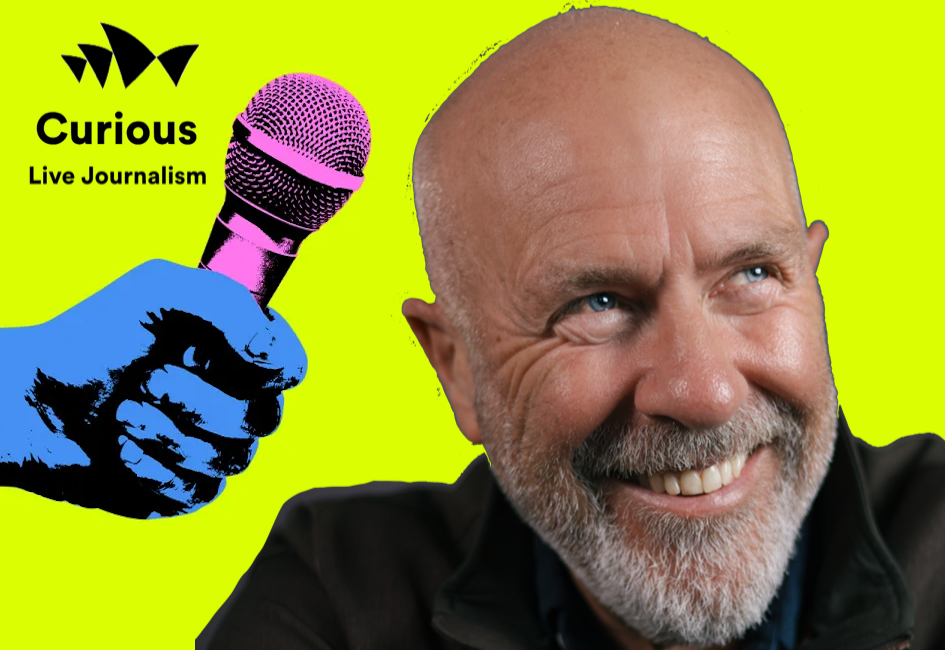
In the Curious talks series at the Sydney Opera House this weekend, writer Richard Flanagan was part of a session on journalism.
“Tonight’s subject is live journalism. But I wish to talk though about its antithesis, dead journalism,” said Flanagan.
With his credentials in investigative writing, as well as fiction and screenwriting, Fanagan’s examples of journalism “giving up” was a warning to work harder on getting all the facts for a story and not too readily accepting the spin from one side of any argument.
“I want to talk about what happens when journalism gives up, when it’s managers and practitioners, the journalists, capitulate to the idea that truth doesn’t matter. When journalism grows craven to power. In such a world, the only voice then heard is the voice of the most powerful.”
Referencing Donald Trump’s daily utterances and questionable claims, as well as other world events, Flanagan warned Australians against complacency.
“Too many Australians think we here are somehow immune from the baseness of fascism. Yet these things can easily happen here if people end up wanting to burn the house down.
“To explain why they might want to burn the house down… you could do worse than visit my home state of Tasmania,” he said.
He criticised the Murdoch media, The Guardian and other news media for capitulating to the influence of money, political power and big business over important issues in that state, including the stadium and pollution from over farming in the salmon industry.
But he saved his most vehement criticism for the national broadcaster which, he said, should be reporting factually on behalf of all Australians.
“The ABC too often gives every appearance of surrendering its independence and integrity to powerful lobby groups…”
He criticised Tasmania’s ABC for “abandoning the principles of journalism in the interests of vested power,” after meeting with the national broadcaster to discuss his assessment of recent news reports.
“I cited numerous examples of facts not being checked, of stories reported in a biased way that reflected only the interest of entrenched corporate or political power. Of extraordinary stories that have been ignored or sat on for years, of them not doing their job as journalists.
“I asked, for example, why, in their surprising coverage of the environmental catastrophe that is salmon farming in Macquarie Harbour, what evidence they had for the claims they’d made about the sometimes hundreds, sometimes thousands of threatened salmon farming jobs they reported as fact, but were no more than industry talking points, with no evidence to support such claims.
“I asked these people to tell me just how many people worked in the salmon industry in Strahan, the town on Macquarie Harbour, that ABC viewers might fear was in risk of imminent ruin should salmon farming end there.
“They admitted they didn’t know. They didn’t know, yet they run stories using grossly exaggerated jobs figures for which there is no evidence. I gave them a printout of the most recent ABS statistics for Strahan, which showed 21 workers were employed there by the salmon industry. 21 even in Strahan, that’s not a lot of jobs.
“I asked them why they had chosen not to run the story of the Tasmanian Premier’s secret $4,000 a head Liberal Party fundraising dinner… I asked why the Tasmanian ABC is such a prominent cheerleader of a highly controversial AFL stadium that the government wishes to build at tax payer expense in the middle of historic Hobart…
“I understood why the only other media in town, the Murdoch owned Hobart Mercury, cheered the stadium on, helping as it does the Murdoch’s online gambling businesses. But why did the local ABC frequently give the appearance of being little more than a media unit for the AFL and the ruling Liberal Party?”
Flanagan says “these examples are small, trivial even, but that they could be “multiplied endlessly” through Australian media.
“Sadly, they speak to the nature of too much of Australian journalism today. It’s essential sickness, the metastasising cancer of crippling fear, and craving simpering to power.
“It’s true that good journalists are still out there, can still be found in all media outlets, still doing good work. But these brave journalists are rare these days, and their employers are ever less likely to back their courage.”
He acknowledged that “the problem is multifaceted,” citing new technologies, loss of advertising revenue, libel laws, and so on,” but insisted that national character and culture need live strong journalism, not “dead journalism,” which is “collaborating in its own destruction,” by neglecting standards and not looking at all the issues in a story.
“Australia does not yet have a Trump or a Farage… but with our accelerating inequality, it has all the preconditions for a demagogue to emerge and erupt and find mass acceptance preaching a gospel of fear and hate.
“In Australia, we do still have time. We can change course, we can do better. That means journalists and media organisations, now more than ever, should not do the bidding of power and money, should not practice their journalism, but return to their real job.
“It’s time we all rediscovered the necessity and urgency of truth for live living journalism,” he said.
More from the Curious session here.