
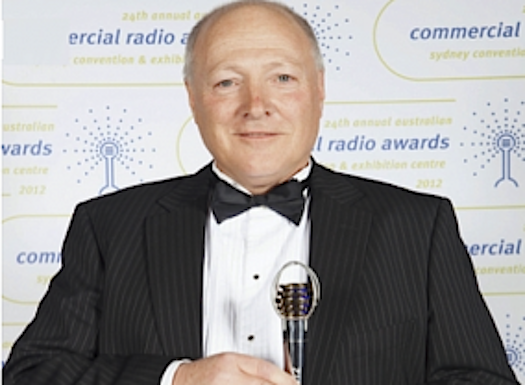
“The board has not made any decision to sell the network,” newly appointed Super Radio Network CEO Graham Mott has told radioinfo. Instead the network is looking to strategically grow revenue as it reviews its business plans over the next 12 months.
Mott is in Newcastle this week as part of the orientation for his new role. He brings years of success in radio industry leadership, much of it built from leveraging local advertising into profit.
From the late 80s to 1995 he was instrumental in the success of 2WS (now Gold FM). When the station first went to air in November 1978, 2WS was a local station for Western Sydney, and quickly built a base of local advertisers who were beyond the reach of agencies. When 2WS converted to FM in June 1993 it went to No.1 in the lucrative 25-54 demographic, which saw agency advertising revenue “flow in,” but the station still retained a strong direct advertising base as well. When he ran the Southern Cross Broadcasting Radio Network that was acquired by Fairfax Media in 2007, Mott was able to add icing to the agency advertising cake by leveraging direct advertising into the network’s talk formats. “3AW, for example, had good agency revenue and was also very successful in direct sales.”
Mott plans to take the same approach with the Super Radio Network by maximising local revenue. “National advertising is a problem for all traditional media in the new media environment, but we have a network footprint that encompasses many local markets… we will put more resourcing into direct sales.”
The Super Radio Network has “feet on the ground” in all its markets, with a mix of local and networked talk and music shows.
“People are migrating from the big cities… there is lots of business activity in regional markets, we are present in those markets,” he said. “Some of our sales people also have an on-air role, that builds their profile and opens doors when they make sales calls.”
Not every regional market is thriving, but across the network there are plenty of revenue rich locations. “We are not planning any redundancies, but of course we will always manage our costs closely. Our smaller markets have less revenue available to them, but they have smaller staff numbers and a different cost structure from the bigger markets.”
The larger markets, such as Newcastle and Sydney, provide much of the networked programming content to the smaller markets, allowing their higher priority shifts to stay local. Chris Smith’s morning show is networked from 2SM, afternoons is from 2HD, with sport shows, Nights and Overnights also originating from Newcastle. Super Radio Network’s music formats also have a mix of automated and networked programming.
2SM is slowing gaining more traction, although there is no talk of re-entering the Sydney ratings any time soon. “For some time we were networking Newcastle breakfast into Sydney, now we have a local breakfast show… Tim Webster is a seasoned operator, and Chris Smith is an old hand at talk radio… the station is rebuilding its local audience.”
As well as increasing resources for direct sales, the network has also brought in Abe’s Audio to add more resources for commercial production.
While no sale is planned, Mott is a seasoned media business consultant, so he is well aware of business valuations. Radio and tv licences are valued at a multiple of EDITDA (profit). Mott made the point that the multiple used to be about 15 times EBITDA, but, judging by recent network sales such as ARN’s purchase of the Grant Broadcasting stations for a multiple of 8.7 times, the multiple for valuing radio business is now sitting between 6 and 8 times EDITDA.