
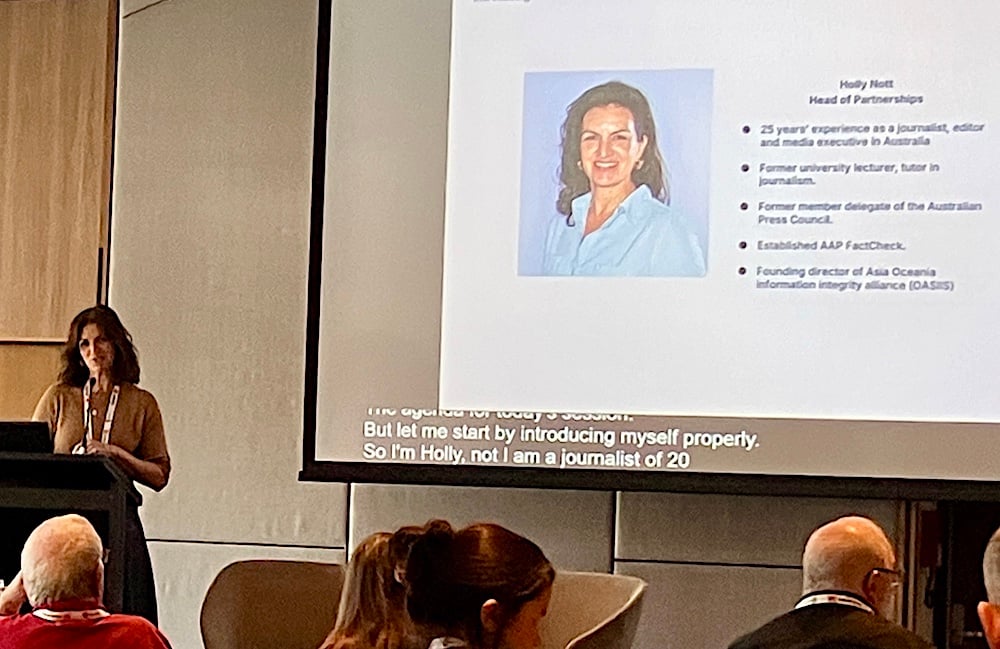
“When fact checking, if in doubt leave it out,” said Holly Nott, Head of Partnerships for AAP at the CBBA conference. “The aim of the session is to give confidence and to support your community station and presenters in the vital role they play in helping the audience navigate truth from falsehood.”
The Australian Associated Press is Australia’s national independent newswire which has developed media literacy campaigns, journalism training and AAP FactCheck, the only international fact-checking service in the Australia, New Zealand and Pacific region.
Holly defined a fact as follows:
- Verifiable
- Objective
- Corroborated
- Accurate and complete
“In The Community Radio Code of Practice, Code 4 (Material not suited for broadcast) and 5 (News and journalistic content) is a safety net intended to protect you, plus to support and protect your audience. Neither code prevents discussion of legitimate issues. The codes are also about standards ensuring excellence,” said Holly.
“It’s also important to be aware of the 7 types of misinformation and disinformation,” she said.
- Satire or Parody
- False Connection
- Misleading Content
- False Context
- Imposter Content
- Manipulated Content
- Fabricated Content
Consider the following as red flags designed to manipulate the audience by a “bad actor”:
- Emotional Content
- False Dichotomy
- Personal Attacks
- Incoherence
- Scapegoating
“Station staff need to be reminded of the code and your responsibility for accurate news content,” said Holly. “Trust is hard won and easily lost.The AAP news is a trusted source as it’s been through many checks and balances for verification.”
Remember that due impartiality does not mean equal time to all sides. “Focus on weight of evidence and people who are qualified to give that,” said Holly.
Be aware that the following can’t be fact checked:
- Fiction
- Opinions
- Personal beliefs
- Emerging issues
- Unclear statements
- Future events
Always ask the following questions when researching a story:
- Who is saying it?
- Understand where the information comes from as this is important context.
- What’s the evidence?
- Find what’s supporting the claim.
- What do credible sources say?
Find further perspectives as you want to be seen as a credible source. A credible source is:
- Transparent about source
- Verifies the claim, particularly with original sources
- Admits when you don’t know something by showing corrections
- Doesn’t manipulate media
- Doesn’t seek to to deceive
- Declares interests and possible bias.
The final tip Holly gave is, “Just don’t pick up a press release and run with it before checking.”

More CBAA Conference reports here.