
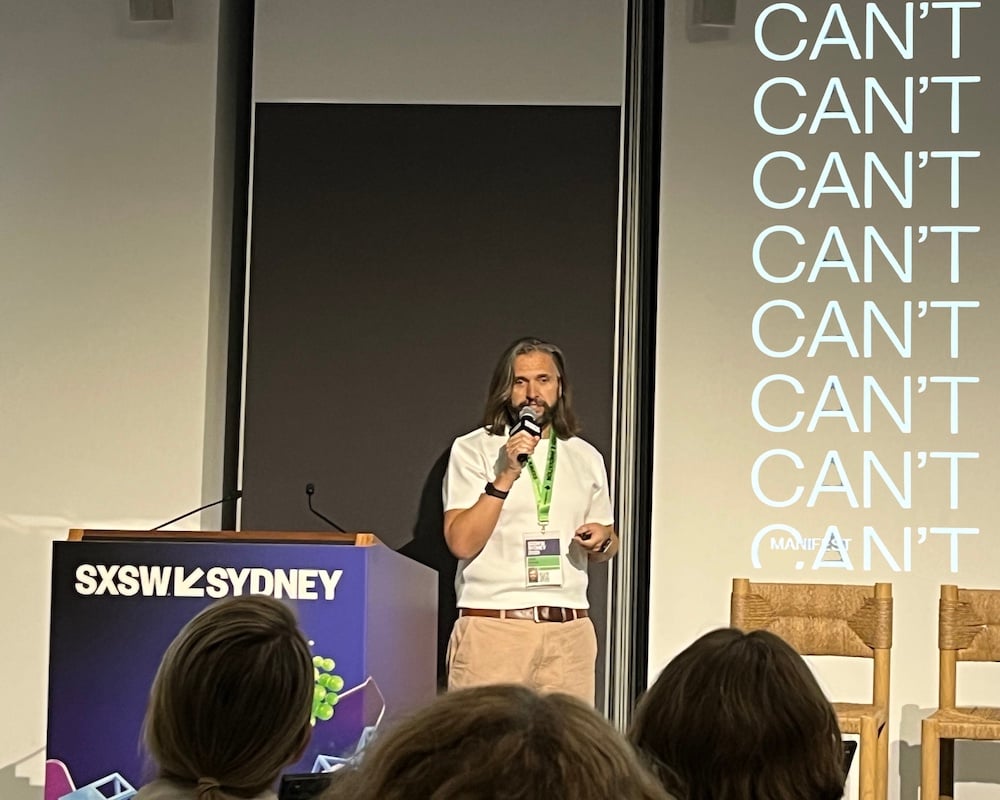
“This is a manifesto for free thinking,” said Alex Myers at SXSW Sydney, pushing the boundaries of advertising creative.
Encouraging a risk taking approach that challenges the rules of advertising such as “always lead with the benefit” to “keep it simple,” the Manifest CEO and Founder said, “in an age of data, if the data doesn’t prove it, then conventional wisdom says we shouldn’t do it. But that means we’ll never do anything new ever again.”
“We’re in a really polarised world at the moment, where everything has to be right or wrong, left or right, where the nuance of the middle ground is disintegrating.
“We’re all allowed to jump to conclusions and judge everyone as much as we want. That fear of judgement is one of reasons why people don’t do new things. We’re also in an era of meetings that should be emails. There’s less agility, more friction in the process. There’s a lot of words being thrown around, but not enough action.
“It’s easy to say that’s not going to work, or that didn’t work. It’s not so easy to back a new idea… Great creatives don’t come up with better ideas and other people. They just believe in them more.
Myers treats the work of his agency as an obligation to “help people make the right choices.” He created his “united brand communications agency” Manifest to make a “cultural impact” and to be his “dream job for the next 25 years.”
“It’s not enough for us to just do what everyone else is doing, we have to do what no one else has tried.”
There are too many can’ts in advertising. The way Manifest approaches its work is to ignore the “you can’t do that” thinking in client briefs and campaigns.
One example is a fruit juice campaign. The founder of the fruit juice brand identified one of the biggest problems in the industry – “everyone has the same oranges.” Yet every juice company’s advertising tried and get people to care about what’s in the carton.
“As if you’re going to care about which oranges or apples are in there, but that’s what campaigns tend to be obsessed with. That’s what the rules say you should do.”
But Myers flipped the approach, from focusing on the oranges to focusing on the person drinking them, after a big night out, or after a loss in their local footy game. “What if, instead of being fresh from an orchard in Somerset or Florida, we instead said that this juice brand is fresh from me… that’s what turning the brand lens means. Instead of getting people to care about what’s in the cart, why don’t we get what’s in the cart and to be relevant to people… fresh from reality.”
In another campaign the agency built a seven foot cranberry juice carton on a billboard during university orientation week. Within about two days the students took it down and made off with it. “It was cool, because they were breaking the rules. So we did too. We said we’ll just embrace this. So we’ve put up missing posters all over London. It turned into a social interaction campaign when the sightings began to come in, we didn’t have money for socials, they said we can’t do that, but it happened spontaneously.

“We didn’t make the product the hero, we made the audience the hero.”
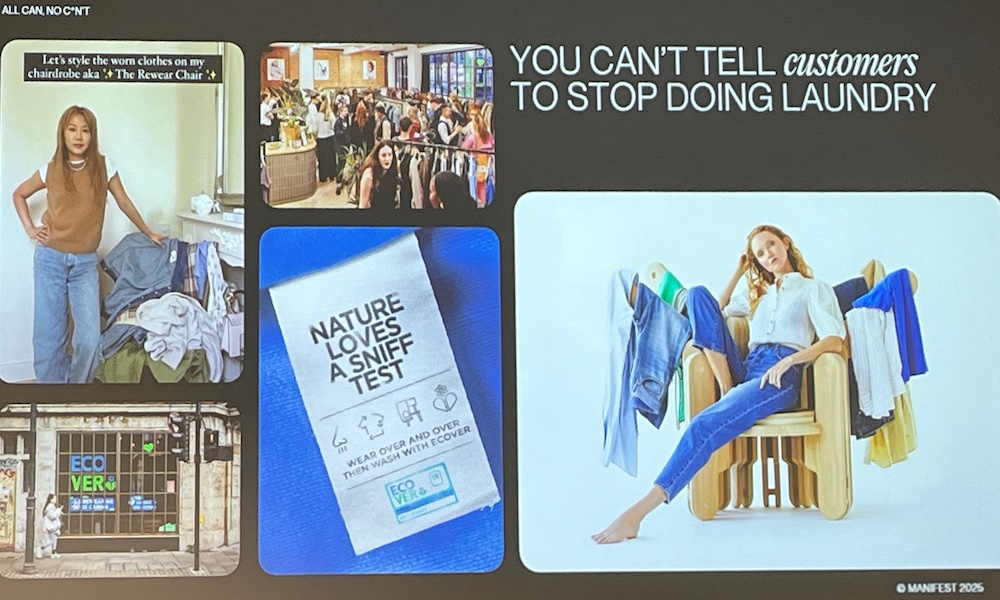
They also broke the rules for the laundry detergent category when an environmentally conscious product tasked them to create a campaign. Manifest could have focused on the product, but they broke the rules and asked ‘what would really cut down on washing detergent in the environment?’ The answer was ‘wash your clothes less.’ They broke through the ‘You Can’t Do that’ objections and created a campaign that said wash less, but when you do wash, use EvoVer
One of the campaigns he is proudest of it for Tommee Tippee baby products.
Manifest’s #TheBoobLife campaign disrupted how the parenting category speaks to women, broke down deeply entrenched stigmas surrounding infant feeding, and lobbied Facebook to remove its ban on showing breastfeeding – all through one unified global campaign.
“Tommee Tippee is a global brand that sells bottles, sterilisers, things like that. But the first product they ever launched for mum’s was a breast pump. The brief just asked us to land the sales message…
“When we looked at the category, everything supported the sanitised idea, the breastfeeding and pumping was easy, polite, and it was delivered with laborious lactating metaphors. There was nothing that was real about it. So we spoke to mums the world over, and interestingly, none of them talked about lactating. They talked about their boobs.
“Those mums became a team of 2,500 creative directors, one of whom said, ‘I didn’t choose the Boob Life the Boob Life chose me,’ so that became the name of the campaign.”
The campaign challenged the social stigma around breastfeeding and for the first time featured real mums and their children, showing real authentic breast feeding experiences.
“In a world that said you can’t do this, we created an advert that showed breastfeeding.”
The campaign got them into trouble with regulators and saw the images banned on social media sites due to nudity restrictions. But the support for the campaign and the backlash against what was considered censoring something natural and authentic resulted in a change of rules on social media for breast feeding images.
“Now Big Tech will show your children and your grandchildren, real authentic breastfeeding experiences, because they’ve changed the algorithms after thousands and thousands of mums turned it into PR story.”

Another of the big rules of marketing is to have separate budgets for digital, out of home, radio, broadcast, tv, above the line, below the line. “Who cares!” says Myers.
Measuring impression and reach are vanity metrics, according to Myers. “We talk about value metrics and sales metrics, that’s what’s really important.”

In another advertising session at SXSW, three researchers challenged the validity of research based campaigns.
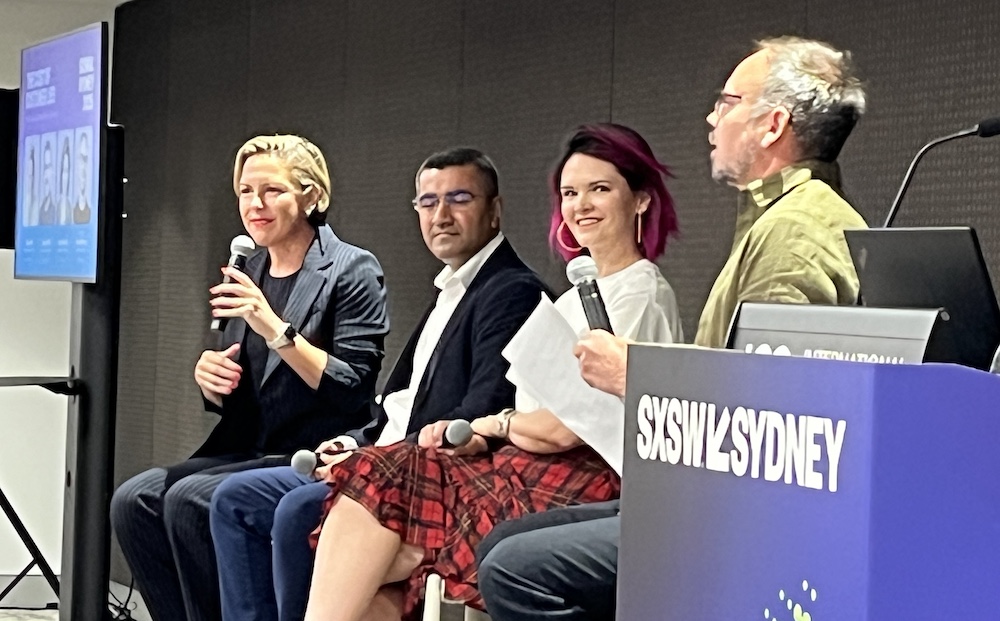
Heatseeker’s Kate O’Keefe, Psychologist Alison Hill and Market Researcher Sonny Sethi joined moderator Steve Brennen from ADMA to discuss the proposition that ‘Customers Lie,’ in market research.
There is a big Say-Do gap.
“What people say and do are sometimes out of alignment. Intent accounts for about 30% of our behaviour, then there’s a 70% gap. People may believe what they say when they say it, but something happens in the gap between saying and doing.”
Two of the reasons that the research and the reality do not align are:
- Optimism bias – we think we can do it, until it comes time.
- Cognitive dissonance – not lies, just a gap of understanding.
The disconnect affects the trust that can be put in market research.
Sonny Sethi said the market research he ran when he was at Optus told him that people wanted more content and channels, but in reality they only ever used about 10 channels.
Kate O’Keefe urged market researchers to let people see it in the real world, not just talk about the product. “Only when you present people with something, can you see what they will really do with it. Prototyping is the way to see how people respond to the thing in the real world.”
Reporting from SXSW: Steve Ahern