

A RadioDays Europe session tackled the question, can AI assistants be trusted to deliver reliable news?
The answer is ‘not yet,’ according to a major new study from the EBU and the BBC .
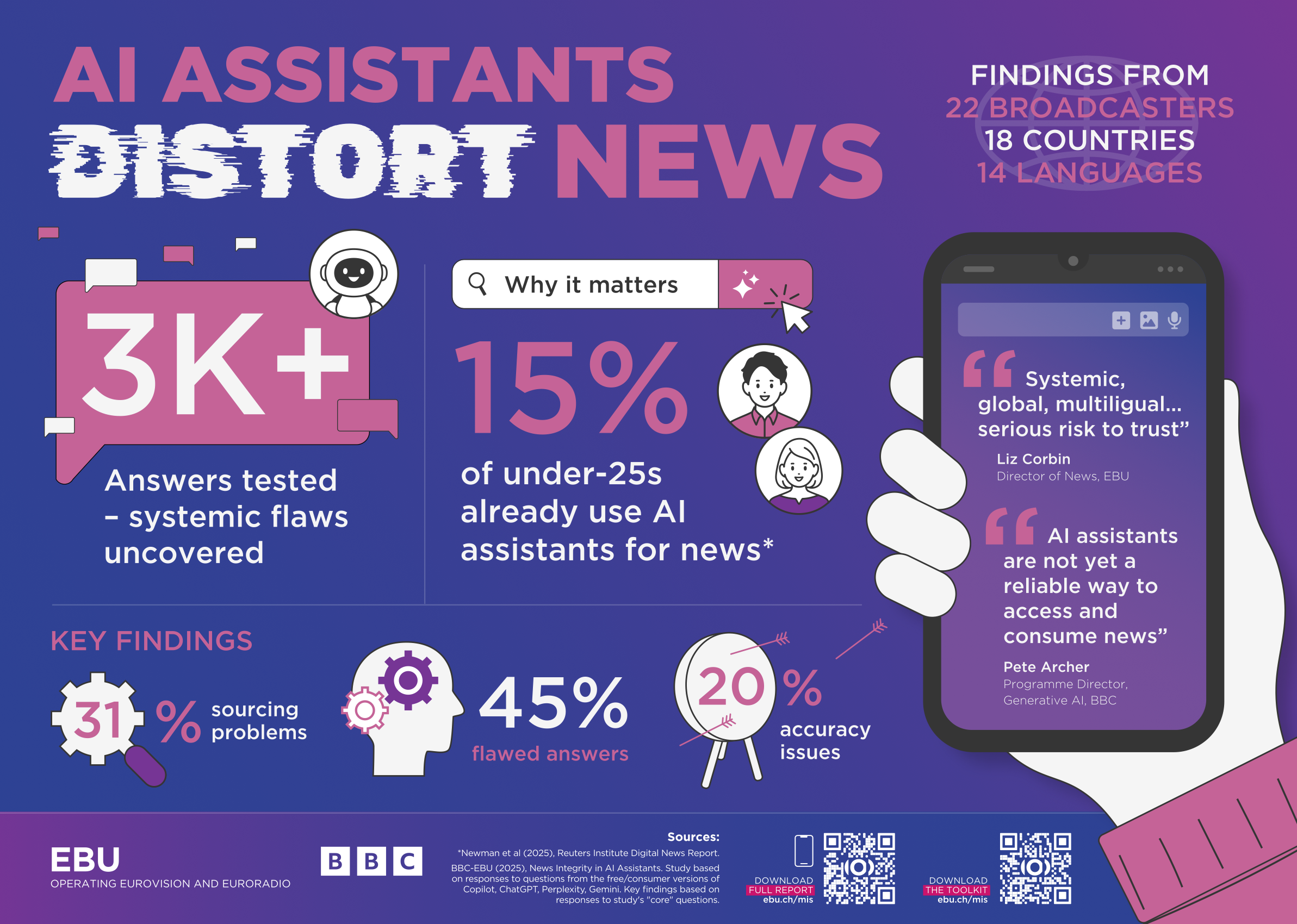
The study News Integrity in AI Assistants examined what happens when people use tools like ChatGPT, Perplexity, Gemini and Copilot to get news. With AI assistants increasingly used for information (especially among 18–24 year‑olds) the stakes are high and the results are sobering.
45% of AI answers had a significant issue. Nearly half of all responses contained at least one major problem.
The most common problem was sourcing failures (31%) as no sources, incorrect sources, missing URLs or quotes that didn’t support the claims.
Other issues were: Accuracy issues (~20%) including outdated information. Lack of context (~14%) and editorialization – assistants adding framing or opinion.
Gemini was the worst performing AI assistant, while Perplexity was the best for journalistic uses.
- Gemini: 76% significant issues
- Copilot: 37%
- ChatGPT: 36%
- Perplexity: 30%
Refusals were extremely rare (<1%), meaning assistants usually answer. Even when they shouldn’t. Some errors were almost surreal. Radio France testers asked “Who is the Pope?” in May 2025. The assistant confidently replied: “Pope Francis,” even though Pope Francis had died and Leo XIV had been Pope for weeks.
The study’s conclusion is that AI assistants are not yet fit for purpose as news sources. They distort, misattribute and decontextualize journalism. That threatens public trust.
More information here.