
When Donald Trump ended American “tax payer subsidization of biased media” through an executive order last year it cut $5 million from America’s National Public Radio (NPR) budget.
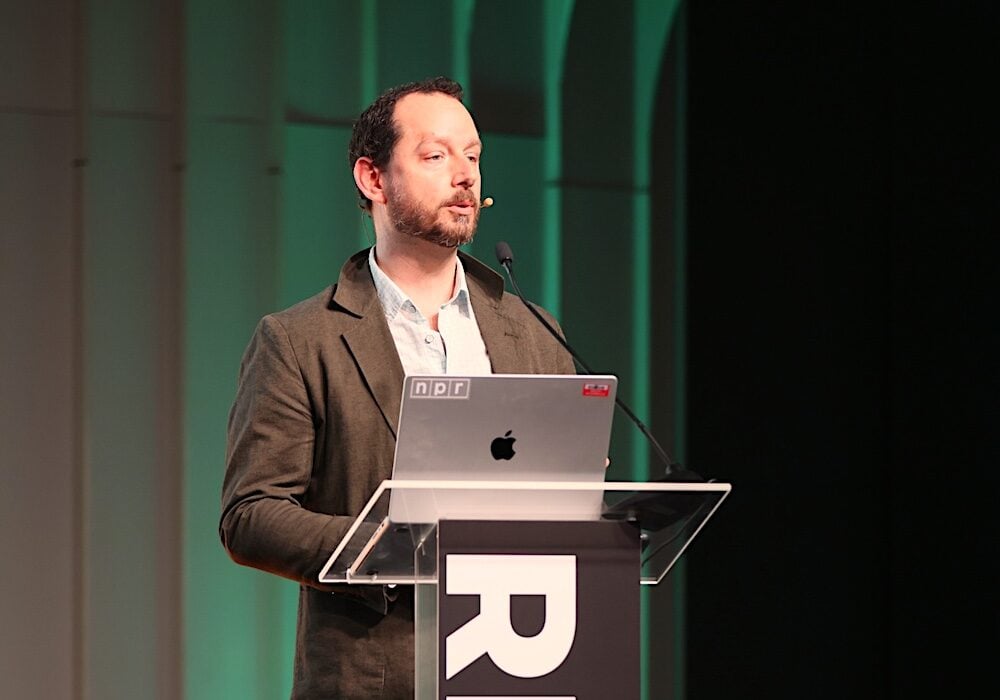
Ryan Merkley, the Chief Operating Officer of NPR was at RadioDays Europe.
He described the current state of public media in one word: “disrupted.”
But his message was not about decline, it was about transformation. NPR is “not trying to preserve an outdated model of radio; it is actively building a future-proof version of public service media, one that is independent, collaborative, and deeply rooted in the communities it serves.”
In a media environment “shaped by outrage, algorithms, and the disappearance of local journalism,” Merkley described thne role of public media as something fundamentally different: calm, contextual and human. Not just reporting events, but helping people understand them.
He spoke openly about then funding cuts and the political pressure in the United States, that has hit smaller, rural stations hardest.
Kristian Porter, CEO of the Public Media Alliance (PMA) placed the American experience within a broader global pattern. Public media organisations such as the ABC, BBC, CBC and Latvia’s public service broadcaster LSM, amongst many others, are facing similar pressures. Those pressures “weaken independent journalism, erode trust, and limit the broadcaster’s ability to hold power accountable,” he said.
Public media is “not a legacy institution to be protected out of nostalgia, it is an essential part of democratic infrastructure.”
Podcasters are also using their medium to build trust through authentic, long form, well researched conversations that try to explain what is happening in the world, not just report it.

In a session moderated by Sarah Toporoff on conflict journalism, podcasters Adélie Pojzman-Pontay the Ukraine: The Latest podcast and Guilhem Delteil from Radio France International – and Sarah Toporoff explored how podcasting can cut through that fatigue, not by simplifying the news, but by reshaping how it is told.
“Audiences are not just struggling to keep up, they are switching off… understanding conflict requires stepping outside binary narratives,” but in response, reporters should not ignore or simplify the news, they should “reshape how it is told.”
Delteil, who covers Palestinian lives in Gaza, seeks to restore complexity. His podcast moves away from timelines and headlines, instead telling stories through geography, identity, and lived experience.
Since the first day of the Russian invasion, the Ukraine podcast has combined “fast-paced military and political updates with deeper narrative locaation reporting.” Its format moves fbetween battlefield developments to intimate moments, such as funerals.
Over time the podcast has built a relationship with millions of listeners who return daily, “not just for information, but also for understanding.”
Images: RadioDays Europe