
July 7, 2024 is the 50th anniversary of the formation of the Community Broadcasting Association of Australia (CBAA).
On the 3rd and 4th of July 1974 the Department of the Media held a conference to consult on the introduction of public broadcasting. The following two days founding members from community radio stations met at the University of NSW in Sydney for an “Independent Seminar on Public Broadcasting”. On Sunday 7 July 1974 they issued a public statement to announce the formation of the Public Broadcasting Association of Australia (PBAA).
Australia’s first experimental community radio licenses were later approved at a Cabinet meeting held on 23 September 1974.
Excerpts from the public statement issued on 7 July 1974:
NEW PUBLIC BROADCASTING ASSOCIATION OF AUSTRALIA
“Widely diverse groups in the public broadcasting movement found that they all face an extensive set of common problems before they can get on the air. As a result of the formation of the Association, groups as widely distinctive as student broadcasters and university institutional broadcasters, classical music and pop music broadcasters, local suburban regional and metropolitan-wide broadcasters, public affairs and cultural broadcasters, colleges of advanced education and adult education broadcasters, will work closely together in a united front to establish the new public broadcasting sector.
This new sector will provide a wider and richer diversity of programmes than possible through the existing commercial and ABC sectors. They will use the new FM and extra AM frequencies which are now becoming available.”
The PBAA became the Community Broadcasting Association of Australia (CBAA) in 1988 as a response to changes in funding.
CBAA CEO Jon Bissett said:
“Community broadcasting services deliver on the vision held in 1974, and we’d like to thank all community broadcasters for providing valued services that enrich and strengthen the social and cultural fabric of Australian society. The CBAA, in many ways, retains the hallmarks of the original PBAA, with our purpose to support strong and successful community broadcasters.
Today, community broadcasters deliver over 500 AM/FM/DAB+ stations and two TV services that reach almost a quarter (24.8%) of Australians. It is driven by over 17,000 volunteers and almost 1,000 employees generating $1/4 billion in value, playing an increasingly important role in connecting Australian communities that are underserved by other media.
| Regional and remote Australia |
|
| First Nations Australians |
|
| Multicultural Australia |
|
| Australian Music |
|
| Disaster Resilience and Crises |
|
| People with disability |
|
| Faith-based communities |
|
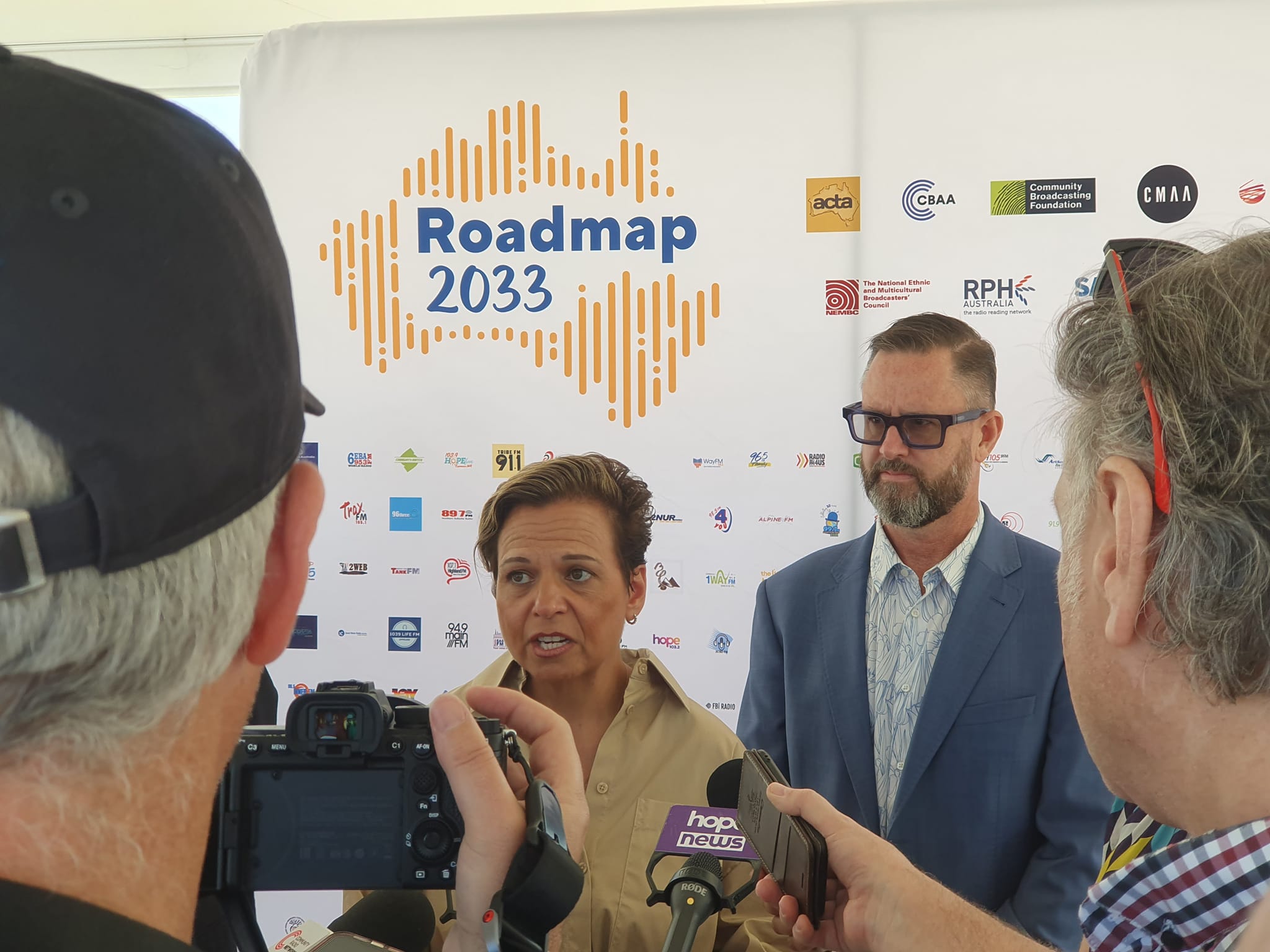
Minister for Communications The Hon. Michelle Rowland with CBAA CEO Jon Bissett at Roadmap 2033’s launch
Last year’s sector Roadmap 2033 was designed to:
- give more Australian’s access to trusted, independent, local news and information from diverse sources;
- play a unique, hyperlocal role communicating emergency information and provide more support to build community resilience in times of disaster. The CBAA and ABC have a 12-month strategic partnership towards these goals (main picture).
- support self-determination of Aboriginal and Torres Strait Islander communities and close the gap in social and economic outcomes;
- elevate Australian music, arts and cultural industries;
- strengthen social and economic inclusion and cohesion, support settlement of new migrant groups and strengthen multiculturalism; and
- provide more skilled career pathways into the media and communications industry for all communities.
The CBAA is seeking additional Government funding, from $43 million to $80 million per year, ongoing and indexed, for community broadcasters to deliver these plans over the next decade. Their Budget Submission is here.
Minister Rowland is also undertaking a “Community Broadcasting Sector Sustainability Review”.
Bissett said of the anniversary:
“CBAA and our members are grateful for the vision and dedication of this founding generation of broadcasters.
The diversity of voices, and the creative, unique, specialist and hyperlocal content that community radio and TV stations provide and amplify, remain important to our communities and key to the sector’s place in the Australian media landscape.”
Picture: (L to R) Anthony Gerace, ABC Managing Editor News SA, NT & Emergency; CBAA CEO Jon Bisset; Rebecca Brice, SA Newsroom; Martin Davies, CBAA News Network Director.