
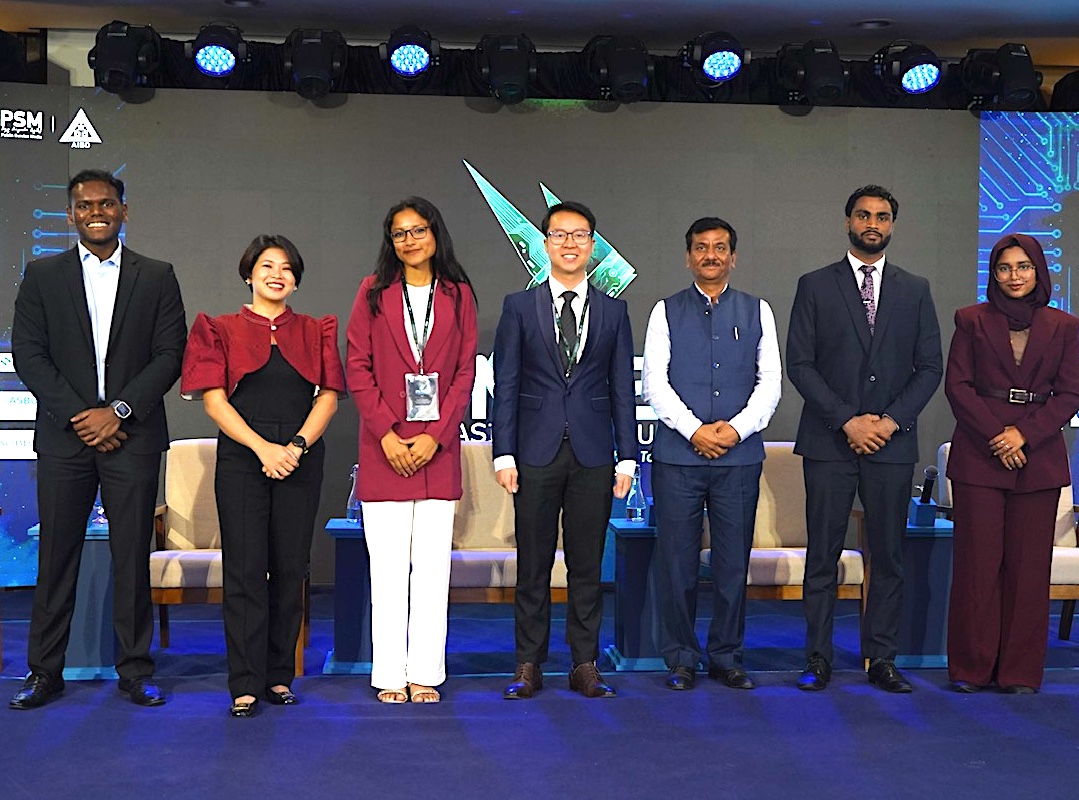
A panel of young media professionals discussed methods, theories and stumbling blocks to bridging the gap between traditional and modern media at this year’s Asia Media Summit..
When asked about the latest video they watched, the young team’s answers included a cat video, travel tips for the Maldives, a renovation video, and a how to video on making a bag out of plants.
The answers reflected youth preferences for short motivational videos, YouTube, Instagram, reels and shorts. Things that are easy to watch and share with friends. They are also well aware of the need for information, but in different forms.
“Today it is not about informing, everyone can get information on their phones. It is more about contextualisation and the ability to converse and debate about what has happened.”
Jacquelyn Manabat, who used to work at ABS-CBN in the Philippines before it was shut down by the Deturte government, founded her own media production company called Amber Studios, which now has 20 employees.
She values the rigorous journalism methods and values she learnt at ABS-CBN, and now uses them in new ways for the content she and her team produce. Her output is primarily produced for social media outlets.
Asked what made her change from working in traditional media, Jacqueline said it was first a matter of necessity, she needed a job. But it was also more than that.
“Traditional journalism had become so familiar I was dissatisfied. When the government shut down ABS CBN I had to find an income, so I leveraged the reach of TikTok.
“After covid people just wanted to be entertained. I knew there were more ways to tell a story… Traditional media was controlled and boring, it was not speaking the language of the future, so I wanted to do something different.”
Other panel members included a range of politically active young content makers from the Asia region who use media and journalism in various ways:
Rakshya Bam – Coordinator at Gen Z Front in Nepal,
Saani Simaadh – Youth Cohort Member, UNICEF Maldives,
Nazaha Nazeem – Vice President of the Presidential Youth Advisory Board, Maldives
Ng Peng Han – Malaysia Chapter Leader of The Young SEAkers
Sura Prakash Gupta – a professor from India
They responded to a series of questions from Moderator Lucanus Nathan, a Business Development Executive at Penn Global Holdings, Malaysia.
Why do young people prefer to get news from social media?
- It’s handy, not costly, efficient, fast, accessible.
- Traditional media feels like it is too controlled, I prefer to get my news from influencers.
- It gives contextual content that is useful for me.
- As young people we were just born with it as an option.
- It’s suitable for our lifestyle, now reading news is no longer a task, it comes to us naturally in our feeds.
- It’s not that young people don’t trust traditional media, they know it will give them traditional news, but they also want more.
Relatability and reliability are two sides of the same coin. “Social media is relatable, but not necessarily reliable. Traditional media is mostly reliable but not relatable enough to our generation.”
What is lacking in traditional media that is on social media?
- It failed to listen.
- We need to go where the audience is and listen to them.
- We also have to be where the misinformation is, we want people who consume misinformation to listen to us too, so they can know what is really happening.
- You can have a two way conversation with the reporter on social media that you can’t do on traditional media.
- Social media is becoming the new search engine, shifting from Google.
- There is less use of hashtags now, instead we are using AI to help us find topics just by key words. It is convenient.
- On Tiktok you can create your own playlist, it is just like creating your own tv channel.
- Social media is quick, it can give us trending information.
- You have the power to block people.
Panellists like the live streaming features in social media platforms because they can interact live with creators. They also like the ability to interact live to find out about shopping products.
Monetisation is a factor attracting young people to social media. “I now earn three times what I earnt as a journo anchor in trad media,” said one panellist.
Social media brings connection with friends and family. “We can play games online with them and chat to them while doing that.”
Social media reaches the most remote parts of most countries to gather like minded people together. Rakshya Bam said: “We use social platforms to gather young people together for them to express their opinions. When governments ban social media we see it as banning our voice. Like the new Prime Minister in Nepal. We use all social media to get around the ban, including Discord.”
Panellists were also well aware of the weaknesses of social media and its ability to manipulate.
“The design of social media is faulty, but, instead of avoiding it, those of us who know how to fact check have to be there on social media, otherwise the audience will get lost in useless scrolling forever.
“We have to be there on social media, games, Discord, everything so that the ones that give disinformation are not the only ones reaching that audience.”
How can younger generations help older generations to avoid AI slop and scams on social media?
“Sit down with your grandparents… we know what is AI slop, so tell them about it. Here’s an example, my grandma asked me, ‘can a cat become a Muslim,’ because she had seen ‘Cat Becomes Muslim’ fake videos. Or cleaning whales, that’s not real! We can help by explaining what’s happening.”
How can social media be improved?
“We have to make big tech accountable. They love AI slop because they can monetise it.”
“Some social media platforms like Facebook are full of harassment if you express an opinion. We should approach it from a proactive approach. Promote good things and good behaviours, Identify and solve the problem proactively. The platforms should do that too.”
“It is a slow process, but when big tech receives reports about spam accounts they remove them eventually. So report fake accounts and scams – it is a two way responsibility.”
“The onus to cross check is now on the users, where it used to be on the broadcaster. Some people don’t want to have that responsibility, they are the ones who will be vulnerable to misinformation.”
The session ended with a GenZ saying: “They ate and left no crumbs,” meaning they covered everything.
Related reports: