
Media worked are calling for greater transparency on the way employers use Ai.
Artificial Intelligence (AI) has rapidly advanced from a niche technological concept to a transformative force across multiple sectors, including the media and creative industries.
AI voice generators are being used to replace voice actors and radio hosts, while the technology is also producing and distributing synthetic music across major platforms, driving down payments to originating artists, according to the union, which has conducted a survey of members.
While AI presents opportunities for innovation and efficiency, workers whose livelihoods depend on human creativity, originality, and authorship are being adversely impacted. AI is already being used to plagiarise and substitute the work of Australian journalists and has been the subject of allegations of copyright theft by artists and writers.
On behalf of members, MEAA is calling on the government to introduce legislation and regulation to ensure strong protections for workers and consumers.
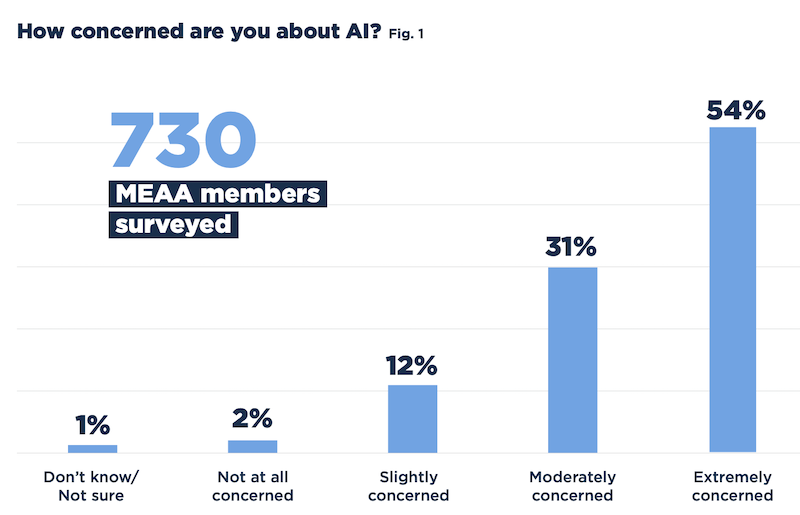
Misinformation, loss of human creativity and theft of work are thne top three concerns of media workers.
An overwhelming majority (93%) of MEAA members agreed that greater government intervention was needed to regulate AI.
Only 3% of MEAA members consented and received compensation for the use of their work to train AI. About one in four MEAA members are using AI in the workplace. Respondents signalled strong support for a range of measures to regulate AI. 52% of workplaces do not have an official policy governing the use of AI.
Comments recorded in the survey include:
“AI has already stolen the work of authors, actors and visual artists … We are moving way too slowly. We need regulation yesterday!
“We should be using AI as a tool for work, but it cannot become the way we work … And human creativity cannot be something that is replaced by AI.”