
Deadline 2025 has now passed. That was the name of the initiative run by the National Film and Sound Archive and The Data and Digital Government Strategy towards the digitisation of public and personal collections of audio and video tapes. The NFSA said, tape that is not digitised by that date, will in most cases be lost forever.
A friend of mine shared on social media this week the last picture (now digitised) that was taken with his sister. It was with an old school disposable camera and lacking the filters we are accustomed to now. But the joy of the pair was palpable.
After discovering Deadline 2025 via Radioinfo I paid to get some of my old cassette recordings digitised last year.
I heard my brother’s voice for the first time in two decades.
David Marshall OAM is the Manager of the Harvey Recreation and Cultural Centre, Foundation Chair of Harvey Community Radio 96.5 FM and an inaugural inductee into the CBAA’s Community Radio Honour Roll.
Harvey is about 150kms from Perth in Western Australia. The Harvey shire has a population of around 30,000, Harvey itself, just shy of 3000. It was featured in the ABC program Back Roads last year (watch below).
One of my 2026 work resolutions is to phone people and have an actual conversation. With so much of interviews and written work assisted by AI, I want to hear the voices of people who I’m in email contact with all the time and, in a story such as this, I want you to afterwards be able to imagine Harvey, David and the extraordinary Melva Mitchell, who you are about to hear about.
I phoned Harvey FM about their Sounds Like Harvey project, and the new series, Women in the Workforce, and David later called me back.
I don’t believe he would say this of himself but David Marshall is the most community minded and creatively motivated person I have ever had the singular pleasure of chatting with. For a town with under 3000 they have had astonishing success in receiving grants and then delivering national and culturally significant outcomes.
He feels a huge responsibility to amplify Indigenous stories and experiences. Towards that Harvey’s local theatre is about to commence a three-year pilot program alongside three other (significantly bigger) venues, through the national arts body Creative Australia, to bring First Nation storytelling to regional areas. David said, it is about breaking down barriers and building trust.
Another way Harvey FM does this is via Ruth Campbell-Hicks, host of Books at Breakfast, and shire librarian. As a dairy farming town, many have migrated to the region. While they could speak English, they couldn’t read it. Every weekday morning Ruth reads books for children, and has done so for 20 years. The local paper is read weekly by Sue and Jude as part of the national Radio Reading program.
It was the audio library however that initiated my phone call.
The Sounds like Harvey project, alongside Deadline 2025, should stand as a template for what can be achieved through community spirit, time and dedication.
The Harvey District Oral History Group, with quite some foresight, gathered in 1989 a band of volunteers and collected some 120 interviews on cassette tape, to document the stories of the town and its people before they became lost.
Around 2004, with the advent of modern technology, the group reached out to the radio station to transfer all this precious audio into a digital format. This is where we meet Melva.
Melva donated hours and hours of time to editing the interviews, cataloguing them, and then creating the themed Sounds Like Harvey radio episodes around parts of the interviews that would fit, be it dairy farming, the timber industry, migration or the World War II Internment Camp. They are available still via the station website.
To all accounts Melva was an exceptional woman herself. She was a published author, and while she had a perfectly good house, and bed, she would sleep at night in a replica Pyramid of Giza that had been built in her back garden. She died in 2024 with David saying that he was tremendously grateful that he had turned the microphone back on her once, and collected her story.
After sharing about the pyramid, David told me that he received a phone call from a female listener after airing a Sounds Like Harvey episode. She was in tears and explained that she had heard her father’s voice again, and with her children, who had never met or heard him before.
We both paused then to compose ourselves, and please let this be a nudge to you to digitise your precious tapes as well.
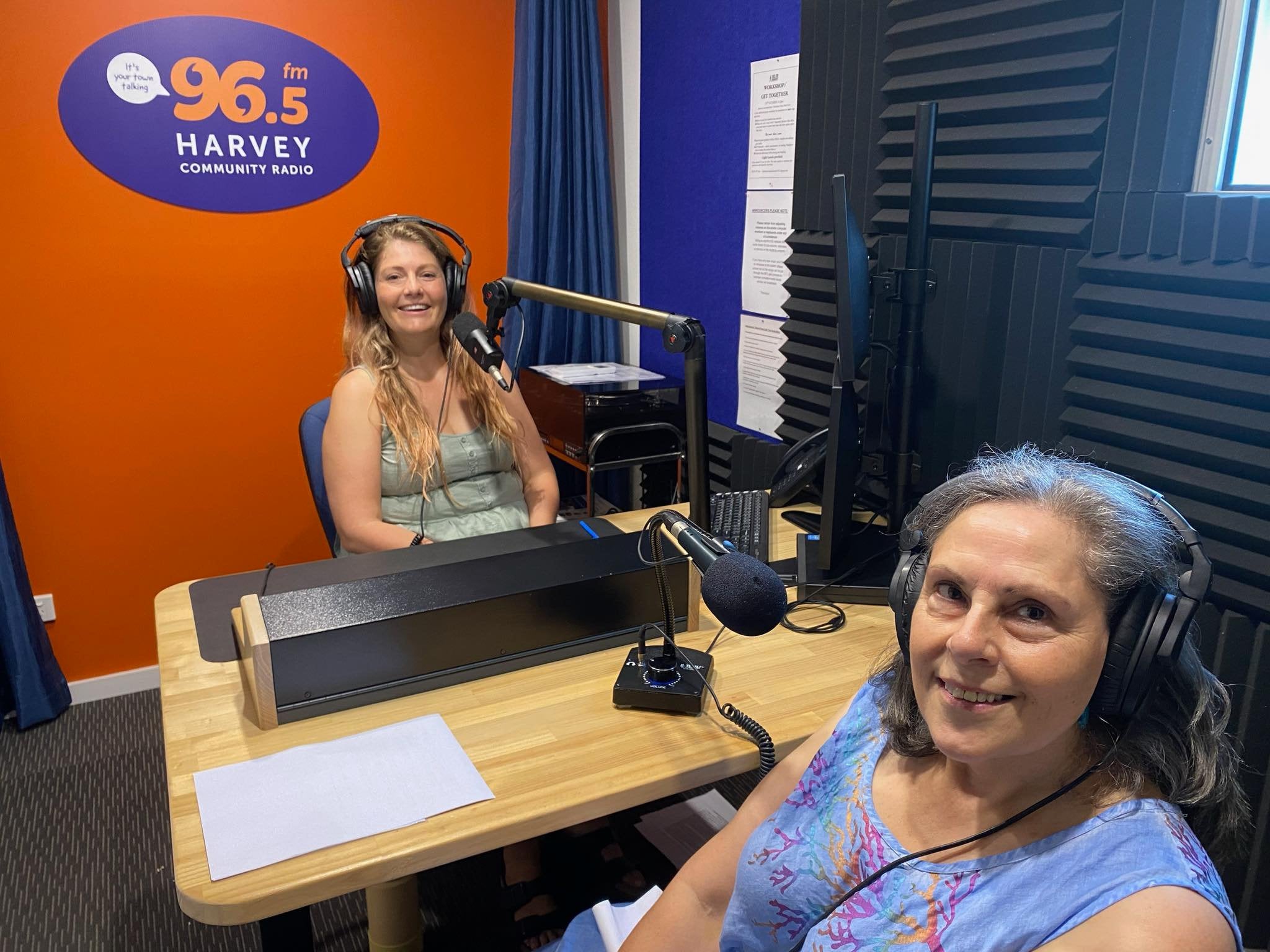
The new series of Sounds Like Harvey is a modern take. Twelve women of all different ages will be interviewed about their work. Where they came from and the journey to now, plus two significant songs. The project is funded by the CBF. Like everything that David and his team initiates, this is a project that can be enjoyed far beyond those who reside in the town of Harvey.
For all the participants, across 35 years, it is a legacy for their loved ones too.
You can listen here: https://www.harveycommunityradiofm.com.au/interviews/
Image (supplied): A Sounds Like Harvey 2026 Women in the Workforce interview mid discussion with guest Frida Rombout being interviewed by HCR 96.5fm volunteer announcer Verity Hyde.
Jen Seyderhelm is a writer, editor and podcaster for Radioinfo. Email: [email protected]