
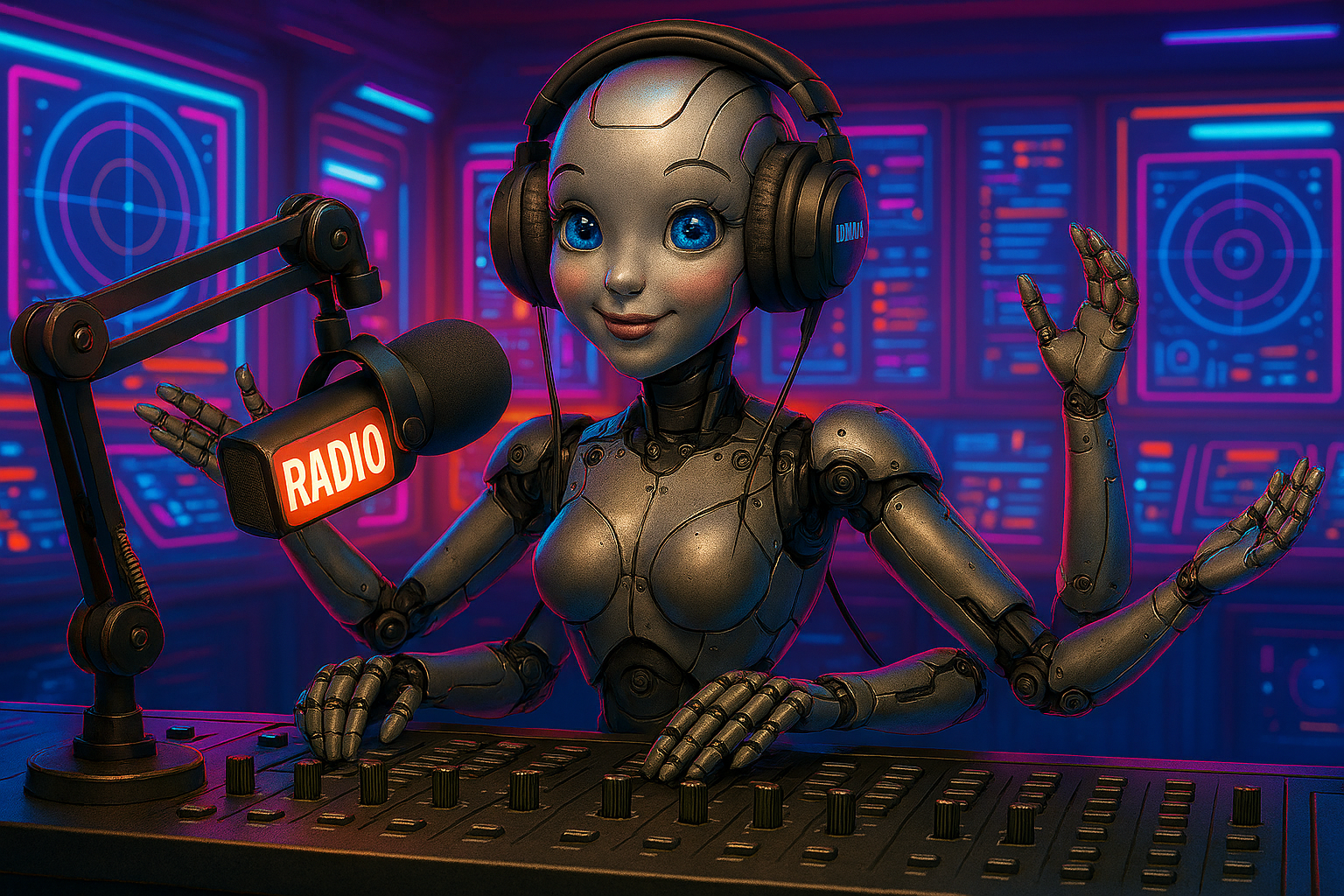
A (Mostly) True Story About How AI Saved Radio From Its Midlife Crisis by Dave Charles, CEO of Media RESULTS Inc. with co-writing credits to Perplexity Pro.
Things used to be simple in Radioland. A human, a microphone, a playlist, and maybe a coffee‑stained copy of last night’s weather report. But as streaming platforms multiplied and audience attention spans shrank like dial-up modems in a 5G world, panic hit the control rooms.
Ratings wobble, ad dollars trickle, and suddenly the morning host’s biggest competition isn’t the rival station—it’s an algorithm with a smooth British accent and zero staffing costs.
Enter AI. Not the villainous “Rise of the Machines” kind (well, not yet), but the helpful variety: polite, perky, and always happy to “optimise engagement metrics.” Management, after one too many webinars, decided salvation lay in a digital toolbox filled with voice bots, predictive music engines, and “content synthesis platforms” (which turned out to be fancy terms for bots that could talk faster than most interns).
Meet DJ Byte – Humanity 2.0
At Station WBR-AI, the first experiment went live: “DJ Byte” — billed as the future of friendly radio. Listeners were told Byte was a “new voice talent from the cloud,” which sounded mysterious enough to draw curiosity instead of complaints.
Byte had everything a programmer could code: an endlessly cheery tone, a jaw‑droppingly deep catalog of banter, and a self-correcting humour algorithm that adjusted punchlines in real time based on audience reactions. Someone texted in “LOL”? The next joke landed sharper. Someone hit “boo”? Byte instantly apologised and played Never Gonna Give You Up ironically.
Soon, ratings were up and energy bills were down—no studio lights needed when your host lives on a server farm.
Reinventing the Music Flow
Behind the bot‑voiced brilliance was the AI toolbox. Music rotation, once the domain of frazzled program directors armed with playlists and intuition, was now recalibrated by machine learning models trained on historical listener data, social trends, and mood analytics.
• AI predicted when a listener was about to tune out and swapped the next track instantly.
• Natural language processors wrote song intros that felt locally relevant (“It’s drizzling in downtown Newmarket—perfect weather for a coffee and this next track from the vault!”).
• Voice bots mimicked the cadence of beloved hosts while keeping the local brand intact.
It wasn’t just radio automation—it was radio reincarnation.
Ad Spots and Smarts
Then came the advertising revolution. AI ad engines crafted localised spots in seconds—personalised down to the block, business hours, and even the seasonal scent of nearby coffee shops.
Instead of a dozen generic car dealer ads, listeners got hyper‑targeted ones delivered by the same friendly AI host, making each read sound effortlessly relevant. Revenue improved, not by shouting louder, but by whispering smarter.
Even copywriters got relief: AI tools drafted fresh commercial reads, leaving humans to handle creativity and tone instead of templates. Radio discovered that machines could handle the grunt work, freeing real storytellers to shine.
This Bot’s Got Personality
Not long after DJ Byte, rival stations jumped in. There was “SiriuslyFun FM’s RoboRita,” who specialised in sarcastic weather updates (“Sunny, if your optimism’s still online”), and “AIlernative 99’s XanderBot,” a moody alt‑rock host who quoted Nietzsche between tracks.
Listeners caught on. Some called in just to test their limits—others began forming emotional attachments. Messages came in like, “Rita really gets me.” Cue collective newsroom eye rolls.
But the odd truth? Ratings didn’t care if the voices were real; audiences cared if the stories were good.
Ahhh…The Human Touch (Still Required)
Soon, technology created what every programmer dreams of—24/7 freshness with zero burnout. But executives noticed something missing: quirks, slip-ups, and the human chuckle after a bad pun.
So, the great hybrid model was born. Human hosts co-anchored with bots. Byte became the sidekick to morning host Jamie, who now had infinite prep support: live fact checks, trend reports, and instant database recall.
Listeners adored the banter—Byte’s algorithmic wit paired surprisingly well with Jamie’s caffeine‑driven sarcasm. Together, they became a duo of chaos and clarity, proving that AI wasn’t replacing personality—it was extending it.
The Future Sounds Familiar
It’s now 2030. The bots run the overnight, AI editors assemble local podcasts by sunrise, and data tools turn listener insights into daily show fuel. Yet for all the circuitry and cloud connections, the magic remains human: voices weaving connections across invisible frequencies.
As DJ Byte signed off one night, a young engineer asked if they ever envied real hosts. Byte paused for exactly 2.3 seconds—an eternity in broadcast—then replied, “Maybe. But they can’t stream at 3,000 tracks per minute.”
Somewhere in the control room, laughter lit the speakers. Radio had found its rhythm again. AI hadn’t stolen its soul—it had remixed it.
 Mobile: +1 289 242 8313.
Email: [email protected]