

Dave Charles, President of Media RESULTS Inc, was joined by Radio Futurologist James Cridland for a wide ranging conversation around the future of radio and its definitions, assistive versus generative AI, the search for passionate radio talent and the importance of respect for your audience.
Dave Charles: You’re currently based in Brisbane but originally from the U.K. Is that correct?
James Cridland: Correct! I moved to Brisbane in 2015. I met a girl…
DC: How did you become the Radio Futurist that you are today travelling in between the world and offering advice on all aspects of the current media menu?
JC: I’m actually a “radio futurologist”, and you might be thinking that the word doesn’t exist, and you’d be right! But I’ve always wanted an “ology”.
I’d worked for a number of local radio stations in the UK, then the original Virgin Radio in London, and then at the BBC, always looking at where radio’s future was heading. After I left the cold clutches of the BBC in 2009, I went round the world for six months, visiting radio stations in Canada, Japan, Australia, Korea and many other places – and realised there was a lot of interesting things that individual markets were doing that radio could learn from.
I’ve also been blogging and writing a radio trends newsletter for more than twenty years, https://james.cridland.net/radioland, which keeps me connected.
DC: Radio is downsizing in many countries. What in your view from your global travels is the cause for this?
JC: I think there are three things going on.
First, there’s the natural progression of technology allowing people to do more with less. I was telling someone recently that my first regular job in radio was playing ads for a networked show – I’d sit in a dark studio and wait for someone a hundred miles away to tell me down the talkback what the cue for the next ad stop set was. When I heard the cue, I’d play a set of carts, and fade their studio up at the end, and hope that there wasn’t too much of a gap. Clearly, technology has replaced all of that today – and rightly.
Second, there’s the inexorable drive for more profit, from broadcasters who are now, mainly, listed on the stock market. Investors think short-term, and this thinking means companies are always keen for more cost-cutting. Radio has fixed costs, of course – the cost of the facility, the music and the transmitters: so there’s actually little cost-cutting that you can do other than people. It says something that privately-owned companies appear to do better in this environment – Global in the UK is a shining example – where this short-term thinking is ignored.
Third, there’s pressures from a decline in revenue. This isn’t evenly distributed – in Australia and the UK, radio revenues are mainly holding up well, but in North America it’s not a great story. Part of that is an overly-restricted definition of “radio” – SiriusXM is absolutely radio, as one example, and if you included them in the figures….
DC: Where is Radio going to find the next generation of talent in all areas? In Ontario, Canada five colleges have discontinued their radio courses. Radio will now struggle to find talent to develop. This includes on air, production, creative writers, news/sports, promotions and marketing areas.
JC: Radio will need to work harder! The UK had precious few college courses in radio, but has had a vibrant radio industry for thirty years. I find reliance on college courses, with the same happening in Australia, a bit odd.But, creators in all areas of the media have more opportunity today than ever before. Someone with a microphone can make a successful podcast. Someone with a camera can get onto YouTube.
The era of the “multi-hyphenate” is with us, and there is more opportunity for a driven creator to earn money and achieve stardom without any gatekeepers like radio or TV stations.The issue isn’t radio ‘finding talent’, the issue is radio stations convincing these creators that they want to work in radio. And that, I can’t help with.
DC: Radio is using AI voices and AI toolbox is a real time saver in developing news and commercial production. Will Radio benefit by integrating AI voices and tools in its day-to-day operations?
JC: If radio does it carefully, yes.There are two ways to use AI, assistive and generative.
Assistive AI is “I’m going to interview Steve Ahern tomorrow, what questions should I ask?” That can be very helpful to get us thinking about different angles, to help with research, and to do the uncreative stuff to free humans to be more creative, engaging and interesting. Assistive AI, where the human is assisted by AI, can really help us use our time better.However, where AI turns into generative AI, and replaces humans, that’s a slippery slope.
We have to understand that the reason people tune to radio has changed dramatically since the 1980s and 1990s. The primary reason now is human connection, not actually news, music, or information. Radio gives a sense of belonging, and a community of common interest that other media does not. But I have the feeling that most programmers haven’t, yet, understood why radio has changed, and think that as long as they just play the hits, they’ll be OK.
AI is fine to read weather or travel news, I think. But to replace the host, the person with whom you share your day? Any radio station that tries that needs to give their head a check.
DC: ‘Respect for the Audience‘, Lee Abrams talks about true respect that goes beyond slogans. Building authentic relationships with the audience that fosters loyalty, transforming users into dedicated fans. What are your feelings on how radio can improve this relationship and remain viable?
JC: In Brisbane, where I live, there are two stations with the tagline “Brisbane’s #1 hit music station”. They both can’t be right. This treats audiences with derision and contempt, two sets of programmers, assuming that we don’t switch between the two, or we are too stupid to realise that both stations are claiming the same, trite, catchphrase. Respecting the audience starts here. And we fail, every single day, while we play silly games with our audience like this.
Being honest with audiences is the fundamental part of building authentic relationships, which means not pretending that you’re in Brisbane when you’re voice tracking a show from Melbourne two days earlier; or asking people to call in to a phone-in without being clear that, because of time zones, the only people who can actually take part are people in Sydney.
There are some that have nailed the authentic relationship. Christian O’Connell on Gold 104.3, for example, was very open when he moved here that he wanted the help of his audience. He gained respect, built relationships with them, and has ended up with a #1 show. That’s not by mistake. When I spoke to him recently, he said that he had calls from listeners when Kyle and Jackie O moved into the Melbourne market saying, “We won’t let anyone not from this city move in here.” Christian is British. “Oh, well, you’re different,” they said.
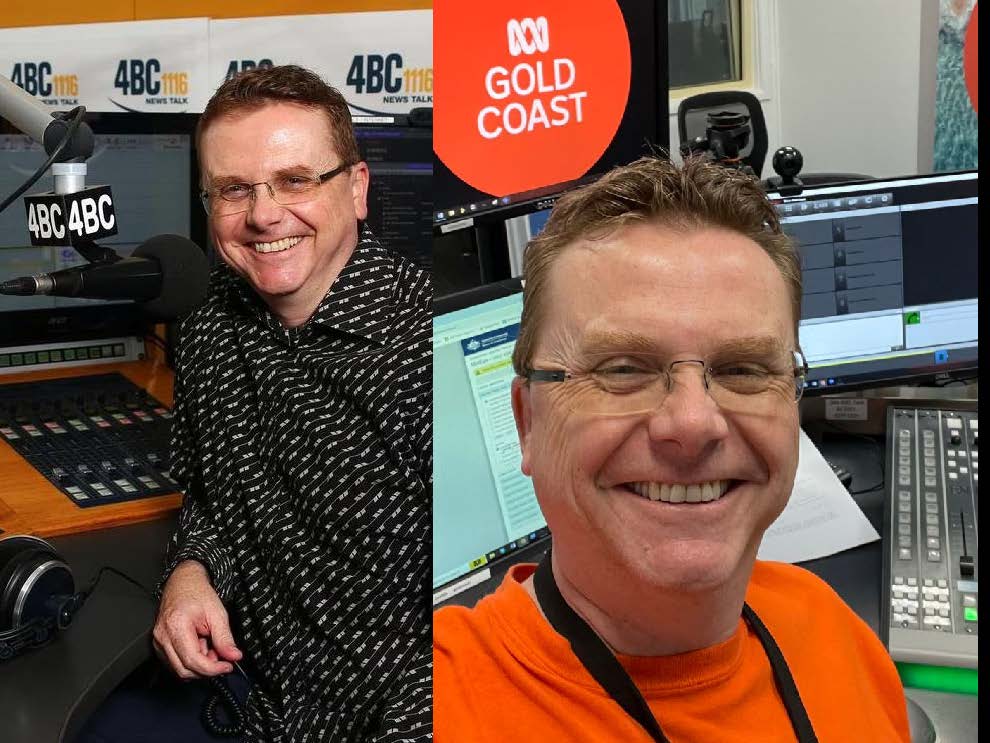
And Spencer Howson on ABC Radio Brisbane (pictured above). He spent six years away from the station, and a little time on 4BC, but not weekdays. When he returned, not only did audiences react as if it was the return of an old friend, but they spent time, in the first week when he came back, filling in each other on how his old regulars were. One particularly poignant bit was when he asked about one regular caller, only for someone to call in with the news that they’d passed away. That is the community, the sense of belonging, that we know worked in COVID; we know worked in radio in the 1980s and the 1990s, but that the liner cards and trite positioning statements have destroyed.
The future of radio is all about human connection and a shared experience. Non-stop music hours are not that; and if you’re a music intensive station, your main competition is Spotify. If you focus on the bits in between the songs, you’ve a much, much more interesting future.
DC: Is Radio creatively and intellectually bankrupt? I say this because ratings are down, and revenues are diminishing. What are you thoughts on this?
JC: Well, hold on.
Ratings aren’t actually down. Weekly reach and cume is as high as it’s ever been. People still listen to the radio, they don’t listen to the radio ‘as much’. Part of that is down to programming choices, but part of that is down to the choice that we now have, from Spotify and other music services, to the wide range of on-demand audio, and video, that we can now consume. Radio is in much, much better shape than broadcast television.
Radio in Canada is not well, partially because of the stifling regulation in the country, and no, it’s not all the Canadian Content rules. Radio in the US isn’t well, because it has no money to spend on anything any more. But radio in much of Europe, and in Australia, is well and thriving.
I think, though, that we’ve lost faith in ourselves. We don’t understand why people listen to the radio any more; and ad buyers are all 20-somethings who think that radio is for 55 plus. That’s partially because we’re now programming it that way.
DC: Australian podcast shows are doing extremely well. Why do you think that is?<
JC: Again, hold on! When you look at ad-funded audio, podcasts as a whole, Australian or not, have 6% of all time spent listening to ad-funded audio in Australia. Australian commercial radio? 82% of all time spent listening to ad-funded audio. All of the podcasts out there are competing for that 6% of time. Radio is still doing really very well!
Podcasting works well because it’s on-demand content; it’s free; it works on an audience’s time, and it is a collection of millions of niche pieces of content aimed at specific audiences. Something like Toni and Ryan is a podcast that totally understands their audience, treats them with respect, and includes and involves them in every decision that they make. And, podcasting increasingly is earning money from their audience directly, without involving advertisers.
DC: Who are some of the most innovative radio companies/stations that are doing everything right to maintain their market share and audience loyalty?
JC: In the UK, take a look at Global. They have very high quality radio stations, from Heart to Capital, Classic, Smooth and LBC. They’ve totally understood how to continue to serve local audiences and advertisers with information, while, in the main, producing national stations and national brands. They have added a number of additional stations online and on DAB. They now have the biggest radio brand in the UK, beating the once invincible BBC, and that’s in spite of the BBC being ad-free and a programming budget that’s many times bigger. Perhaps one secret about Global’s success is that they’re a private company, in it for long-term growth and not constantly chasing profit for next quarter’s financial results to keep the stock market happy. Maybe there’s something in that.
The original Now Radio in Edmonton, Canada had a fascinating way of communicating with its audiences. Every on-air personality had to respond to every tweet and Facebook message during their on-air shift and every on-air shift was given money to spend on their show if it made great radio to do so. Every presenter break was carefully considered to be more than just trite catchphrases and a throw to tomorrow’s breakfast show. And it worked.
DC: Big Box radio groups like iHeart continue to dominate the markets they serve. In America, iHeart currently has over 800 commercial radio stations tied into their various mainstream formats. What is your advice to those stations competing against mega radio and marketing companies like iHeart? How can they carve out their share of the media pie?
JC: When I listen to mega-radio like that, I hear, in the main, stations produced by people who don’t care: who’d sooner be optimising supermarket shelves the next day, or running an auto dealer. It’s a shame, but it’s also an opportunity for others, I think. Just care about what you do. Obsess about it. Get others at the station who obsess the same way as you do. Be surrounded by people who care. And yes, they’ll shout and stamp their feet and be difficult because they care, but if they care, they’re the people you want.
It’s no surprise that Global in the UK used to have “an obsession statement”. They’ve wiped it from the internet now. (The image is below)

They now have a simpler one, but no less good:
“People may forget what you said, people may forget what you did, but they’ll never forget how you made them feel.”
When you’re making 800 radio stations across a vast country like the US, how can you be “obsessive” about what you do?
DC: If you owned a radio station in a cap city market what are some of the essential content that you would advocate in your format?
JC: I’m not a programmer, so you’ll not catch me out that way!
But, I’d focus less on music, and more on the stuff in between.
And I’d also suggest that we stop broadcasting the best stuff we do only once. Why waste something great? You’d not play the highest-researching song just once.
DC: What does James Cridland do in your personal time when you’re not travelling the world?
JC: I enjoy working on open tools that help others – like OpenStreetMap, an alternative to Google Maps that everyone can contribute to (and use). I walk the dog, enjoy a decent coffee, and like building things. And, of course, I listen to the radio. There’s always something good on. You just have to seek it out.
Dave Charles, President Media RESULTS Inc. 
Mobile: +1 289 242 8313.
Email: [email protected]
James Cridland image credit: Tor Erik Schrøder