

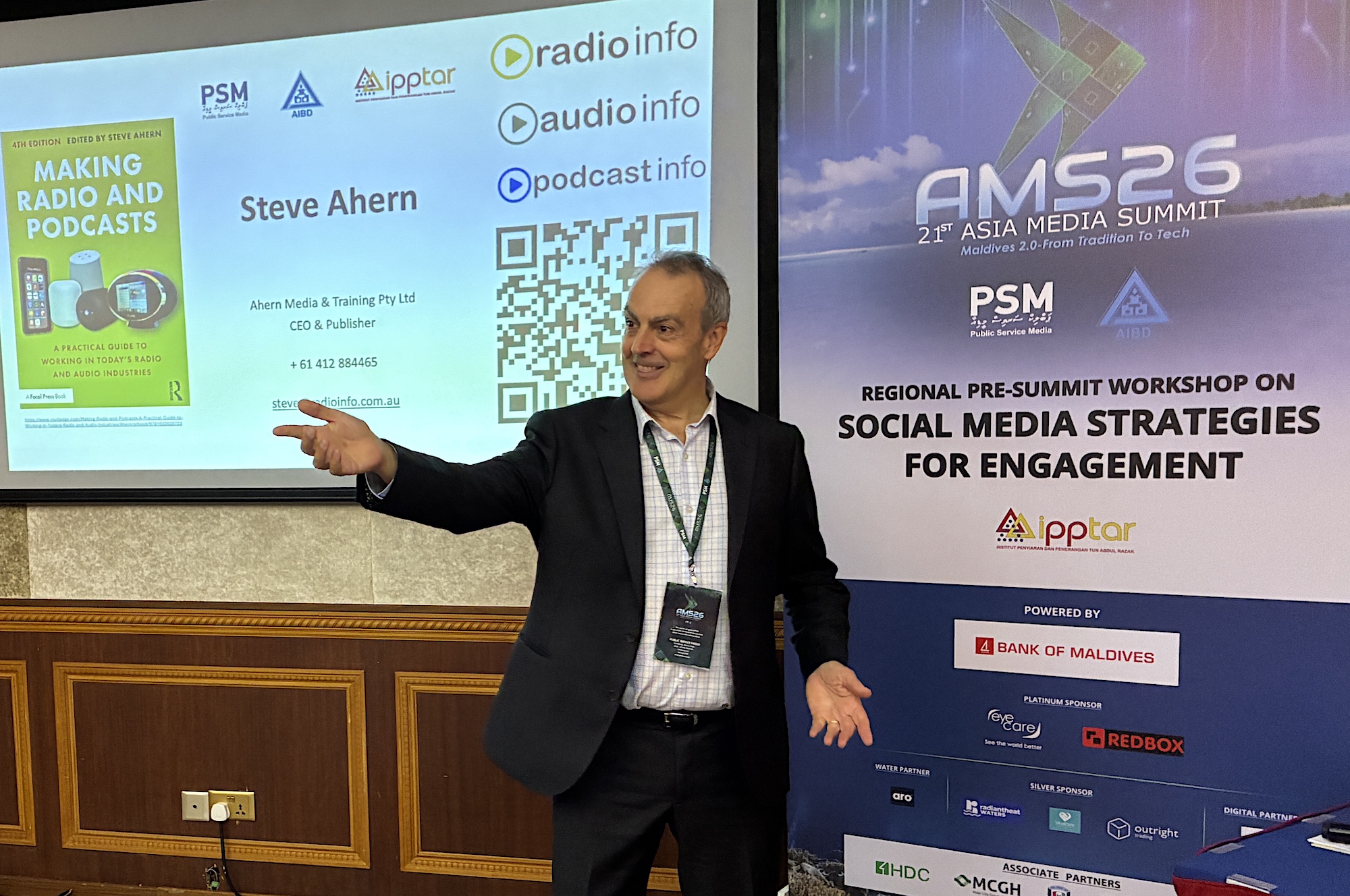
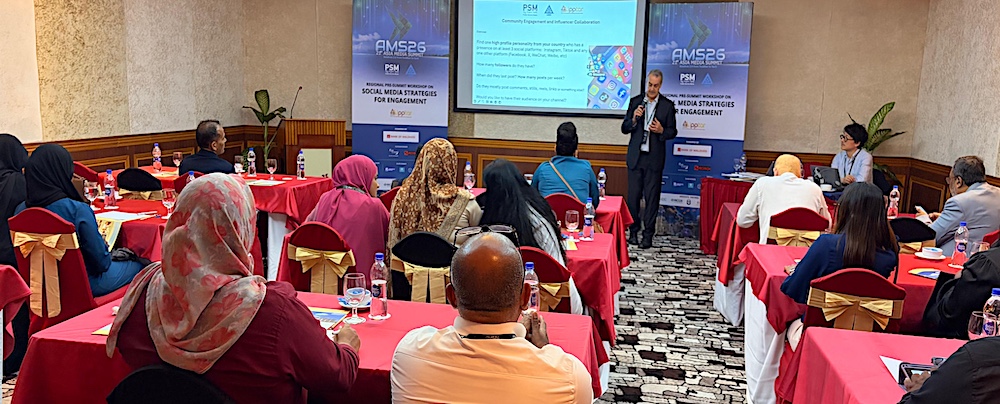
“Who owns your audience now?” asked Steve Ahern, In a full day workshop held on the first day of this year’s Asia Media Summit (AMS) in the Maldives.
AMS is a top level media event for broadcast leaders, regulators, policy makers and government ministers from across the Asian region. Organised by AIBD and supported by Maldives Public Service Media, the theme for this year’s AMS26 is From Tradition to Tech.
In a packed session covering alogrithms, AI and audience engagement, Ahern showed broadcasters how to adapt the latest media technology developments to their broadcasting mission and also advised regulators in the workshop on the intersection of language, culture and media in strengthening their societies. The role of social media was also explored, with tips and tricks on how to use social media to connect with young audiences, without sacrificing professional media values.
Young audiences are more likely to play games, engage on social platforms and listen to music for entertainment, while older audiences consumption patterns favour watching tv and listening to music. Technology and the age divide is splitting audiences.
“Radio and tv have always had two components, a tuner and a consumption output (screen or speaker), we just considered them to be one device in the past.
“Smart tvs and smart speakers have now separated the tuner from the display device. Now the tuner on smart tvs allows you to choose not only broadcast tv but also Youtube, iView, iPlayer and many other choices of video content. Your smart speakers will deliver you any audio via the new tuner, from streaming live radio to podcasts and music services. We still want screens and good quality speakers, but the tuner inside them now allows us to choose from more connected sources.”
With the intersection of connected devices, social media, games, streamed content and linear broadcast is all considered media, especially by younger audiences. The secret to success for broadcasters is to be visible on all platforms, but also to draw audiences to their own direct outputs so that they can more effectively interact with them.
“Of course you need to be on Youtube, TikTok, Instagram, Facebook Reels, but remember that someone else owns the audience on those platforms and decides what they hear and see with their own algorithms, so don’t hand everything over. Your personalities and your brands need to be there, but you will get the most value when they are also on your own platforms, because you can understand their consumption preferences and can also use your own AI to deliver content to them that is meaningful to what they want to watch or listen to.
“Those audiences will see the value of your broadcast company output, but when they only see it on Youtube or TikTok, they think it is Youtube or TikTok content. Audiences are no longer loyal to media brands, they are loyal to content creators and influencers.”
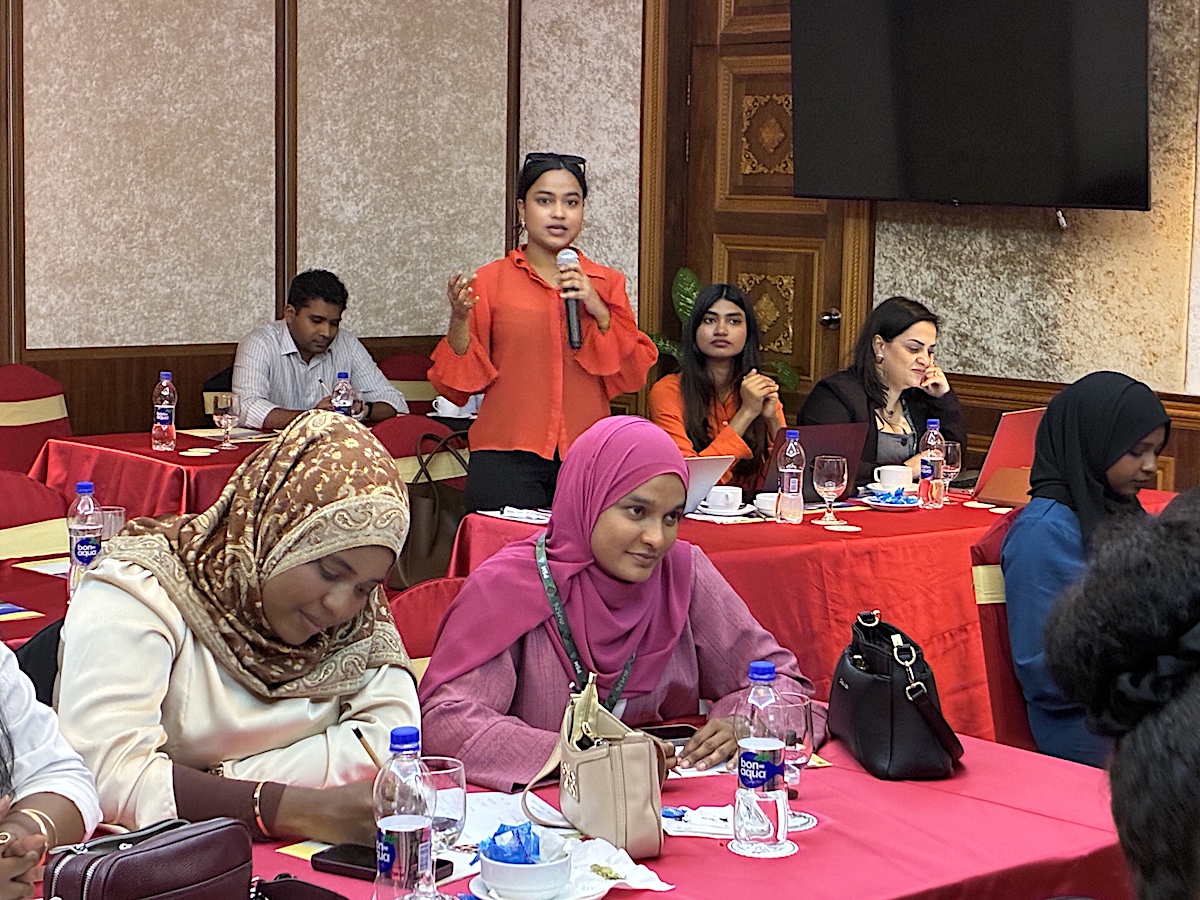
Ahern took the group through a range of workshop scenarios where they developed plans for their countries to strengthen their broadcast presence on new media platforms with currently unreachable audience segments.
He also looked at the current court cases in America where Google staff have exposed the algorithms that affect search rankings.
“Patent US8938463 and the recent court case brought against Google in the US has forced insiders to reveal how search rankings are really done. It is not just SEO content, it is ‘dwell time’ and ‘pogo-stick clicks’ that affect rankings. If a searcher finds a search link and dwells on it for a long time, Google will rank that URL higher. If a searcher clicks on a link but quickly bounces back to the search again to find a better answer, then the link receives a lesser ranking. This information is available in public documents and has also been analysed by SerpClix and other analysts, so we should take that into account when planning our search strategies on external platforms. We should also be further developing our own search ranking algorithms inside our players.” said Ahern.
Search is one of the keys to visibility, but the power of search is changing with the advent of AI.
“Click throughs have drastically decreased for websites since AI has been presenting quick answers to search questions on its own search pages. Google loves it if you can get the answer to your question at the top of the search engine page because you don’t go anywhere else, they can monetise you the longer you stay on their search page. But the website that they scraped the content from has been deprived of a click, I call it click theft. In the new era of search, those of us who create credible content need to constantly adapt our strategies to draw searchers to our pages, our streams and our apps. It is crucial to our future,” said Ahern, who showed various strategies for content creators to influence how their content is displayed by AI in search queries.
The Asia Media Summit continues this week, see more reports in our international publication, radioinfo.asia.
Related reports: