

This is the seventh in a series of interviews exploring the career and life journey of women in the media industry. The aim of the series is to reflect on the wisdom they have gained during their journey.
So far we have had a cross section of women in different roles and career stages: Lauren Joyce, Laura Bouchet, Cathy O’Connor, Megan Smith, Kim Napier and Amanda Lee.
This week we profile Jacquie Riddell, who began her career in community radio and after a full, varied career journey has come full circle and now volunteers for the community sector as president of the Community Broadcasting Association of Australia.
1.Describe your current professional life and your stage of life.
Starting with the difficult questions right off the bat!
My current professional stage of life is best described as “it’s complicated”. I am at the peak of my powers, full of knowledge, energy, experience and capability – in my ‘prime time’ as journalist Bec Wilson describes this powerful later-stage career period.
On the other hand, it is difficult to find meaningful ways to use those powers in the industry. I wrote a LinkedIn post recently about ‘accidental retirement’ and it hit a nerve for lots of people. Whether it is ageism, experienceism or something else, many of us (particularly women) find ourselves running at full speed right off the end of the treadmill, suspended in the air, legs like Road Runner! That is frustrating, a waste of talent and productivity.
2. How did you come to be in this industry?
I always wanted to work in radio, so much so that I got a tattoo representing that as a teenager. I was lucky to go to university in the era when study was free, and universities were abuzz with ideas and activism. Much to my parent’s despair, I paid no attention to my formal studies and instead focused on my ‘radio studies’ at student radio station Radio Active 89FM as presenter, producer and then station manager. I owe that community station a lot, fuelling my passion for radio, even meeting my partner there! New Zealand’s Student Radio network has contributed so much to media and culture in NZ and continues to do so despite strong headwinds.
Community radio is a great place to start a media career, and as it turns out for me, also a great place to end a media career!
3. What are your core beliefs? How are your values evident in the work you do or the life you lead?
Growing up in Aotearoa in NZ, nature and adventure were never far away. This had a big impact on my life and career, as I was always up for new challenges and adventures. Creativity is what really drives me – problem solving, generating ideas, connecting interesting people, and leading creative teams. I am in my element when striding up a mountain or shaping up the future and leading others there.
4. How did your education, formal and informal, enrich your career/ life journey?
In my early education despite being at university for a good few years, I lost interest in my formal studies and instead focused on my ‘radio studies’. Things took off from there. Media was, and still is, about learning on the job from colleagues and mentors. Along the way, you will encounter people who truly see and amplify you.
In my case, I have had three significant bosses who have shown me that support, as well as many other colleagues and mentors who have helped along the way.
In my early 20’s I came to Australia as NZ media was and still is a very small industry. I had heard about this cool radio station Double J and wanted to work there. Magically I landed a job there just as the network was expanding nationally. Talk about timing and luck. The first of my significant bosses Maggie Hamilton, gave me that career-defining break and I am forever grateful to her.
Next Barry Chapman has provided opportunities, encouragement and mentorship for me at Triple J, Channel V and throughout my life.
While Shaun Brown, the MD of SBS, has remained a friend and inspiration. All three epitomise visionary, compassionate and ethical leadership.

The colleagues you work alongside and lead are as important, mentorship is not always from seniority. Amassing a large posse of amazing colleagues along my career journey, I call them my ‘life teamers’ as they are never far away for advice, connections, support, or a good laugh when the going gets tough. That is the true meaning of network for me. It’s about quality over quantity.
More recently I graduated from the Australian Institute of Company Directors and that gave me the grounding to work on some high profile boards as well as working as both director and chair.
Of course, a career will not only be charmed. There are bumps and challenges along the way, including bosses and colleagues that are not so supportive, or even downright horrible. But that’s ok, as long as you maintain your self-belief, lean into your ‘life teamers’ for support, and approach difficult situations as opportunities to learn. How could I handle it differently next time? How would I guide someone else through that situation? What do I take from that experience into the next inevitable one?
4. When did you stop, take a break or try something different in your career? How did this change impact you?
My career has been non-linear because my sense of adventure often leads me astray. Like when I helped launch Sydney’s new light rail during the pandemic! Inspired in part by my late dad’s love of transport, I took the opportunity to get out of the house during lock downs and dived headfirst into transport, using my extensive skillset to help launch Sydney’s new light rail network.

I led a large team of drivers to develop and deliver a safe and efficient transport service. I regularly got on-the-tools driving the vehicles, gathering insights from the front-line to improve the operation of this complex transport network.
Most people respond with ‘wait whaaaat?’ when I share this recent career chapter, but it is not that different to leading media really. Same strategy skills, same people management skills, same operational management skills, same problem solving, just different content! Everyone needs good, clear strategy and leadership, no matter the job.
However, I don’t recommend an unplanned and spontaneous career path to others. Traditional linear career moves will get you further up the ladder if that is your desire. Chopping and changing is not always valued by employers. Hopefully that can change because diversity makes teams stronger in every way.
5. What makes you happy? What makes you get up in the morning?
I now do a range of jobs from strategic advisory to personal training. My very favourite job is the one I do voluntarily as President and Chair of the CBAA.

I really love media and contributing my experience to the 450 community stations and 10 000 staff and volunteers who make up this wonderful community media sector. Thinking about the future, creating and planning with colleagues, and navigating the ever-changing media landscape of digital and AI plus everything else keeps me very motivated.
6. Share your words of wisdom for others in the industry or those wishing to work in the industry?
Currently helping my daughter with her career planning, things have changed. It is much harder to get a leg up with more competition for roles, AI screening barriers, and a greater expectation of formal education.
Here are my top tips:
Keep knocking on doors – sure, many won’t open, but some will; most people are more than happy to meet you and offer you advice and encouragement
Start gathering your ‘life teamers’; building a quality network that will help and support you over your whole career journey
Get involved with industry organisations like Women in Media and CBAA; attend conferences to learn and meet people; read radioinfo and other industry news; stay open, curious and engaged
Make the most of your career. Enjoy it as it will be over before you know it.
As the radio guru Valerie Geller says “never be boring”
8. Describe your vision for the audio media industry in the near future.
For 40 years, my mantra has been ‘it’s a great time to be in media’. Delivery might become more digital, audiences might diversify, content might expand, business models might challenge, but the one constant is the power of human connection.
Yes, there are existential threats – not least AI and the risk that we lose our ‘humanness’, but skilled and passionate people, together with solid and sensible government support plus regulation can navigate these challenges and turn them into opportunities. It will always be a great time to be in media.
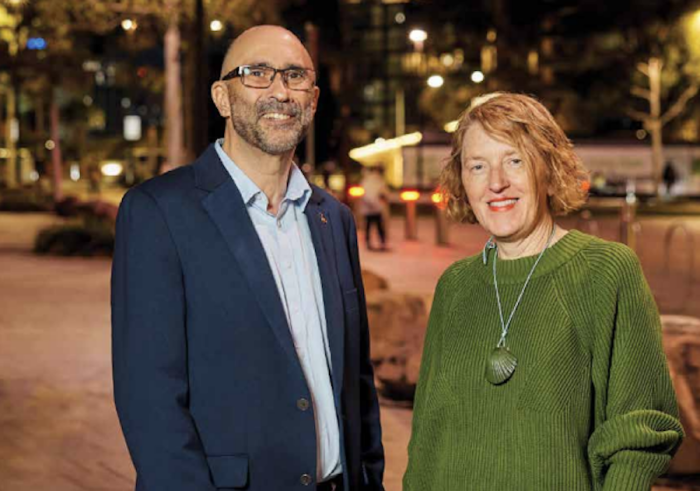
Ian Hamm CBF president with Jacquie president CBAA.
In 2023, we led the community broadcasting sector in the co-creation of our ‘Roadmap 2033”, laying out the future for community radio and tv. It is a very positive future, prosperous, with community broadcasting a dynamic cultural asset that empowers every Australian to participate in community life. Its epic nation building stuff!
9. What role would you like to play in shaping the audio industry of the future?
Guiding and supporting the future of community broadcasting as president of the CBAA, ensuring everyone values and engages with this critical community infrastructure. And hopefully being that transformational boss and mentor for a few more people to thrive in their media career.

Series compiled by Serena Ahern for radioinfo.
If you have a suggestion for someone to be considered for this series, please send a note to [email protected]
Previous articles:
Wisdom of Women in Media: Kim Napier, Breakfast Presenter ABC Northern Tasmania
Wisdom of Women in Media: Megan Smith, Senior Producer Gold 101.7
Wisdom of Women in Media: Laura Bouchet, Content Director Triple M
Wisdom of Women in Media: Lauren Joyce, Chief Audience & Content Officer ARN