
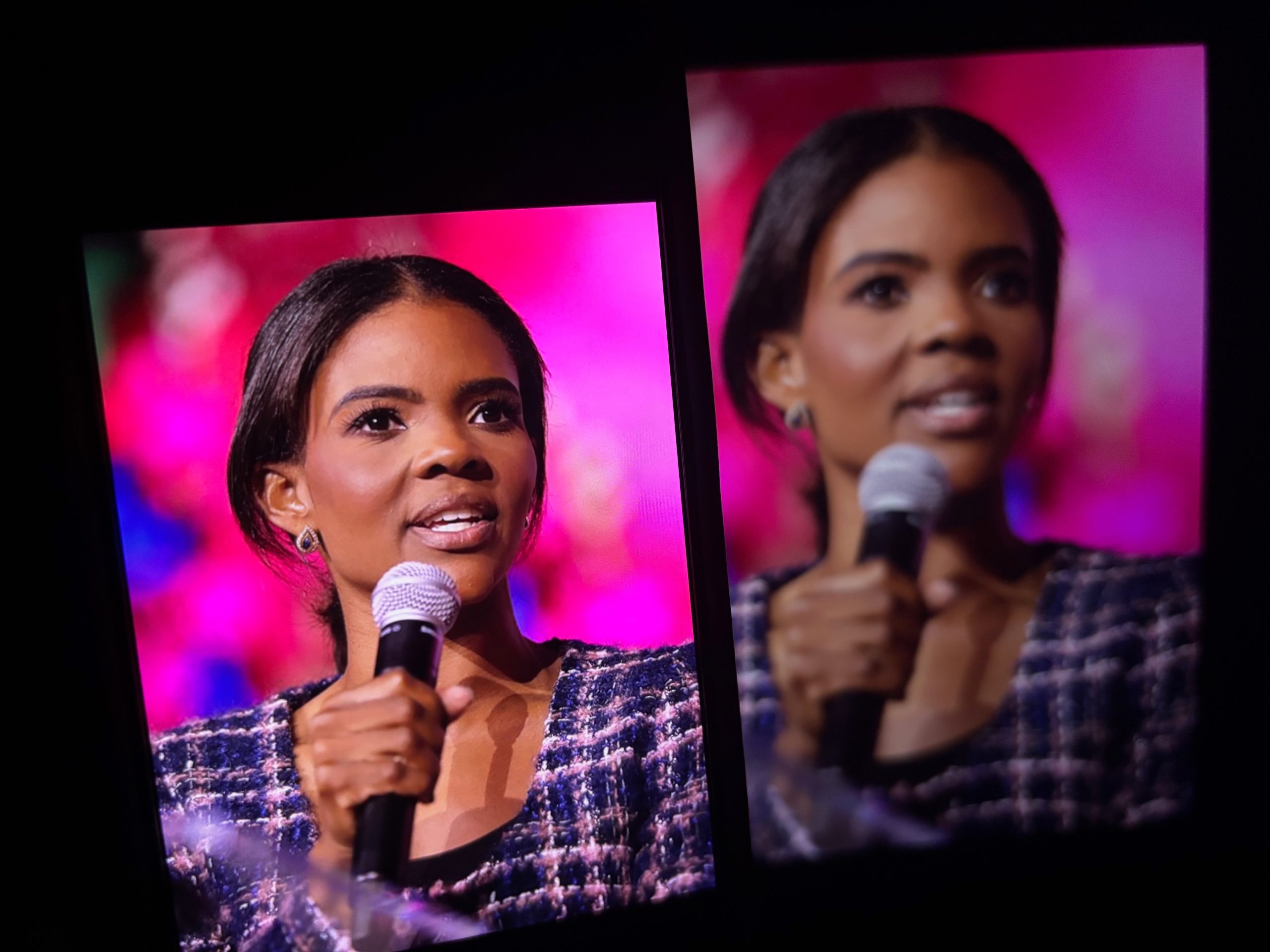
Google‘s response to being asked the difference between an “influencer” and “conspirator” was that influencers often leverage social media to build audiences and promote products or ideas, whereas conspirators operate in the shadows, often promoting harmful or misinformation based narratives. The only addition to this might be that that certain podcast conspirators, promoting an idea or belief perhaps without basis or evidence, are operating right out in the open.
Such is the case of American political commentator, author and podcast host Candace Owens (pictured). Owens released an eight-part YouTube and podcast series called Becoming Brigitte alleging that Brigitte Macron, the wife of French President Emmanuel Macron, used to be a man. Now the Macrons have filed a defamation lawsuit after repeated requests to Owens to retract statements made in the series and on social media. Candace responded in her podcast saying:
‘I am floored. This is just goofy. You are officially a very goofy man Brigette. I gotta give it to you, you’ve definitely got balls.”
Uncomfortably there was an ad before the episode calling for applications to join the Australian ‘intelligence development program’ with ASIO. When we drew it to their attention, an ASIO spokeswoman told radioinfo: “We are very disappointed that our advertising has been linked to this questionable content. In purchasing this advertising space we stipulated brand safe requirements, and stated our advertising should not appear alongside questionable content.”
What were Owens’ hoped for outcomes from the series? Tom Clare, a lawyer for the Macrons, said in a statement:
“Owens both promoted and expanded on those falsehoods and invented new ones, all designed to cause maximum harm to the Macrons and maximise attention and financial gain for herself.”
Either way legal proceeding will only increase the profile of the case, and Owens, who had her visa canceled ahead of a speaking tour of Australia last year based on her “capacity to incite discord”.
Without codes and practices like those that are applied to the radio industry in Australia, public, commercial and community, there is the risk of podcasts becoming the wild west of audio, where anything can be said without repercussions. Such repercussion were evident when Antoinette Latouff shared a post on social media expressing support for Palestinians while employed as a fill in at the ABC and was dismissed. The subsequent unlawful termination case went to the Federal Court, which last month found in favour of Lattouf.
This weekend also saw Australian podcaster and influencer Abbie Chatfield share a now deleted clip on TikTok apparently asking young men, ‘incels’, ‘to ‘just do it’ and by ‘it’ the implication was use gun violence against the US President.
While she doesn’t mention Trump by name, the whole clip is uncomfortable as a paid employee of a radio network in this country, even if the views shared were outside of her It’s a Lot podcast. Imagine the backlash if any other high profile personality had done this?
We have all said or shared thoughtless comments promoting an idea or belief without basis or evidence. Candace and Abbie are examples of how people who have influence on groups of followers numbering in the millions can share beliefs that are emotionally and potentially physically damaging too. More needs to be done to protect vulnerable people from inhaling audio misinformation or misguidance. With additional care toward the advertisers that accompany it.
ASIO, like other government departments, operates under the Whole of Australian Government advertising system, a coordinated and centralised procurement arrangement, to place Government advertising. Its current campaign is placed on social media, Spotify, and out of home, it is currently not placed on safer brand environments like radio.
The Department of Finance administers the Central Advertising System (CAS). CAS is the coordinated procurement arrangement that consolidates expenditure and buying power to secure optimal media rates for the placement of government advertising.
Universal McCann (UM), a division of Mediabrands Australia Pty Ltd, is the master media agency (MMA), responsible for the placement of all advertising under the CAS. UM operates under a Deed of Standing Offer with the Commonwealth.
Jen Seyderhelm is a writer, editor and podcaster for Radioinfo.