

Mental Health is a six-episode educational podcast series that demystifies psychological wellness through science-based insights and practical strategies.
It’s also made entirely by AI.
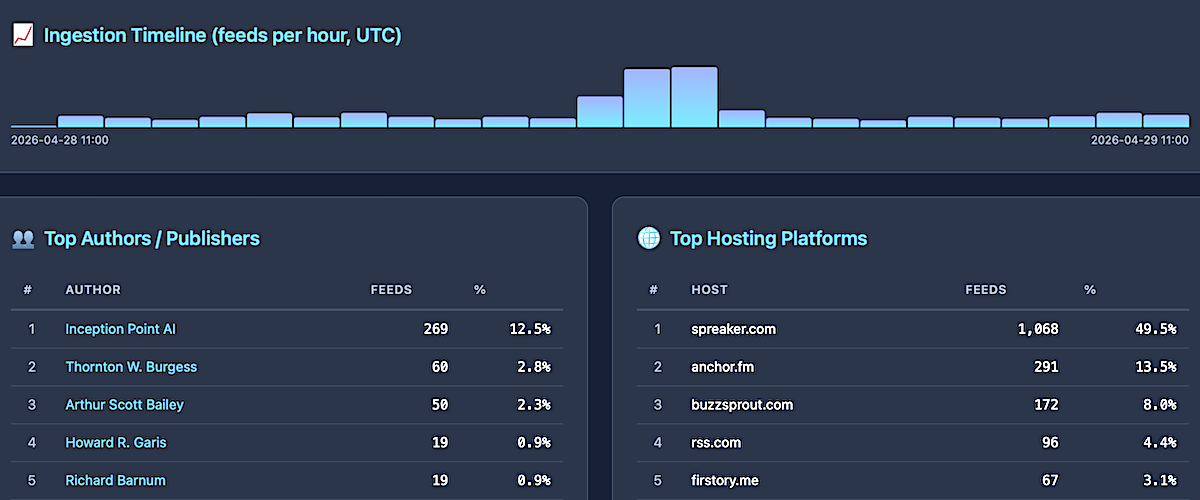
The podcast is one of 269 podcasts created by the company Inception Point AI, in the past 24 hours, according to data from PodcastIndex. Twelve percent of all podcasts created on the internet yesterday were created by this company, using AI to generate content and artificial voices. Spreaker hosted most of the podcasts from this company.
I just listened to the latest episode, Depression Demystified. The female voice is calm, soothing and reasonably human sounding, if you don’t listen too closely. Her flow is good and delivery is close to human if you don’t listnen too critically. Is this the future?
The content is solid although generic, presumably gathered from AI scraping of genuine mental health websites from around the world. It begins with an intro saying the show “makes sense of the complicated stuff happening inside your head.” It then goes on to a breathing exercise to get listeners ready for the info they will receive, then talks about brain chemistry and describes a range of conditions. It then talks about ‘self medication’ through drugs, alcohol, etc. It also mentions the possibility of depression leading to suicide and has a generic disclaimer, encouraging people to get help and mentioning the American Lifeline phone number.
The podcast goes on to talk about antidepression medications and other treatments. It all sounds like the AI host is reading a generic medical mental health webpage. She doesn’t take a breath as she rattles it off and encourages listeners to seek professional help. You can listen to it below, if you want to.
The podcast does not hide the fact that it is created by AI. There is no indication whether the company has or has not received any money from drug companies.
Listening through it, my opinion is that there is nothing harmful in it, but nothing supportive either. It is as if I sought the same information from a mental health website, but without the clicks going to whatever that organisation might be.
I got me thinking about a few things:
- Click theft – if the info came from Lifeline, Beyond Blue or one of the many mental health organisations on the internet, they have now been deprived of a click to their website by the ‘AI expert Julia Cartwright.’ Less clicks might mean less funding.
- Real help – the podcast is out there and can be listened to any time, so it may deliver real help to someone, somewhere, sometime, that they need at that moment. That’s probably a good thing, but could they have also got that from a real person hosting a human generated podcast, rather than an AI persona?
- Voice cloning – AI voices have come a long way and are pretty close to human voice quality now, but, to my ears, the reading style and breathing is still not natural.
I also noticed that the podcast had two real ads in the pre-roll and one at the end. The podcast duration was about 27 minutes.
It got me thinking about how advertisers would feel about being placed in that content, and wondering about how much AI Advertising revenue is going to Inception Point AI. Will we eventually see a legal case, similar to the US litigation for using AI generated songs to get royalties from various music streaming services, recently lost by Michael Smith.
“Michael Smith generated thousands of fake songs using artificial intelligence and then streamed those fake songs billions of times,” said U.S. Attorney Jay Clayton. “Although the songs and listeners were fake, the millions of dollars Smith stole was real. Millions of dollars in royalties that Smith diverted from real, deserving artists and rights holders. Smith’s brazen scheme is over, as he stands convicted of a federal crime for his AI-assisted fraud.”
Will podcasts such as this legally be considered AI Podcast Slop in future, or will they been deemed legitimate content? There must be a court case looming some time soon.
Once people know how much podcast content is generated by AI and how much is podcast spam designed to entrap listeners into gambling or other exploitative activities, will the special human connection of podcasts start to wane? A recent attitudinal survey suggests that it may.
These questions are real and relevant right now. According to the Podcast Index, in the last 24 hours, only about 60% of newly created podcasts were real/genuine. That means that about 40% were not real or were expolitative. The Podcast Index classifies them as:
- Legitimate 60.2%
- Spected Spam/Gambling 14.7%
- Possible AI Generated 24.4%
- SEO/Affiliate 1.4%
The stats above are as at 30 April 2026. This link will go to the current date stats for the past 24 hours whenever you read this report.
Of the 2,159 new feeds published yesterday, there were 123 unique hosts and 79 unique companies generating the content. Someone is using AI to create lots of content not published by humans, or, if published by humans, designed to exploit listeners by using bulk AI publilshing techniques.
There is a line between legitimate commercial revenue earning and fake content designed to exploit audiences and advertisers, with no substantial return to the advertisers. Responsible publishers are doing the right thing, but there are more shonks emerging – where there’s money there’s always scammers.
Add to that the various AI services that will click on a podcast and ‘listen to it’ without a human being ever hearing it, and there are some serious questions looming for podcasters to discuss, so that they can keep the podcast industry on track for legitimate success.
The social media industry is having its own AI Slop moment, where advertisers and consumers are starting to become sceptical of the business model. Podcasters need to start thinking ahead to when that moment comes for them.
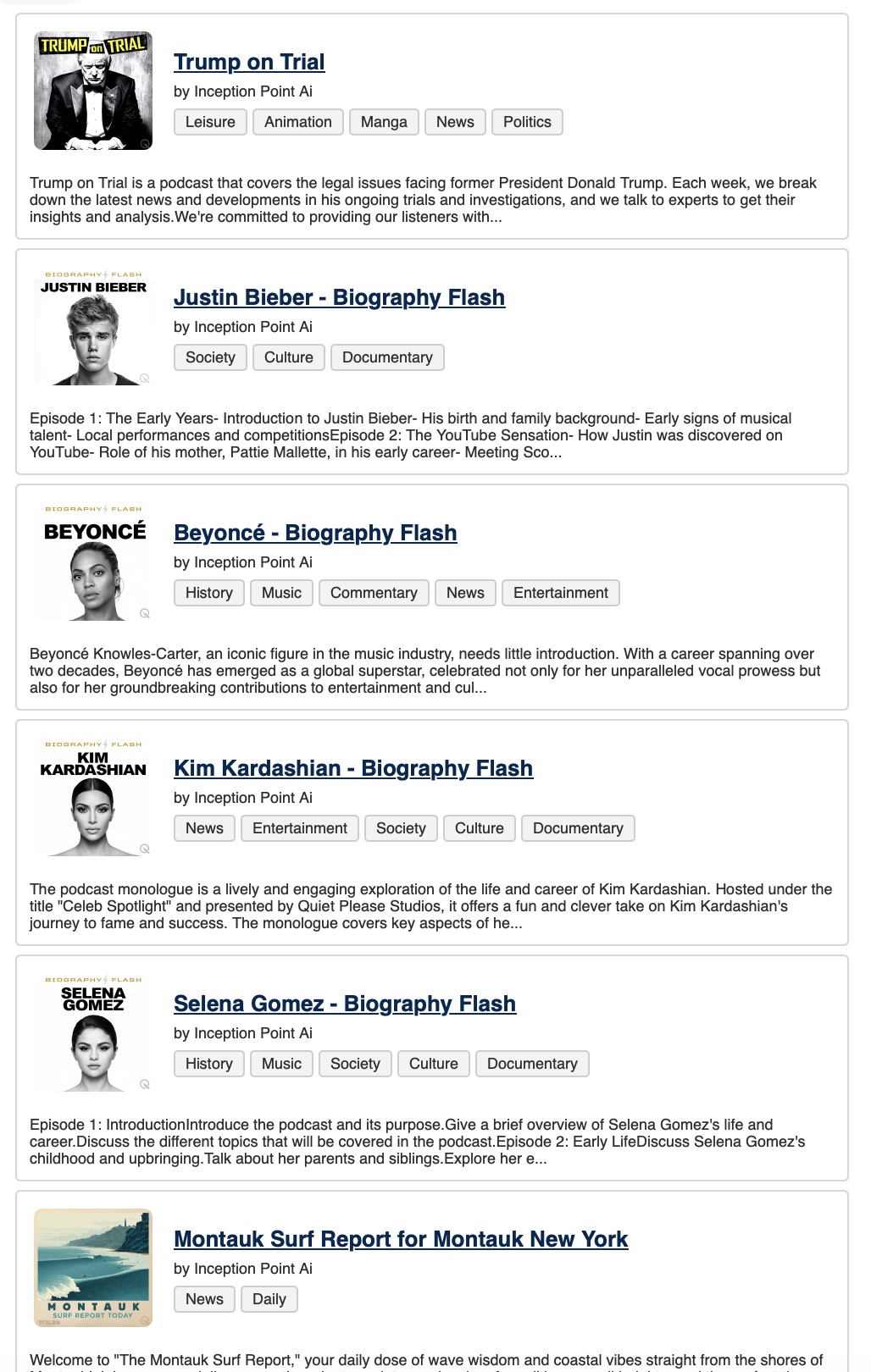
Here are the AI generated podcasts published by Inception Point AI today.
Analysis by Steve Ahern
I can only comment on my experience of videos/podcasts on YouTube and most of the spoken word documentaries are AI in spoken words and vision.
A friend does podcasts using ai-assisted scripts and sample of his voice.
The resulting podcast has his voice with a British twang.
But he's Australian.
On many videos/podcasts viewers' reaction refer to the AI voice.
The viewers can tell.
But not all the time. Some viewers may be fooled by falling in love and showing their affections for AI-generated models.
Thats despite the channel description saying that the model is AI-generated.
It will be worth a future time surveying the podcast market and find out whether the public has had enough of AI-generated content.
Long term it may have consequences on presentations on radio using AI-generated personalities.
Maybe acceptable to announce songs, the weather, time and news.
But AI may lack the sponteneity of a sporting match or political commentary.
Anthony, Strathfield South, in the land of the Wangal and Darug Peoples of the Eora Nation