
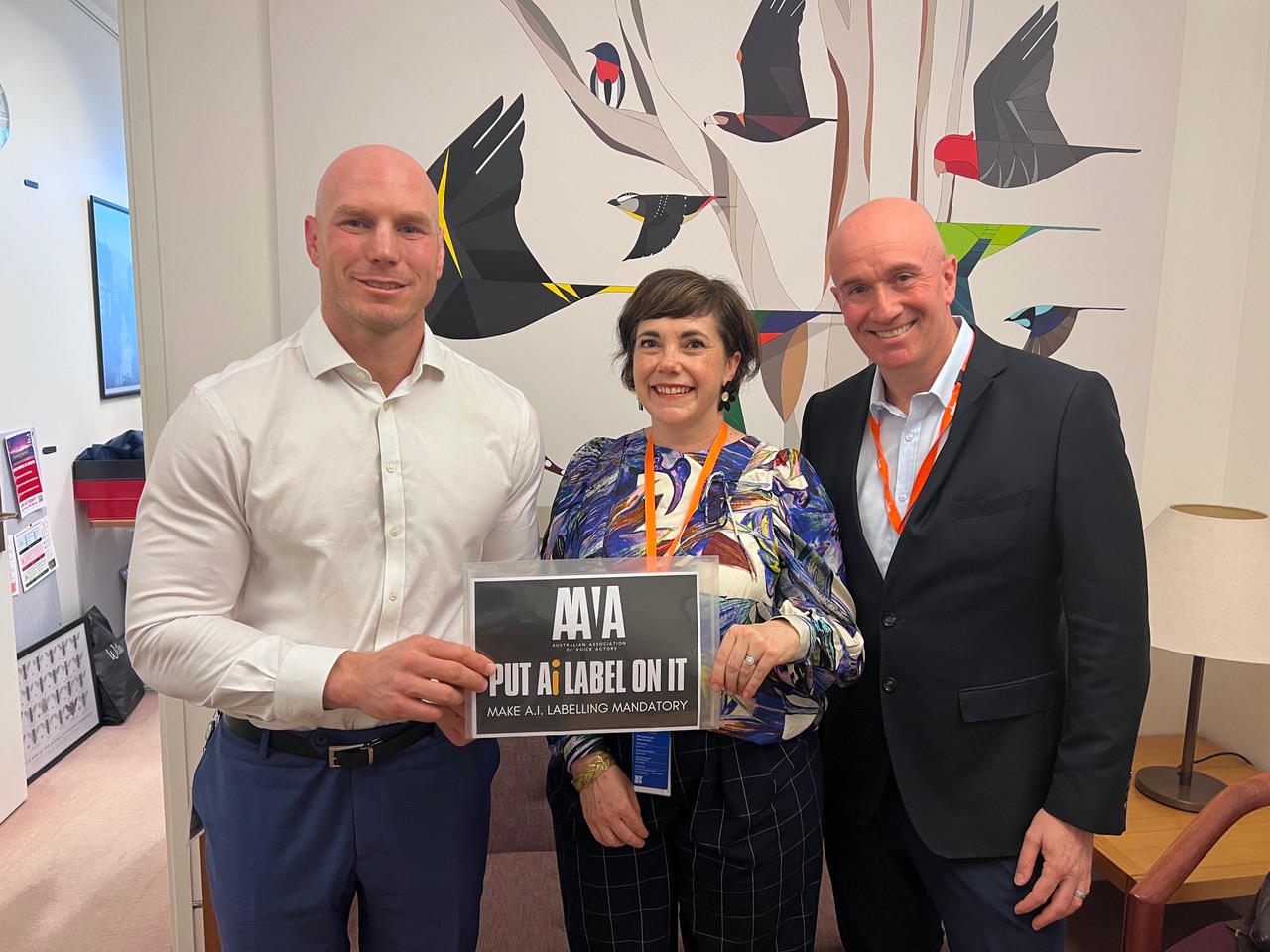
“When it comes to using generative AI to make content, AI Voices in particular, very few people are thinking about the ethical or future legal implications of doing so,” according to Simon Kennedy, President of The Australian Association of Voice Actors (AAVA).
“When using or creating an AI clone of someone’s voice, if you’re not thinking carefully about consent, control, compensation and transparency, then you could setting yourself up for trouble” Kennedy says, referencing the ElevenLabs copyright infringement law suit and the recent legal settlements by ElevenLabs and Anthropic.
“So many audio houses and broadcasters have rushed into deals with ElevenLabs without realising that the dataset the ElevenLabs model is trained on contains thousands of hours of voice data from actors who did not give consent or receive any payment.”
Kennedy warns caution, “ElevenLabs have already had lawsuits filed against them in the US. and as laws in Australia shift towards protecting copyright holders and artists from exploitation, who knows how viable doing business with a company like that will be moving forward.”
Signing long-term agreements with platforms such as ElevenLabs, whilst concurrently letting go of real human talent “can be a risk” given the ever-shifting legislative landscape, says Kennedy. AI-voice company Narrativ.ai, which was widely believed to be based on the ElevenLabs platform, recently ceased operations barely a year after signing an agreement in the US with union SAG-AFTRA.
Simon Kennedy was in Canberra during the last sitting weeks of Parliament to explain the case to politicians. He is pushing for labelling of AI cloned voice use to inform listeners and advertisers when a cloned voice is used, so that they can decide whether to listen or advertise, or whether they would prefer to hear real humans. AI voice cloning is “a risk to jobs, to truth and to creativity, according to Kennedy.
AI is now producing voices, images, scripts, and music that make it difficult for audiences to tell the difference between what is real and what is not. This ambiguity can cause job losses and also means that “misinformation and deepfakes can spread faster than ever, eroding public trust.”
The Australian Association of Voice Actors (AAVA) is leading a campaign, and asking the wider creative community to stand with them, to call on the Federal Government to introduce mandatory labelling and watermarking for all AI-generated content. This action would align Australia with global standards already being adopted by the European Union and China.
This means:
- Clear audible disclaimers for AI-generated voices and sound.
- Clear visible labels for AI-generated video, imagery, and written content.
- Metadata watermarking for traceability and copyright transparency.
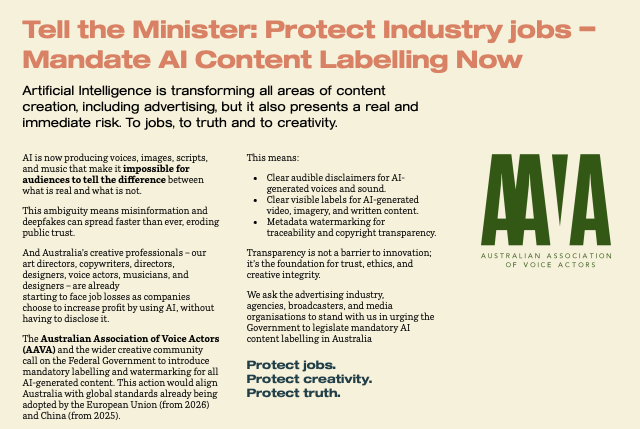
Kennedy says: “Transparency is not a barrier to innovation; it’s the foundation for trust, ethics, and creative integrity.” He got a good hearing from some of the politicians he talked to during his recent Canberra visit.
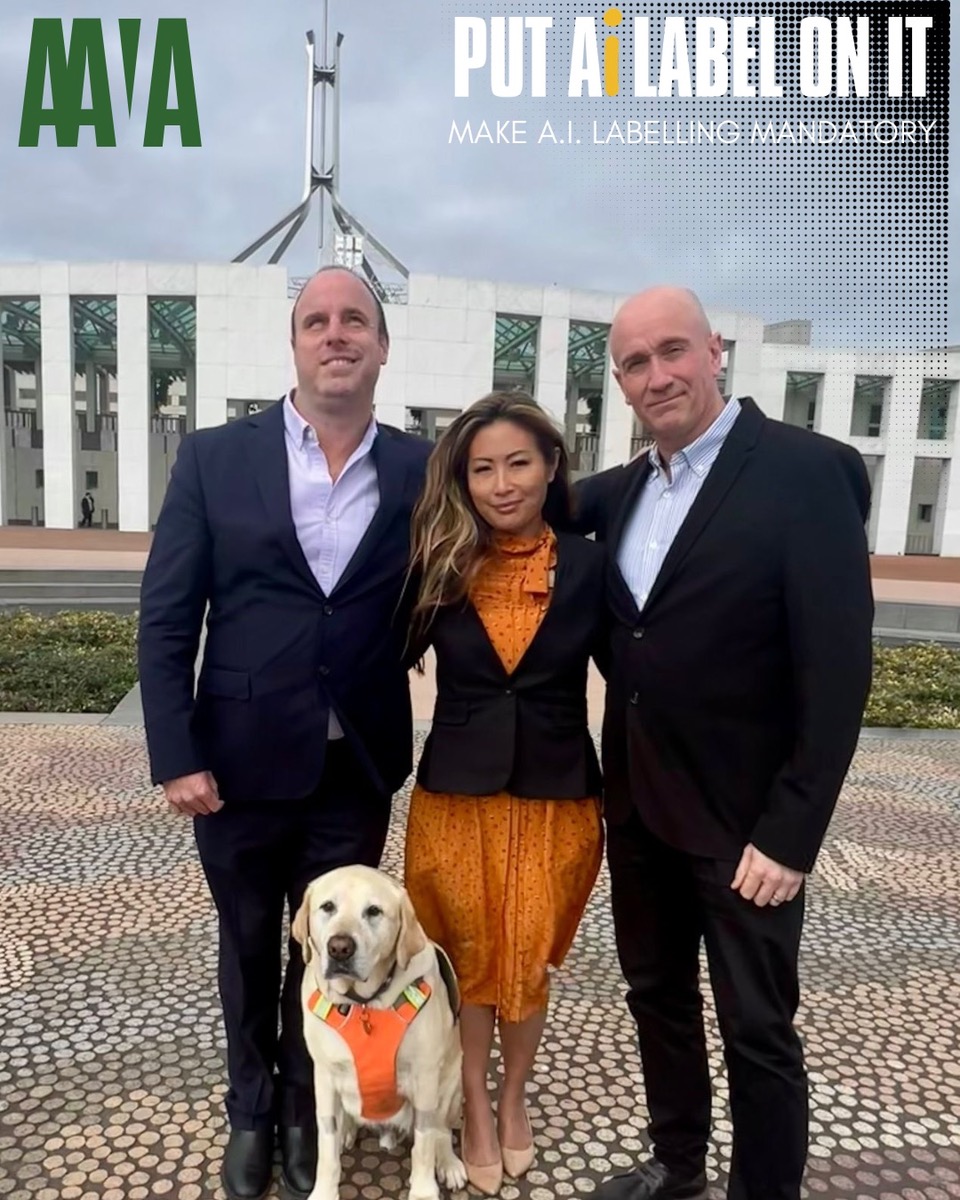
“As a guy with radio in my blood it saddens me to see networks doing less of the one thing that the music streamers don’t really do – be human,” says Kennedy
“Replacing people with AI in radio is like using the hull of your ship make firewood.”
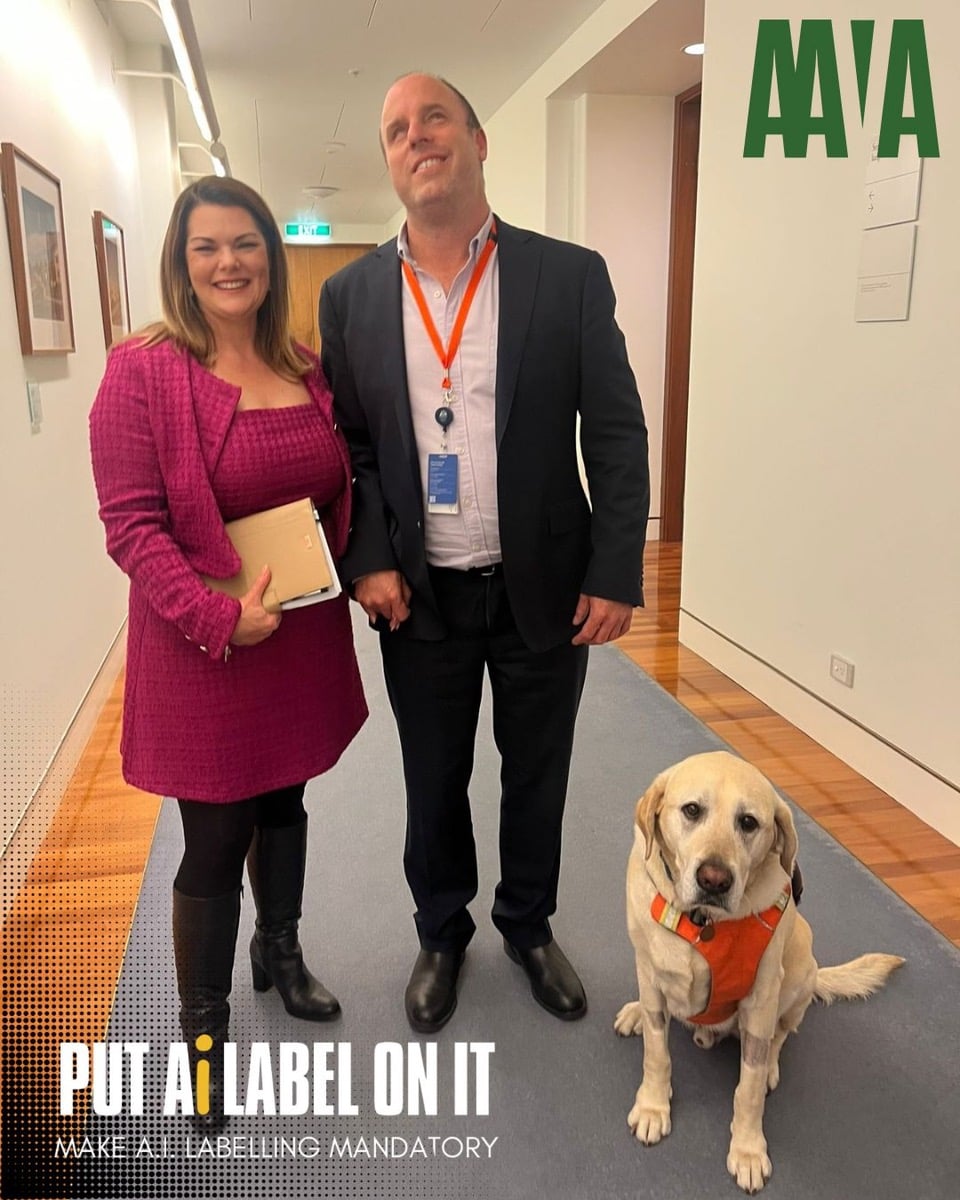
Pictures: Alistair Lee – AAVA disability advocate, Teresa Lim – AAVA Vice President, Cecelia Ramsdale – AAVA National Secretary, King the guide dog, Senator Sarah Hanson Young, Senator David Pocock (photo credit S Kennedy)