

“When ChatGPT was released, people were hit with the next wave of AI disruption, Generative Artificial Intelligence,” said Michael Davis from the UTS Centre for Media Transition in a CBAA conference session
A study of AI use in newsrooms conducted by UTS three years after the launch of OpenAI’s ChatGPT has found that it “remains neither its saviour nor its downfall.”
“People were worries about fake news and losing jobs. They wondered if it would mean the end of journalism and radio presenters. Things have calmed down since then. Now we can studty the real effects,” explained Davis.
The study looked at a variety of media news organisations to determine what is the real impact.
Since the first report in 2023, there has been increased experimentation with generative AI across synthetic voice, image generation and content summarisation, with synthetic voice emerging as a significant opportunity for broadcasters.
Talking to newsroom leaders for the study, Davis and the UTS team found that “news integrity and audience trust is important to newsrooms,” so they were reluctant to jump in too fast.
“They tested and found things that could be done more efficiently to support journalists doing their reporting… The biggest thing we heard about from them was the importance of maintaining news integrity.”
Quoting other recent research, Davis discussed a Medianet report that found 64% Australian journos had never used GenAI. He compared that with global research that found 49% of journalists around the world use AI daily.
From an audience point of view, the 2025 Digital News Report found that audiences are “open to using AI in news.”
The latest UTS report, which studied 13 Australian news organisations, found that newsrooms are “cautiously experimenting with AI now, to see what works. They are developing guidelines, policies and safeguards around AI.”
The media sectors most advanced in using AI are radio and public broadcasters. “They are mostly using it to streamline back end tasks,” said Davis.
“Synthetic voice is the main audience-facing use of AI, mostly for service content such as weather updates. It is also being used for translations and text to speech audio delivery of written copy.”
The consensus from newsroom leaders about using AI for writing news was that it is “not worth the effort” because it doesn’t save time, it “still needs human checking to maintain the integrity of the reporting.”
A recent EBU study has concluded that AI Assistants distort the news
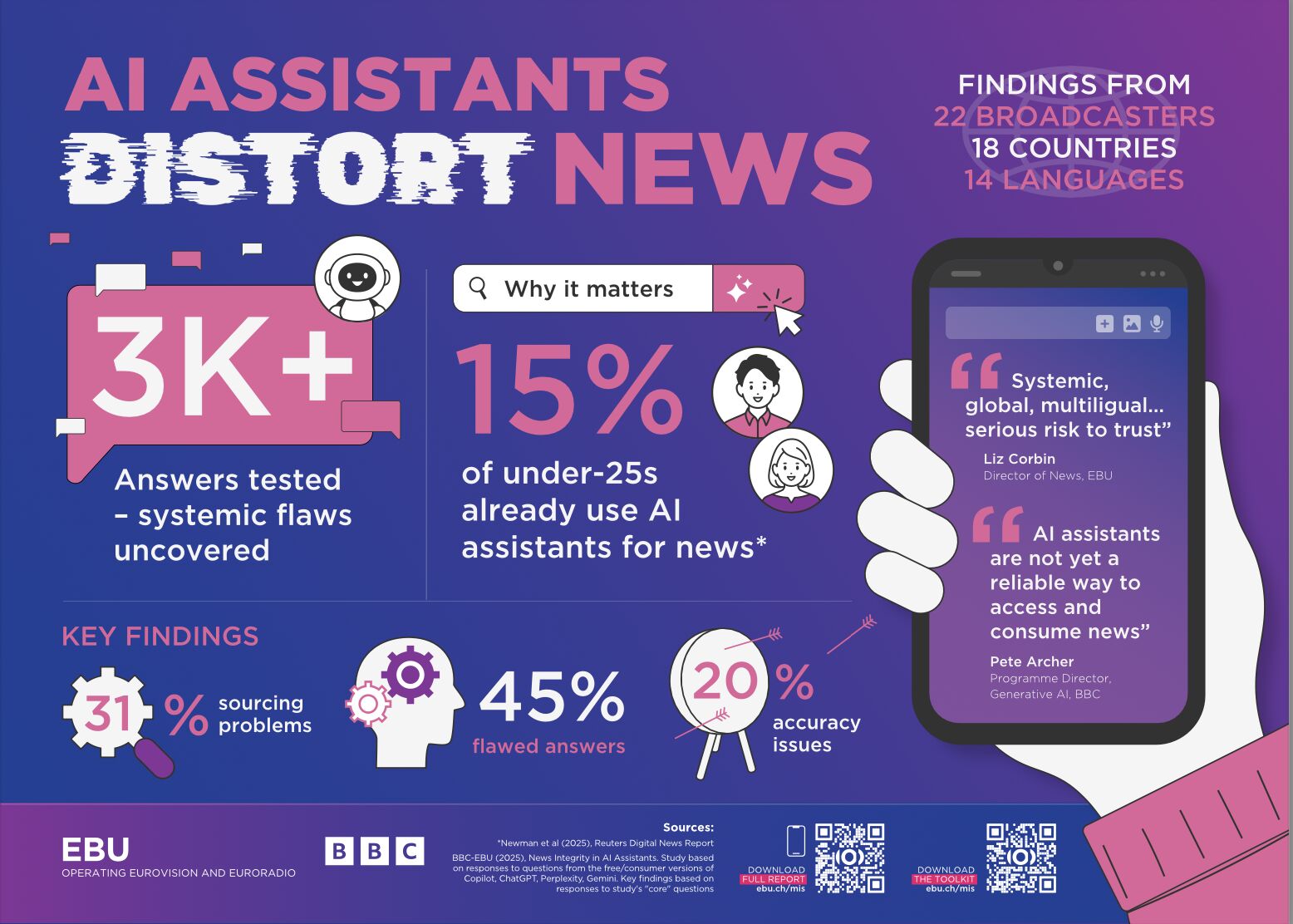
“Consumer level AI is not good at maintaining the integrity of news, more than half the news items had wrong content, misattribution and other faults. But people are turning to AI Chatbots to get their news, so this is a worrying trend.”
“People are staying in the Google AI search engine and are not clicking through to reputable news websites,” causing “a drop in traffic to these sites” through AI click theft.
Verification of whether something is real or not is another challenge. Deep fakes and cloned voices can misrepresent and distort the news.
Most newsroom leaders surveyed believe that if you maintain your audience trust through human oversight and transparency, you can stand out amongst the AI Slop.
Nine Publishing has developed guidelines that aim to balance efficiency gains with the right oversight, verification and transparency. The ABC also has developed editorial safeguards for factual content. The EBU has also developed principles on using AI and principles of copyright
Australian newsrooms remain most comfortable with using AI to augment rather than automate production, and the majority of experimentation is still occurring in the back-end rather than audience-facing uses, concluded Davis.
More CBAA Conference reports here.