
Radioinfo turns 30 this month.
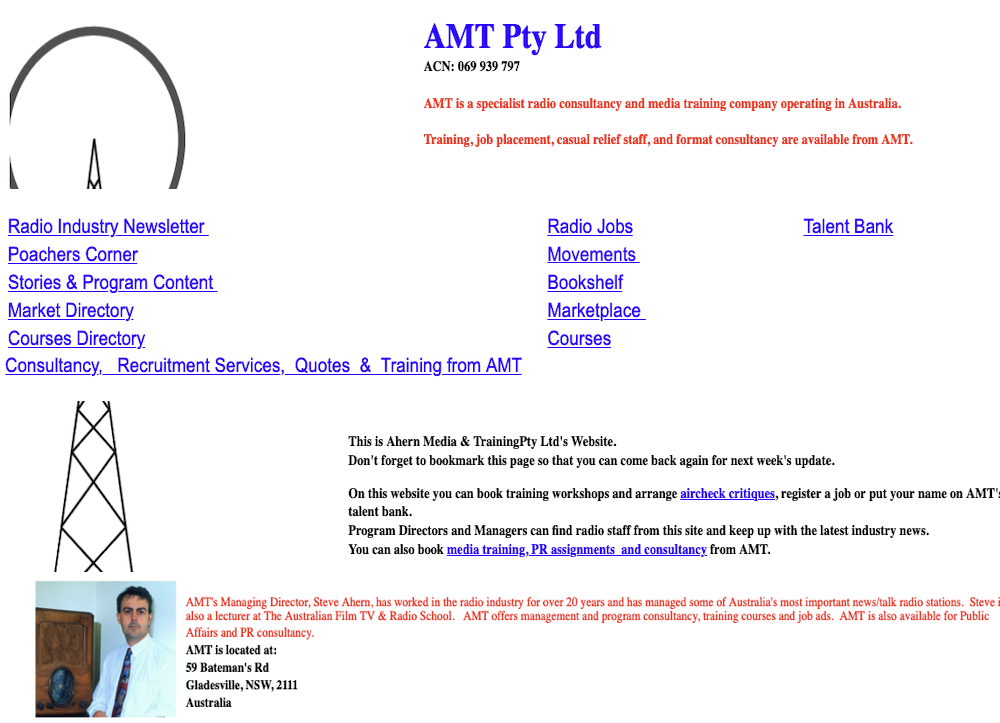
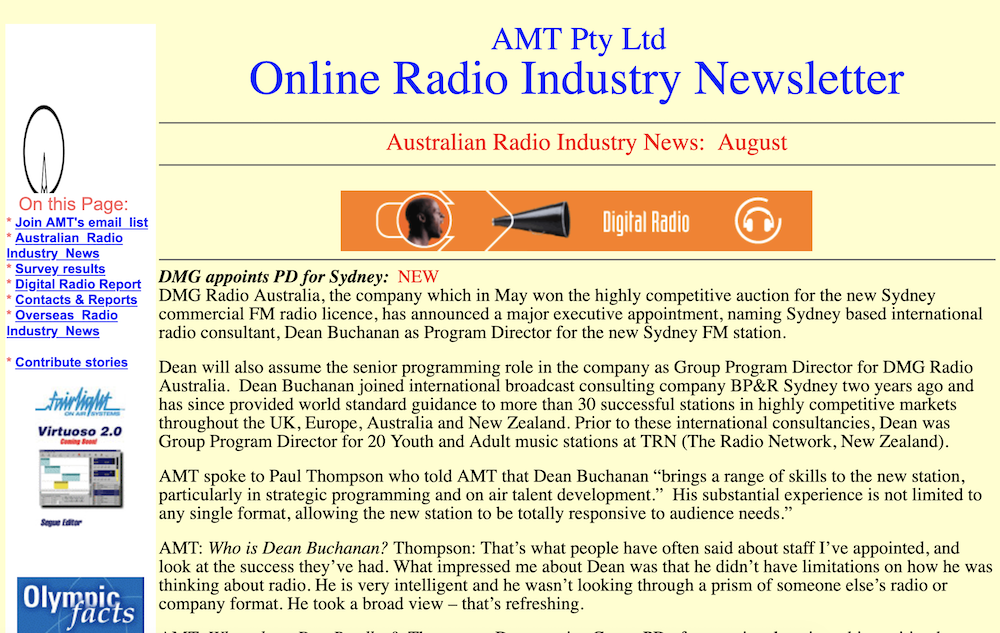
This audio industry trade publication began life as the AMT radio industry newsletter in 1996, and changed its name to radioinfo in 2002. We have been chronicling the evolution of Australia’s radio and podcasting industries for 30 years.
Steve Ahern began working on the idea for an online newsletter after he left the ABC in 1995.
Ahern had worked as a casual at 2UE, 2SER and ABC Light Entertainment (later ABC702) in Sydney, then moved to 2WEB Bourke for a full time job as a presenter and journalist. He joined the ABC in Newcastle as a producer/presenter, later managing the station, then moved to Canberra to manage the national broadcaster’s radio stations in the ACT. After 6 years in that role Ahern moved to Melbourne to manage ABC Radio 3LO Melbourne.
“Our second child was on the way, so it was time to return home to Sydney,” says Ahern. At the time the internet was in its infancy and presented a new frontier for reporting.
“I realised that there was a hunger for serious reporting about radio not just about big stations from the capital city newspapers but in every town with a radio station. I thought about starting a training business and a trade newsletter. My wife Serena suggested that the newsletter should be online, a great idea! I taught myself html code and got a private server, there were no website creation tools at that time.
“It was slow at first, but then word spread and readership grew steadily. At a time when people had to plug their modem into the phone line and wait for the squawking sounds to connet them to the internet, it took effort just to read anything online. The online newsletter was a disruptor to the printed, direct mailed magazines that were around then.”
The Statpak webcounter on the site in the early days tracked 9 weeks of visitors in the second year of operation, showing numbers that are nothing in today’s internet users, but were significant back then. The most popular browser was Netscape.

The combined reach of all publications is now 1.5 million readers and over 6 million page views.
Stories covered in 1996 included triple j going national, a music format change for Triple M, ABC budget cuts, the closure of Radio Australia‘s Carnarvon shortwave transmitter and million dollar paychecks for Richard Stubbs and Wendy Harmer at Austereo, as 2Day and Fox dominated the landscape.
In 1997, Austereo bought 92.9 and MIX 94.5 in Perth, cuts continued at Radio Australia, the ABA (Australian Broadcasting Authority) began plans to introduce digital radio and tv, Australia’s first full time online radio station Wild FM began broadcasting, DMG and RG Capital continued to expoand their regional networks, the community radio sector launched National Radio News. Commercial radio stations collectively made a profit of $93 million (16% profit margin), 4,361 people were employed in Australia’s 103 commercial radio stations.
Not much remains from those early newsletters, that were not archived until a few years later when the Wayback Machine came online and later Australia’s National Library started Trove.
ELAN Audio’s Poul Kirk, a new innovative digital recording company called Fairlight and Radio Computing Systems (RCS) placed advertisements on the AMT website. About one hundred subscribers paid a small monthly fee for an email subscription to the newsletter.
Diana Stokey from RCS has sent us this message:
Happy 30th Anniversary, Radioinfo!
RCS is proud to celebrate three decades of your dedication to the radio industry. Thanks for informing, inspiring, and elevating broadcasters around the world. Here’s to many more years of great storytelling and industry insight!
Subscribers in those early days included Kerry Skyring who was working in Vienna:
Dear Steve,
Just a quick note to say that the AMT Website is keeping this expat well informed of what’s happening at home. So many changes in the past five years. Which is how long it is since I left… I’m happily settled in Vienna…
Hope all is going well for you.
R. Branson from Virgin International<[email protected]> asked:
I understand the Phil O’Neil has left Austereo. Did you report on it in your pages? Where can we contact him
and Guy Dobson, complained about a news item:
“Austereo announcers were banned from using the word ‘easy’ in their talk breaks in case it reinforced their rival station’s callsign” Really? First we’ve heard of it… Guy
The Wayback Machine began to index the AMT website in 1998, followed later by the National Library and Trove. During the next few weeks we will revisit some stories from the past as part of our birthday celebrations.
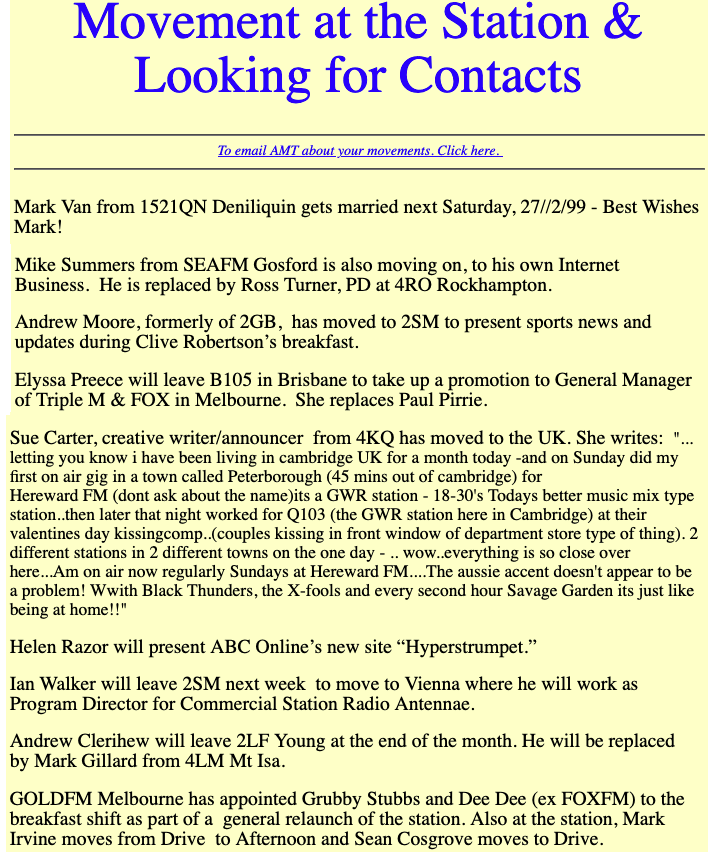
Have we mentioned you in our news or movements pages during your career? Did you get a job from our jobs page?
Send us a message and a birthday present
Radioinfo Highlights:
| 1995 | Steve registers Ahern Media & Training company name |
| 1996 | AMT radio industry online newsletter launched |
| 1998 | Site sold to Radiowise when Ahern takes role of Head of Radio faculty at AFTRS. Ahern contnues to write for Radioinfo |
| 1999 | National Library begins to archive AMT online publication |
| 2000 | Brand renamed radioinfo, some sections locked behind a paywall. ACRAs reporting begins. |
| 2003 | Daily updates replace weekly newsletters |
| 2008 | Ahern leaves AFTRS and begins to buy back the publication from Radiowise |
| 2009 | Ahern awarded an Order of Australia (OAM) |
| 2010s | Expansion into Asia and Africa editions, Ahern works internationally. Radioinfo expands into Podcasting |
| 2011 | Radioinfo enhances its reporting from the ACRAs with ‘winners speeches‘ |
| 2021 | Radioinfo buys Radio Today |
| 2024 | Radioinfo launches Audioinfo and expands into technology reporting |
| 2025 | Peter Saxon retires as editor, Steve Ahern takes over full time. |
| 2026 | Radioinfo and Mumbrella launch Australian Audio Awards (entries have just closed) |
We will bring you some past stories from our 30 years of publishing over the next few weeks.
Here are some stories from 1999:
Thank you to our regular loyal advertisers for supporting us for all these years.