
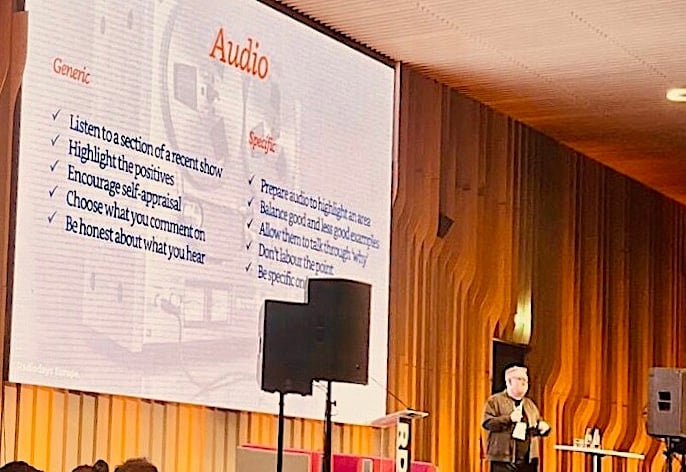
Nik Goodman presented a session on airchecking at RadioDays Europe.
There are generic ways to do airchecks that include listening to a section of a recent show, highlighting positives and choosing what to comment on, but a specific approach can be more beneficial if you take the extra time needed to prepare it:
- Prepare audio in advance to highlight a particular area for improvement
- Balance good and less good examples
- Allow them to talk through ‘why’
- Don’t labour the point, the talent will hear it for themselves
- Be specific
In a Linkedin post after his session Nik commented on the feel of this year’s event:
“I kept hearing across the event, not just “what’s the future of radio?” but “how do I make tomorrow’s show better?”
“Because for all the talk of technology and transformation, the thing that still cuts through is pretty simple: great content, real people, a genuine connection.”
On Podcasting, there was plenty of discussion about video podcasting (see previous report), but how to use video in news report podcasts is still a work in progress. Rachel Quester said The Daily podcast is still tyring to figure out when it is most efficient and effective to use video in podcasts. “It’s not as easy as one might think.”
he BBC’s Guang Jin Yeo and Stevie Middleton agreed, saying that podcast visualisation and video should be used selectively, not as a default add-on for every podcast. Younger audiences increasingly discover podcasts through visual platforms, making video a “route to attention rather than a replacement for audio.”
BBC examples focused on designing projects from the start for audio, video and social, with separate versions for each platform and workflows that can be repeated at scale.
Another session, led by Norma Jean Blenky, with Sarah Toporoff, Leanne Alie and Arthur Soria tackled the question, ‘where’s the money in podcasting?’
“There isn’t one path, there are a few that actually work,” she said.
They dove into three clear monetization archetypes:
1. The top 1%: shows driving meaningful ad revenue through programmatic and DAI
2. Audience participation: memberships, Substack, Patreon, value-for-value
3. Branded partnerships: where most sustainable businesses are being built
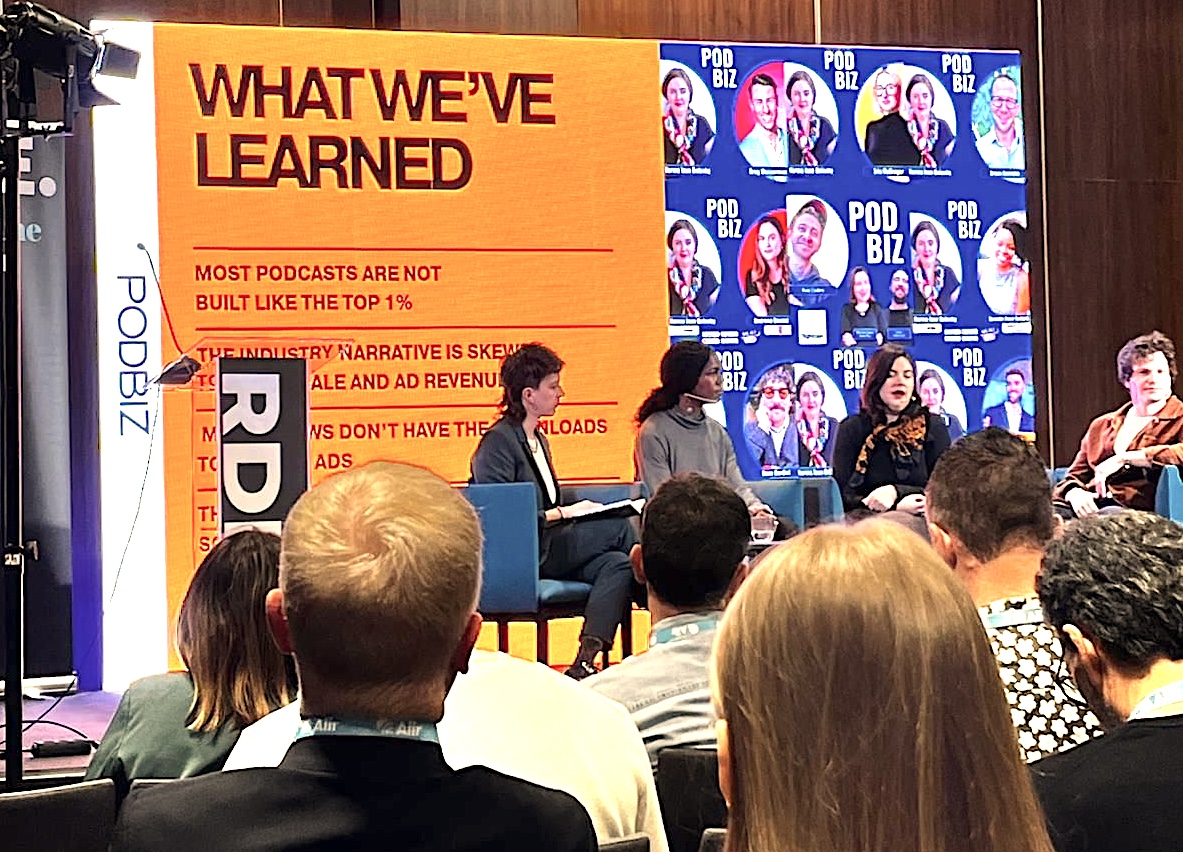
“What matters is not chasing all three. It’s knowing which one you’re building for.”
Pulling examples from PodBiz conversations across each model, it became clear that these frameworks don’t just apply to podcasts. Radio is already adapting them. Sponsorship needs to be rethought. Packaging is evolving. The lines between formats are thinning.
For creators and operators, the question isn’t “how do I monetize?” It’s “what is this show designed to do, and who is it for?”
Another podcasting session explored using paid media advertising to boost podcast numbers. “Paid media can be a powerful tool, if used strategically.”
The panel emphasized the importance of understanding which formats work best for your show. Audio ads, social video clips, newsletter placements, and platform-specific promotions all have different strengths depending on your audience and content type. Successful campaigns constantly experiment with messaging, creative formats, and hooks to see what resonates. Small adjustments, like changing the first few seconds of a promo clip, can dramatically improve engagement. It’s about learning quickly, refining, and repeating what works.
It is a time of great change for advertising and audio businesses. Business models are evolving, with conferences like RadioDays playing an important part in helping to develop new models for the future.
Despite the obvious challenges to the old business models, the future is being reinvented right now. There was a sense of optimism about that reinvention from the participants at RadioDays Europe, captured by Wade Kingsley in his new podcast series.
Wade spoke to Steve Jones, President of Stingray Radio, about balancing financial discipline with creative innovation and audience satisfaction. He also talked about brand crafting and image protection, using ABBA as an example, and Performance of Authenticity.
“Nothing happens by accident. You need to take great pains to get it right…
“I don’t think leadership is a falsely crafted performance, it’s a performance of your own authenticity… You never achieve success unless everyone believes in the mission.”
Lukas Schöne from MedienNetzwerk Bayern, added these points to the conference discussions about radio’s future:
🌟 Makes the community a star
“We send, others receive”; the model has rightly been questioned by the industry for years. But you also have to implement it consistently. Whether a radio station gives listeners their own shows, a podcast turns the community into experts and leaves the choice of topics to them, or shows with just a single note create a sense of community: Radiodays showed that audio can really connect people. If we’re serious.
💶 Fans bring money
Community funding can be more than a nice side hustle. Many people are willing to spend money on their favorite formats and hosts: With subscriptions, on Patreon or at live events. It takes patience, an organic build-up of reach and creative ideas.
👾 AI pragmatism instead of AI skepticism or AI enthusiasm
Use AI for the “heavy stuff” so that there is more time for the essentials. Using AI wisely in workflows and using them pragmatically to build better connections with and understanding of the audience: that’s what it’s all about now.
📻 Good radio is not always plannable
Sure, data is important. They tell us a lot about what listeners want and how they use offers. But they don’t tell us everything. Often it’s also about the vibe, the surprising, the rock’n’roll and the context. Because it remains the great advantage of audio: being the everyday companion in all the situations in which life happens away from the big screen or the smartphone display.