
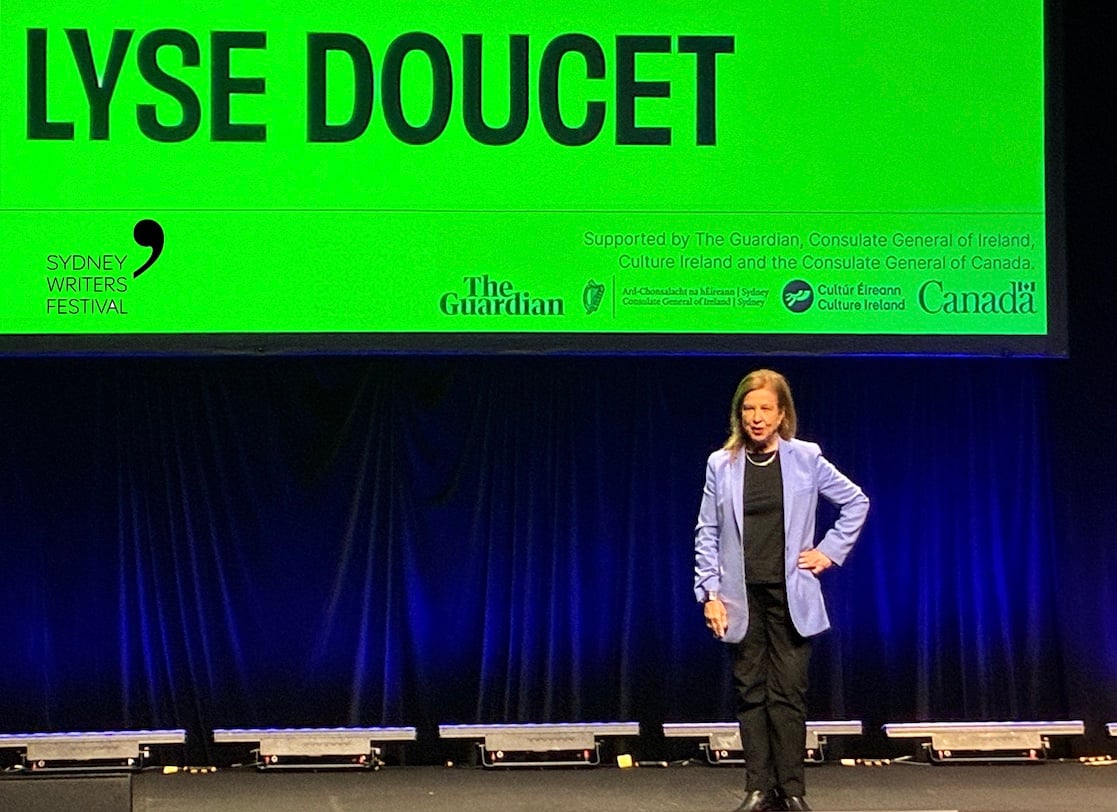
She was in Iran a couple of weeks ago, vox-popping ordinary Iranians to find out their views on the war. Now she is in Sydney, at the Sydney Writers Festival.
This year’s festival has a strong journalistic strand and an overarching theme Show Me the Truth. The BBC’s Lyse Doucet will speak several times at this festival to tell her story and talk about journalism. Her first appearance was tonight.
“They asked us to tell the story within the story. Of course no journalist really wants to be the story. But I’ve come this far so I may as well keep going” she said, as she told part of her own journalistic story, that she called ‘The Angels of journalism.’
Once upon a time, quite a long time ago in 1987, Lyse had a dream, to leave Canada and go to London and work in journalism at the BBC.
It took her some time and some strategic steps to achieve her dream, with a little help from the angels of journalism. She was rejected from her first approaches to the BBC, so she took matters into her own hands and decided to go to Africa and work freelance, hoping to get noticed.
“As it happened, when I arrived in Côte d’Ivoire on the west coast of Africa, so did the BBC. They were setting up their first West Africa office. They needed somebody to help the correspondent and there I was.” She had the wrong accent and not enough experience, but the angels of journalism came down from heaven and somehow she got the job.
After five years of reporting on military coups across West Africa, famine in the Sahara, African music, and film she decided, it was time to go to London. But getting a work visa and a full time job at the ‘BBC Mothership’ was still a long way off.
After some unsuccessful attempts, Lyse was having lunch with a British diplomat in Nigeria and told him she couldn’t find a way to get a job at the BBC London “Without telling me, he got in touch with the London Foreign Office and they sponsored me for a six month visa.” After that 6 months, to pursue her foreign correspondent dreams, she decided to travel again.
“I remember sitting at a table and tracing my finger along the borders of countries to find out where the BBC didn’t have a correspondent. I looked at Afghanistan, Iran, Pakistan. ‘Pakistan is in your destiny… it’s your karma,’ a friend told me,” so she went there hoping to get a job with the BBC World Service.
That began her path towards her dream of a full time foreign correspondent job with the BBC.
“I went to Pakistan, and I chose the southwestern corner of the country. The dusty provincial capital, Quetta, in Baluchistan. It was a place where hardly any reporters went.” After filing many freelance stories, she again tried for a full time job, but was still considered too inexperienced, so she went to Kabul to cover the Russian occupation and Russia’s eventual withdrawal.
“The choice of going to Quetta turned out to be fortunate, because it was there that I met many of the Afghans. At that point, they were spokespersons for the main Mujahideen groups, but they went on to become actually very important people in the future history of Afghanistan, including a certain Mr. Hamid Karzai who became the first president…
“Yet again the angels and journalism intervened and a senior UN official asked one of his high level contacts in Kabul to get me a visa… I found myself on Christmas Day, the day after my 30th birthday, flying into Kabul, in the midst of a harsh winter and in the depths of the Cold War, to cover the Soviet troop withdrawal from Afghanistan. A major historic moment at the end of a decade long, disastrous Soviet occupation…
“By this time, I had settled in to the Intercontinental Hotel Afghanistan… as the day of the Soviet troop pull out approached, there was a swirl, not just of snow, but also rumours and propaganda. For all of the uncertainty of this moment, and for all of this possible peril, I had already made up my mind to stay, because, from the moment that I first met Afghans in Quetta I was really taken by their strong sense of self, which meant they also had a strong sense of humour.
“Reporting for the BBC in Afghanistan was something quite special, it was said at the time that 95% of Afghans were listening to the BBC on the World Service to find out who was winning the war.
“For me, and for many journalists, stories become part of your own personal life. It was that way for me in Afghanistan.”
Telling those stories and witnessing what’s happening is part of her dedication to good journalism, but it is getting herder. “I’m still going to Afghanistan when I can get a visa, but under the Taliban government, it’s ever harder. I am still working for the BBC… at least for now… they have announced 15% cuts to the news department,” she concluded.
Lyse Doucet’s story about Afghanistan is told in her new book, The Finest Hotel in Kabul A People’s History of Afghanistan, one of the many books for sale at this year’s Sydney Writers Festival.
See the Festival Program here.
Reporting: Steve Ahern
Related report: BBC to cut almost one in 10 staff to make £500m savings