
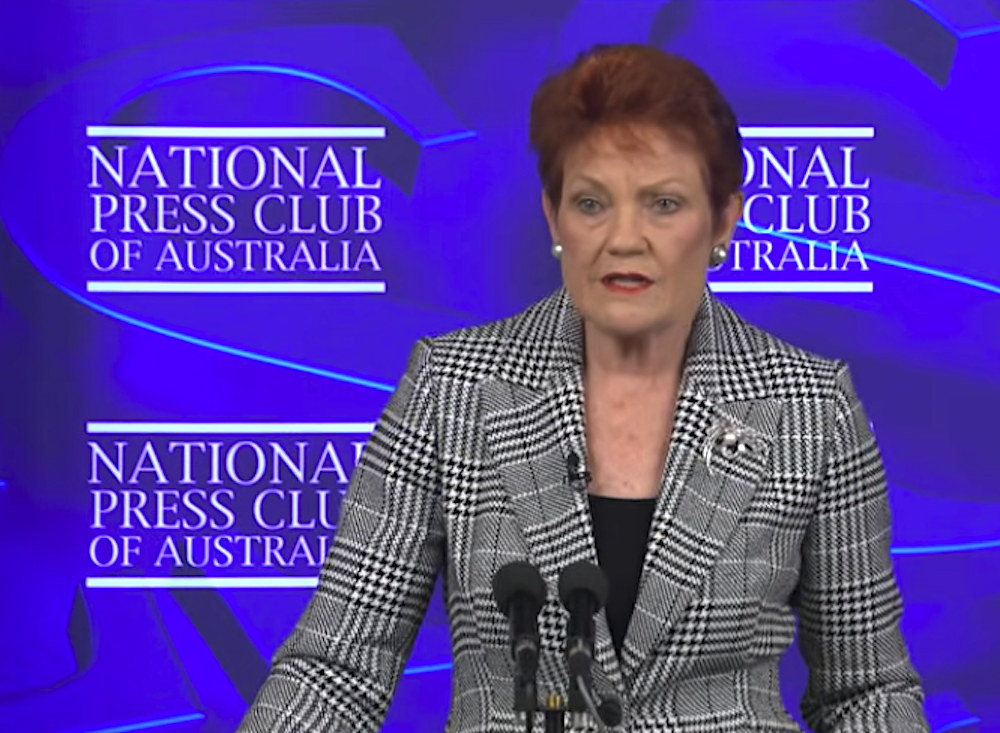
“The internet has overtaken the need for the ABC, [it] will still exist, but in a very different form,” Pauline Hanson told the National Press Club yesterday in a speech broadcast on ABCTV and SkyNews.
Hanson’s vision for the ABC, if her party were to win government, is that “taxpayers will still fund some of the ABC’s operations in regional, rural, and remote areas where there is a lack of commercial media.” Most of the ABC’s local presence in regional, rural and remote Australia is through radio.
In the cities, “which are already saturated with media outlets across the political spectrum,” One Nation’s plan is that ABC services would “only be available via subscription.”
Hanson accused the ABC, “from its chairman down,” of profound “political bias,” telling the Press Club that is why she has often refused ABC interviews.
SBS and The Guardian were also in her sights. “I’ve also banned The Guardian… The SBS will be gone, there’s no need for it anymore.”
“I’m not going to be anyone’s football to kick,” she said.
It was Senator Hanson’s first apearance at the Press Club in her 30 years in politics. The speech comes as polls show her One Nation Party gaining ground in opinion polls at the half way mark in this current government period. Under normal circumstances, a federal election must be called by 20th May 2028, but timing is at the discretion of the Prime Minister.
Since the May 12 federal budget, every poll has had One Nation gaining when measured against the last issue of that poll. One Nation is leading on primary votes in the YouGov and Morgan polls.
Polls since the budget also had continuing drops for Labor. Labor’s support was steady in YouGov and up two points in Morgan, with the overall vote for One Nation and the Coalition steady at 49% in YouGov and down 0.5 points to 46.5% in Morgan. Pauline Hanson’s Prime Ministerial approval rating is growing, but in the most recent polls, Anthony Albanese led Angus Taylor as preferred PM by 43–38 and led Pauline Hanson by 48–41. See a full analysis of the most recent polling in The Conversation.
I watched the Pauline Hanson's speech and amongst many issues was the fate of the ABC and SBS.
I will discuss the implications of applying the subscription model to capital city stations and the abolition of the SBS.
I will also discuss the implications of other parties dependent on the ABC and SBS.
First on a subscription model for capital city ABC radio and TV.
Prima facie, for a network with low ratings, to rely on subscriptions and a subset of the audience prepared to pay is a recipe for the self detonation of the ABC.
Then you ask why would a government authority want to own an entity for the exclusive use of a few?
Suppose the ABC in capital cities was a subscription model, it would require amendments to the ABC Act and Broadcast Services Act to allow a subscription service and for the DVB, DAB and analogue services to be encrypted.
Currently all terrestrial broadcast must be publicly available FTA and not encrypted.
To encrypt ABC's radio and TV services would require conditional access modules 'CAM' into receivers.
The reality is that there are no set top boxes on the market with CAM and if there are such devices would these be sourced outside Australia?
Alternatively, a subscription model may be implemented online. Something like in iView+ premium service.
Then implementing a subscription management system would be costly to implement and maintain.
That's before the ABC subscription in capital cities is implemented.
To put a charge of $45 per month of subscription and one million subscribers would raise 12x45x1000000 = $540million.
Then why should a government own facilities for the enjoyment of a few?
Second, One Nation's policy is to abolish the SBS.
There may be case to abolish it if people consume info from overseas from the web or satellite receiver. There may be a case that listeners to LOTE programs resort to community radio, LPON radio above 1600kHz and narrow band FM channels on 150 MHz.
However One Nation's policy ignores channels like NITV.
On the other hand why not amend the ABC Act and SBS Act to amalgamate technical and programming resources?
Lots of programs on SBS would be suitable on the ABC such as documentaries and Dateline.
Anyway a transformation of the ABC to a subscription model in capital cities and the abolition of the SBS has consequences for a loss of income of transmission facilities owned by Broadcast Australia.
In conclusion, turning the ABC in capital cities to a subscription model will present huge administration and technical issues to set up and maintain.
Amalgamating and consolidating the ABC and SBS will preserve both networks as a FTA network. Many shows on SBS lend itself to being 9n the ABC.
However a loss of terrestrial broadcadt ABC services in capital cities to a subscription model and the abolition of the SBS will result in financial losses to BA.
Anthony, Strathfield South, in the land of the Wangal and Darug Peoples of the Eota Nation.