
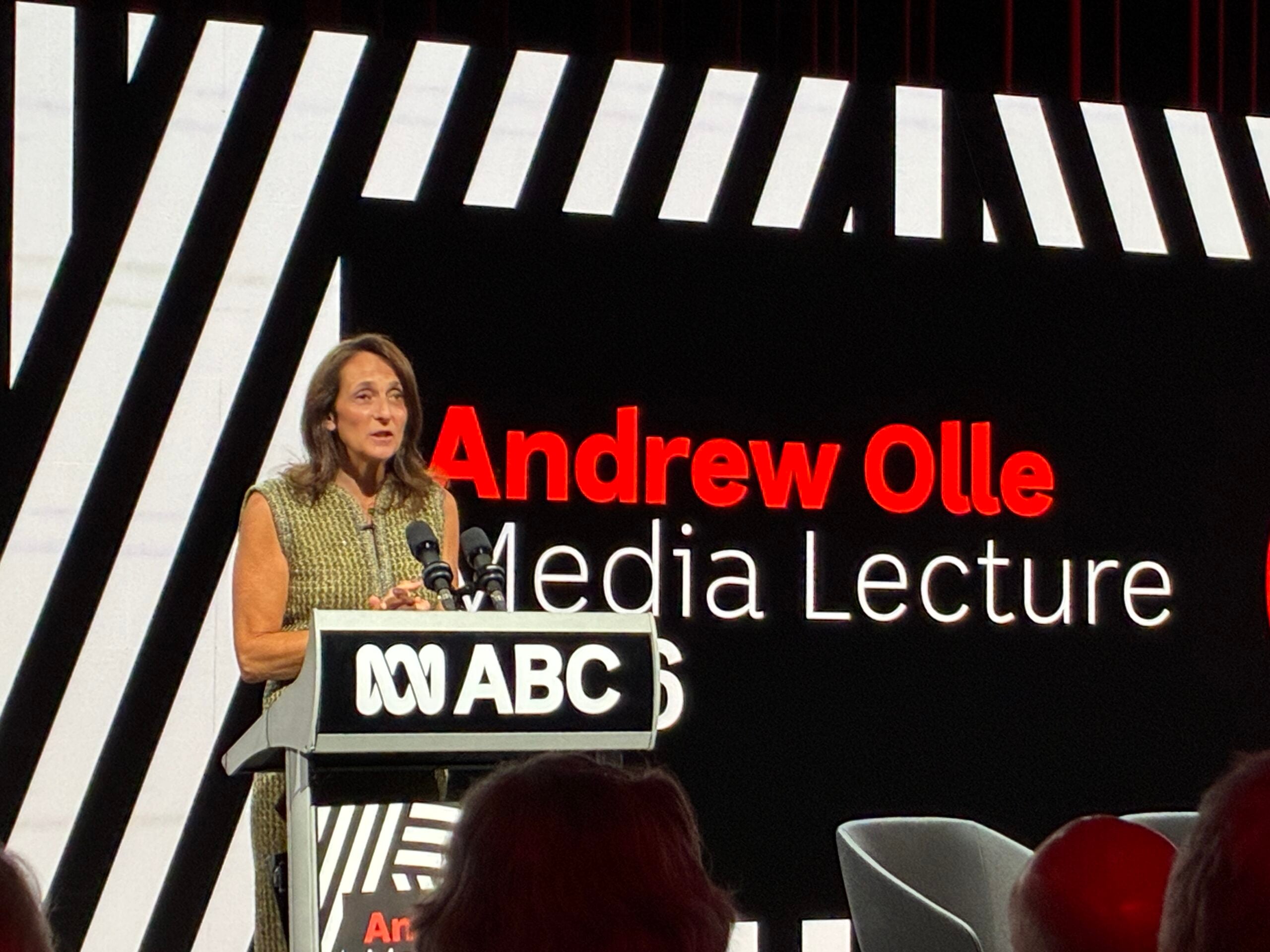
This year’s Andrew Olle memorial media lecture was delivered by the Editor-in-Chief of Reuters, Alessandra Galloni, who explored the future of global journalism.
After a historical view of Reuters’ 175 year history of reporting news, Galloni moved to a discussion of the news landscape today, outlining the threats from AI and algoirithms and the news principles upheld by Reuters and other trusted media organisations.
“There is abundant evidence that AI-generated content does not provide the accuracy users need. According to the Reuters News Institute, global trust in news is at 37 per cent. That, admittedly, is not great. But look at what happens as you move further from the source of the news:
- Trust in news reached via search drops to 32 per cent.
- Trust in news via social media drops to 22 per cent.
- Trust in news via AI-generated answers drops to 20 per cent.
“The further news travels from a human reporter, the less people believe it. The AI tech companies know it. AI companies themselves have acknowledged that original, high-quality journalism is disproportionately valuable for training and grounding their models,” she said.
After Galloni’s lecture, she joined a panel in the ABC Ultimo headquarters to discuss the issues she raised with ABC MD Hugh Marks, News Corp’s Michael Miller, SBS Managing Director Jane Palfreyman and Nine Entertainment’s Matt Stanton.
Here is Alessandra Galloni’s full speech.
Andrew Olle Media Lecture 2026
Good evening. It is an honour to have been invited to deliver the Andrew Olle Media Lecture — a forum that has for thirty years highlighted the crucial role of journalism in society. I am grateful to Hugh, Kim, the ABC and Andrew’s family for the opportunity.
Andrew Olle died in 1995 of an undiagnosed brain tumour at the age of forty-seven. Tragically, survival rates for the disease that took him have barely moved in the thirty-one years since. So I would ask you, at some point tonight, to give whatever you can to Brain Cancer Australia, the charity partner of this event. Andrew’s colleagues built this lecture as an act of memory. It is also an act of research funding. Both matter.
I am the first representative of a news agency to give this lecture. I note this, because it provides some context and – I hope – credibility to what I’d like to explore today: how journalism can stay relevant in the era of artificial intelligence.
AI is reshaping how we seek, consume and monetise information. Today, 10 percent of news consumers globally use AI chatbots to get their news. That is nearly 50 percent more than a year ago, according to the Reuters Institute Digital News Report 2026. Among people under 35, that figure is 16 percent – and these numbers are almost certainly undercounts, as they do not include AI-generated summaries in Google, embedded AI in news apps, or the AI your phone surfaces before you even open a browser.
There is growing anxiety over how AI will undermine journalism and journalists. The fear is AI companies will continue to expropriate the content we have worked hard to gather and use it to train their models, stripping us of our intellectual property largely without consent or compensation. And, as a result, the revenue that should accrue to newsrooms and the audiences we have built are instead going to tech giants – a plunder that will undermine original reporting into the future.
AG Sulzberger, publisher of the New York Times, lent a very eloquent voice to these fears in a recent speech in Marseille. He warned that tech companies are “hijacking the public square” leading to “a future where a crucial wellspring of a healthy society and a stable democracy — the truth, understanding and accountability provided by original journalism — continues to dry up.”
The NYT is leading a pack of news publishers that is taking legal action against the tech companies, pushing the courts to clarify whether large-scale AI training on journalistic content is fair use or infringement of copyright. The outcome of these types of cases will be relevant for all of us.
Some of these same publishers, in addition to news organizations such as my own, have signed licensing deals with AI companies for the use of our content. In parallel, countries are legislating how to protect intellectual property in the era of AI.
Your Prime Minister, Anthony Albanese, just last week said Australia would legislate standards that would preserve the creativity of this country’s artists and “the journalism that is essential to our democratic society”.
Clearly, the battle to define the relationship between AI companies and the media world is well underway. But there is still much to be settled.
And so, after two decades of battling the advertising drain of social media platforms and algorithms, the scourge of misinformation, and the slow creep of news avoidance, we now face a new, potentially existential challenge.
I would like to draw on the Reuters experience to suggest ways we can tackle this challenge. Three unique characteristics of news agencies are particularly relevant:
a) First, we have decades of know-how in licensing our news to other media organizations and businesses and protecting our intellectual property in the process.
b) Second, we are a font of factual, primary-source, first-hand reporting that powers a large part of the news industry.
c) Third, as a key foundation of the world’s news, dispatchers of millions of items of information every day, we must be involved in setting the gold standard for how to use AI responsibly in newsgathering.
Before we try to peer into the future, let me take you back 175 years. The creation of Reuters coincided with the advent of the electric telegraph. Our founder, Paul Julius Reuter, was born Israel Beer Josaphat in Kassel, Germany. He reinvented himself, moving countries, changing his name and his religion before he reinvented the way news was disseminated, setting up Reuters news agency in London in 1851 with a desire to be first. Some of you will have heard the story of the Reuters pigeons: forty-five of them carrying stock market prices between Aachen and Brussels, across a gap in Europe’s fledgeling telegraph line, beating the mail train by hours.
The less famous story, and the one I love, dates to April 1865. President Abraham Lincoln had been shot at Ford’s Theatre in Washington DC. In those days, news took roughly twelve days to reach Europe by sea from the United States. James Heckscher, Reuters’ correspondent in New York, or agent as our journalists were called in those days, arrived at the harbour with the news about Lincoln, but found that the last British mail steamer had already sailed. Undeterred, he hired a tugboat, chased the ship down, and threw his dispatch on board.
On the other side of the Atlantic, Paul Reuter had already worked to shave hours off the arrival of American news into London and the rest of Europe. From the existing London-Cork telegraph line, he had built a privately-funded extension to a village called Crookhaven, at the south-western tip of Ireland. As the steamer with the news about Lincoln came within sight of Crookhaven, a small boat of Reuters’ operators rowed out, grabbed the dispatch off the ship and wired it from Crookhaven to Cork and onto London. Papers in the UK capital had the news before the steamer had even docked.
A century and a half ago, Reuters had already understood the value of trusted news, of being first with that news and of assembling an infrastructure to get that news to people.
Today, our clients include broadcasters, newspapers and financial institutions around the world. We also have a direct-to-consumer business, in the form of our fast-growing, subscription-based website. But it is largely through our thousands of media clients that Reuters journalism reaches billions of people a day.
We invest in the hardest, most expensive part of the work — the origination — and we license it to the organizations that have the audience. Our north star is to offer access to fact-based, verified, independent reporting about the world, whether on our platforms or those of our partners.
Our trusted journalism has thrived for 175 years – editorially and commercially — as we have sold it, on our terms, to the people who need it, under conditions we set. We have done this with newspapers. We have done this with broadcasters. We have done this with terminals on trading floors. And we are doing this with Reuters.com.
So if a growing share of the world will now get their news via an AI system – a chatbot, an agent, an LLM-powered interface curated for individual use – then there is no principled reason we cannot sell our verified reporting to AI companies, provided it is:
* properly represented
* properly attributed
* properly compensated.
What does that mean?
In licensing deals with AI companies, as with other clients, we need to guarantee that certain principles are respected.
This includes ensuring that our clients do not alter the editorial meaning of our reporting – and demanding corrective action if it is. It includes demanding attribution. And it includes fair payment: our journalism should be licensed, not taken.
Our experience licensing to thousands of companies means we have a good understanding of the market value of our work and the contractual terms needed to protect it.
We have already applied this experience to all of our AI-related deals.
Our approach is rooted in a set of principles that was enshrined almost a hundred years ago. In 1941, in the middle of the Second World War, the British government applied pressure on Reuters to serve the national interest with what was essentially propaganda. Reuters’ owners refused to bow to that pressure. Instead, they restructured the company — selling it to a broader group of newspaper proprietors — and created principles that were to govern the agency from that point forward. Integrity. Independence. Freedom from bias.
The Trust Principles were not actually a mission statement. They were a defensive move designed to make sure that this particular news agency could never again be leaned on in the way it was in 1941. And to make sure these principles were upheld, a unique ownership mechanism was created: a single “Founders Share,” held today by an independent Thomson Reuters Founders Share Company, with the power to outvote every other shareholder combined.
Commercial arrangements Reuters has entered into since then — client contracts, partnerships, other deals— have been in line with these principles. And these principles are what guide my news organization in all our interactions with a government, a broadcaster, a financial institution – or an AI company.
Now, Australia has played a big role in our trusted reputation.
From 1947 until 2020 — seventy-three years — the Australian Associated Press was a co-owner of Reuters. AAP and its New Zealand equivalent were brought in as owners alongside the British newspaper associations six years after the Trust Principles were written. That means Australian journalism was, quite literally, part of what protected the independence of Reuters for the whole second half of the twentieth century and the early decades of this one.
Three illustrious Australians are part of this history too.
The chairman of the Thomson Reuters Founders Share Company for the past eight years, up until last December, was your very own chairman, Kim Williams. And I think you know Kim well enough to know how firmly he held my feet to the fire!
The CEO of Thomson Reuters, Steve Hasker, has firmly defended our adherence to the Trust Principles. In my time as editor-in-chief, he has never sought to influence or dissuade us from any area of coverage, even when Thomson Reuters’ own business has suffered from its association with our hard-hitting, independent stories.
The third Australian is Simon Robinson, my deputy and the executive editor of Reuters for the past few years, who will soon be your head of news. I know that, along with his sharp journalistic sensibility and deep experience in managing the Reuters newsroom, he will bring to the ABC the spirit of the Trust Principles.
I mention all of this not to be sentimental or fawning, but because it is a fact. When I stand here tonight and talk about what makes Reuters a trusted and independent news organization, I am talking about something that Australia and Australians have helped to build.
Being associated with this kind of trusted news, built over nearly two centuries, should be valued by the AI companies.
There is abundant evidence that AI-generated content — which by some measures accounts for more than 50 percent of overall online content — does not provide the accuracy users need. According to the Reuters News Institute, global trust in news is at 37 per cent. That, admittedly, is not great.
But look at what happens as you move further from the source of the news.
Trust in news reached via search drops to 32 per cent.
Trust in news via social media – to 22 per cent.
Trust in news via AI-generated answers: 20 per cent.
The further news travels from a human reporter, the less people believe it.
The AI tech companies know it.
AI companies themselves have acknowledged that original, high-quality journalism is disproportionately valuable for training and grounding their models. OpenAI has said it would be impossible to train AI models without using copyrighted materials in general.
I have spoken of how we think about our commercial relationships with clients. But as the editor of Reuters, my most important task is ensuring that we provide deep, original, fact-based reporting. This work is costly – in money and human terms – and most of it cannot be done by AI.
In my conversations with tech companies, I have often been struck by how little they understand about what original, first-hand, on the ground journalism is and looks like. And what it takes to produce this coverage.
* A photographer in a hospital in Gaza, under fire, taking pictures of bodies piling up in a makeshift morgue.
* A correspondent in a refugee camp on the Chad-Sudan border, speaking to the traumatized victims of a campaign of mass rape
* A reporter with a well-informed but reluctant source, seeking evidence and explanation of a corporate misdeed.
For a hundred and seventy-five years, Reuters – like The Associated Press, AFP, AAP and other wire services – has been in the business of being on the ground. In my news organization, we have a global network of 2,600 journalists in 165 countries, with the training, judgment, and access to report what is actually happening. Our journalists are a special mix of foreign correspondents and reporters in their own countries with their invaluable lived experience – of their heritage, their family, their community, their people, which informs their news judgement.
Original reporting, on the ground, costs money. Take Russia’s four and a half year war against Ukraine. We have 70 colleagues – text journalists, photographers, video journalists, technical staff and safety advisers – working in both Ukraine and Russia. Even as other news organizations left Moscow, we decided that it was important we stay to cover this conflict from both sides – as we have every war since the Crimean War in 1854-1856.
Here are some of our budget items:
* rental of passenger planes to evacuate more than 100 of our staff and their families from Kabul: hundreds of thousands of dollars.
* armored vehicles in Ukraine and elsewhere: 250K USD each
* safety gear including anti-ballistic vests: One million USD per year.
* electric generator for Kyiv and Baghdad – 50K USD each
* not to mention insurance for reporters in war zones
But this is nothing compared to the human cost:
Over the past five years, four of my colleagues have been killed in conflict zones while covering the news for Reuters:
* Danish Siddiqui, killed by the Taliban in Afghanistan
* Issam Abdallah, killed by an Israel Defense Force strike, in southern Lebanon
* Ryan Evans, killed by a Russian air strike in Kramatorsk, Ukraine
* Hussam al-Masri, killed by an Israel Defense Force strike on Nasser hospital in Gaza.
The dangers for journalists are not abating: Last year, 129 journalists and media workers were killed around the world, and 330 were imprisoned.
In just the past few months, three of our own journalists have been detained for questioning – in various countries and at times in shocking circumstances – for doing nothing other than reporting the news. There is little accountability from authorities for these acts against journalists: I have repeatedly asked for explanations and accountability for the deaths of our colleagues – and have received none.
Press freedoms are being curtailed via legal means, every day around the world:
* by leaders and governments who enact laws that criminalize reporting in the name of national security
* by bogus investigations into journalists’ private affairs or non-existent crimes
* by measures that punish journalists’ sources.
The U.S., where the flag of a free press used to fly high, has now become a minefield for reporters. As you will recall, early in the new Trump administration, the White House removed the Associated Press from official press briefings for refusing its demand to refer to the Gulf of Mexico as the Gulf of America. Since then, the Pentagon has restricted access to journalists. The administration has also changed rules governing how federal prosecutors can treat journalists when they are investigating leaks of sensitive or classified information from federal agencies, making it easier, for example, to subpoena documents or testimony from journalists. Just last week, the U.S. government subpoenaed New York Times journalists over a story about Air Force One.
For news organizations like mine, this isn’t about resistance or advocacy or political posturing – it’s about bringing people the facts. Holding power to account. Hopefully making the world a little better.
In 2025, we worked on a series of investigations that revealed how social-media giant Meta knowingly exposed users to harmful AI chatbots and profited from a torrent of fraudulent advertising on Facebook and Instagram. Among the findings, the journalists exposed how Meta’s internal guidelines explicitly allowed its AI chatbots to conduct “sensual” conversations with children. In response to the subsequent outcry after our story, Meta revised its AI guidelines to stop letting its bots engage in such conversations with kids.
Also last year, a group of our journalists investigated how President Donald Trump has used the formal levers of the US government and the informal rules of his mass following to exact vengeance on his foes and expand executive power. The reporters documented at least 470 targets, from federal employees and judges to universities and media, in a series we called The Revenge of Donald Trump.
Both series won us Pulitzer Prizes, and I raise them because they both held power to account – in this case, government and big corporate power with first-hand, primary-source, on the ground, painstaking original reporting.
AI can be a powerful tool – a force multiplier – in this crucial endeavour. But we have to use it responsibly.
AI is helping our reporters work faster, identify patterns, connect the dots in the reporting. In the revenge series, for example, the reporters used AI to build databases of thousands of media posts to document how the president and his allies targeted their retribution campaign against people. AI was also used to mine transcripts of Trump’s speeches and orders – and the writings and comments of his top appointees – for evidence of the political motivations behind the administration’s threats and punitive acts.
In a separate investigation last year on the fall of Syria’s Bashar al-Assad, a team of our journalists in Damascus, Beirut, Cairo, London and Toronto employed AI tools to turn 20,000 pages of photographed documents into searchable texts – a trove of information that helped us reveal the existence of a mass grave – and the men behind it – that was at the heart of a campaign to conceal atrocities under Assad.
In this kind of multi-faceted reporting work, AI is now one of many tools in a journalist’s toolbox.
Our newsroom uses AI in other ways too – helping us to distill information from press releases, speeches and other official documents and then provide it to financial clients and other audiences.
For example, we can produce headlines from a press release in seconds with a tool called Factgenie; we can draft the first, urgent paragraph of a breaking news story in under a minute, and we can have a multimedia package and a half-dozen translations just moments later. We also use an AI tool to generate bullet point summaries at the top of stories – this is useful for many audiences, from the casual reader to the fast-moving trader.
While reliability is improving at warp speed, mistakes still happen. Hallucinations can be serious. Recently, a third-party AI tool we tested to apply key words to pictures mistook a SpaceX spaceship for a missile. We thankfully caught it. AI models in other newsrooms have falsely reported the deaths of living people and invented headlines.
This is why we do not publish without human checks.
And the reason is not just accuracy. Our experience is that AI tools are great at finding news, but struggle with context, nuance, prioritization – essentially, news judgement. So, in a central bank communication, for example, AI is likely not to capture the significance of a dove making hawkish comments.
Which, of course, is why experienced journalists doing original reporting remains so crucial!
And this brings me to the question of how we ensure that AI is used responsibly in the newsroom.
Let me give you a sense of how we apply AI guardrails and governance structures at Reuters.
In broad terms, these are the principles:
* Our journalists are responsible – and fully accountable – for everything we publish, just as they have always been.
* When AI plays a foundational or defining role in what we publish, we disclose it. We leave no ambiguity about how, when and why we use AI.
• Use of AI does not change our longstanding practice of correcting mistakes. When we publish an error, we must correct it quickly and openly.
We also have three levels of oversight, with checkpoints at each level:
• Editors, reporters, and AI tool creators assume full accountability on a day-to-day basis for how tools are used and for their quality and accuracy.
• A review committee monitors, tracks and evaluates experimental tools and workflows, ensuring they adhere to our Trust Principles.
* An AI governance committee, presided over by me, makes final decisions on whether tools meet Reuters’ standards for trust, safety and responsible use. If they don’t, the tools may be paused, changed or scrapped.
I would like to end with a thought about what we all can do, collectively, to protect our journalism in the face of new challenges. We owe it to our audiences. We owe it to our clients. And we owe it to the AI companies that are now paying us for our content.
News organisations are, of course. competitors. That is healthy. Nine and Seven and the ABC and the *Herald* and *The Australian* compete every day, and the country is better for it. Reuters competes with Bloomberg, with the Associated Press, with Agence France-Presse, with virtually every major newspaper and broadcaster in the world at some level, including our clients. Competition is how journalism gets better and thrives.
But there are things we do not compete on: We do not compete over the safety of our journalists. When one of our reporters is in Kyiv or Khartoum or Gaza City, and a reporter of another news organization is in the same street, our security teams talk to each other. We share what we know about the threat, about safe corridors, about medical evacuation. We do this because the alternative — hoarding information about how to keep human beings alive as a form of competitive advantage — would be unconscionable, and because we have learned that shared knowledge about how to operate safely in dangerous places is worth more than any individual outlet’s competitive edge.
A Volvo engineer invented the three-point seatbelt in 1959. It was one of the great consumer-safety advances of the 20th century. But instead of keeping the patent and the profits to itself, Volvo let the rest of the industry use the invention for free. It was a boon for public safety, and for the industry as a whole.
AI is still a very nascent technology. Our use of it is too, as are our partnerships with AI companies. We are navigating uncharted waters.
So what I propose to you all, as I come to a close, is that there could be a benefit from sharing openly what we all are learning every day about how to use AI responsibly in our newsrooms – and what are best practices.
How we caught an AI-generated fake before it aired. Or how we noticed a synthetic voice on a source’s phone call. Or identified a coordinated campaign to seed a false story into a search index. What our governance committees are learning, quarter by quarter, about what the machines can and cannot yet be trusted with. I would venture that it is our collective responsibility – to the public, to society – to enhance our and their understanding about the pitfalls and possibilities of AI.
Many of the challenges for news organizations in the era of AI are crystallizing. There are legal, regulatory and technological challenges. But, for us, this is also a challenge of imagination. What will a trusted, sustainable, global news organization look like in an era of agentic AI?
Hopefully, I have provided some insight into how we are imagining this future at Reuters.
The 2025 Andrew Olle scholar Madi Chwasta spoke after Alessandra.