
Jen Seyderhelm is at Radiodays Europe, being held from March 22-24 in Riga, Latvia.
The Daily, a podcast from the New York Times, was launched as Donald Trump started his first term as US President, in January 2017. It began as a weekday podcast, hosted by political journalist Michael Barbaro, making sense of the biggest story of the day, or stories.
By August that first year it neared 4 million listeners. In 2024 it was Apple’s most popular show on their platform. Midway through last year the podcast affiliated with ARN iHeart for its sales representation in Australia and thus appeared on the Triton Australian Podcast Ranker. It usually sits in the top 10, with a million monthly downloads here. In the most recent ranker it was #10 and the only international podcast in the top 20.
From a starting team of five, The Daily has grown to a staff of 40, with now two other hosts, Rachel Abrams and Natalie Kitroeff, sharing the load with Barbaro. Also part of the legacy is Sabrina Tavernise, who was the first cohost, joining The Daily when Russia invaded Ukraine in 2022. She has subsequently chosen to return to her NYT reporting role.
This introduction serves a purpose similar to the values of The Daily, who consider themselves a narrative news media with characters, plot, tension, and stakes. The podcast cares to explain the situation to its listeners, rather than assuming knowledge, and have built loyalty and trust, which is why the Inside the Daily session at the largest of the venues at RDE was packed with attendees, fascinated with the inner workings of the show.
The discussion was with Supervising Producer and Editor Rachel Quester, who has been with The Daily from the beginning, with Sam Bonham, Senior News Editor for the BBC, asking the questions.
Quester is an extraordinary communicator with the gift of broadening the conversation, rather than preaching to the converted.
The early days saw the Daily follow more than one story each episode with the aim to be the audio version of the NYT front page. Now just one major event is fleshed out with The Daily team editorial meeting every morning asking themselves, ‘are we meeting the moment?’ and ‘this moment deserves explanation.’ Then the host and team of usually two producers and editors set to work.
The key inflection points are:
- What is the story?
- What are the stakes?
- Why does it matter?
- What happened?
- Who are the players?
- Three key moments that led to this?
- What is I saw it from this perspective?
- What are the key takeaways?
From there around to hours is spent figuring out the structure and how the story will unfold, a process that has gotten easier over the years, but with the expanded team, Quester said that the ambition of the show grows too.
Bonham had asked Quester to provide him with an image that summed up The Daily. It is below:
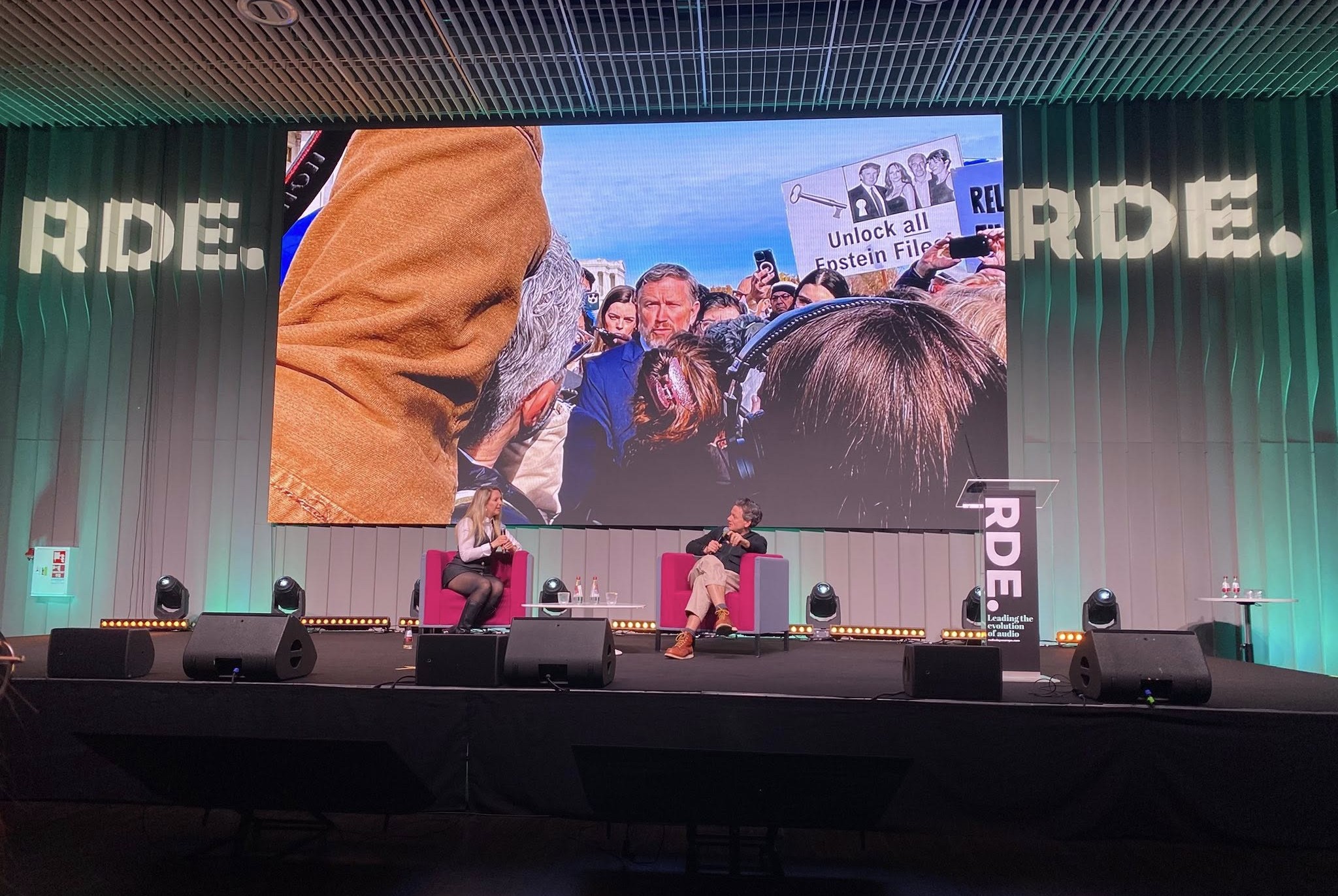
Quester apologised for the poor quality of the picture, taken by her, saying it was from deep in a media throng trying access US Republican politician Thomas Massie, in the blue suit. Michael Barbaro is the head of hair in front of the camel jacket and would get a one-on-one with Massie later that day. Barbaro and Quester had gone to the House of Representatives at Capital Hill to speak with Massie, vocal in his criticism of Trump, towards efforts to release the Jeffrey Epstein files. Quester said that the team tries to be out in the field as much as possible and it showed them actively ‘documenting the day, but also the moment.’
Bonham asked whether The Daily gets tired of all the Trump talk and focus?
Quester’s response here was fascinating. She said that in Trump’s first time the mantra was ‘take him figuratively, not literally.’ When he was returned to office this time, and audio was played from that night and morning as the results became clear, this time the focus is what he says he’s going to do because he now has the people (and lack of inhibitors) to make it happen. And it does happen, so the team is chasing that story from the moment the words leave his mouth.
Additionally, after a spate of shootings in Indianapolis, The Daily wanted to explore people who now regretted their Trump vote, but with the additional thought about why some had voted for him in the first place. One man’s frank response was:
“I was asked over the last three elections to choose between eating my own shit or drinking my piss. I chose to drink piss.”
However, The Daily too always looks for other stories that affect people globally. One was that tipping culture in the US is getting up to 30%. There was a thrum in the room of acknowledgement as well as astonishment at this hike. Sunday episodes too are a relief and focused more on culture and understanding the world around us.
The final question Bonham asked was around The Daily’s video strategy. Video strategy has been a theme of this conference as a whole. The Daily has some video round table podcast episodes, but Quester finds them a challenge because of how quickly episodes need to be produced and video’s editing timeframes. She was also aware of people’s increasing desire for optionality in their news consumption and concluded praising audio’s nimbleness, providing the easiest way to meet the moment.
See our other reports from RadioDays Europe:
“Like making mayonnaise” – Radiodays Europe explores the dynamics of an on-air duo RDE26