

AI companies have been falling all over each other to gather an audience as quickly as possible for their artificial intelligence tools.
Now that they have scale, they want to monetise their users.
First came limits on free tiers, then subscription usage plans, but that has not yet generated enough money to pay for the huge cost of the investment and operating costs of AI tools.
So advertising is coming.
OpenAI has launched ChatGPT Ads in Australia this week, with open auction, CPC bidding and pixel-based conversion tracking. ChatGPT says “ads may appear for users on the Free and Go plans. Plus, Pro, Business, Enterprise, and Edu accounts will not have ads.”
ChatGPT says ads will not affect the information given to questioners by the AI: “Ads do not influence ChatGPT’s answers.” For how long?
ChatGPT says: “Ads run on separate systems from our chat model, and advertisers have no ability to shape, rank, or alter ChatGPT’s responses. Ads are separate and clearly labeled.”
Radio and podcast businesses will face several challenges as AI Ads increase. The first will be another advertising platform taking ad revenue from the broadcast market. The second will be click theft – AI tools will deprive radio and podcast websites of traffic because the tools will attempt to keep questioners inside their own ecosystem, rather than sending them to the original source of the answer. The third challenge will be for radio and podcast businesses to learn to use Generative AI to their own advantage to bring credibility and traffic to their own businesses, without paying too much to the AI companies.
After a couple of years, AI has shown that it is good at searching and at consolidating multiple sources into a few coherent paragraphs. But is has not proven itself to be selective about the sources it quotes, often leading to a faster spread of misinformation. It is also not good at admitting when it can’t find answers, so it often makes them up.
But the idea is, build it and they will come.
About 600 million people globally interact with Generative AI chatbots and code assistants each week, and you can more than double that figure if you include integrated AI tools such as predictive text, recommendation algorithms and search overviews.
And they have come. Google’s AI told me:
The weekly active usage breakdown across the main standalone AI brands and platforms is as follows:
- ChatGPT: OpenAI’s platform dominates the market, reaching 900 million weekly active users.
- Google Gemini: The primary search-backed competitor sees significant consumer engagement, capturing roughly 15.1% of enterprise and business web traffic for generative AI.
- Microsoft Copilot: Integrated into the Windows ecosystem, Copilot’s standalone usage hovers around 20 million weekly users.
- Anthropic (Claude): Experiencing massive growth in the professional and consumer sectors, Claude holds roughly 30 million monthly active users.
But I didn’t believe it, because I could see that the American based Google AI tool had left out its Chinese competitors. So I generated another prompt: ‘include Deepseek and any other non American AI tools as well.’ Then I got a much more believable answer, that also included:
- Doubao (ByteDance – China): 155 million weekly active users
- DeepSeek (High-Efficiency – China): 81.6 million weekly active users
- Ernie Bot / Ernie Assistant (Baidu – China): 50 million active weekly users
- Tongyi Qianwen / Qwen (Alibaba – China): 25 to 30 million weekly users
- Kimi (Moonshot AI – China): 10 million weekly active users
But the Google AI tool still wanted to exclude its competitors from a full table telling me, “tech ecosystems” are excluded because “the vast majority of their weekly users interact with them via built-in system layers rather than direct, deliberate chatbot prompting.“
So I told the sneaky AI chatbot to put them back and display a complete table. Here’s the result.
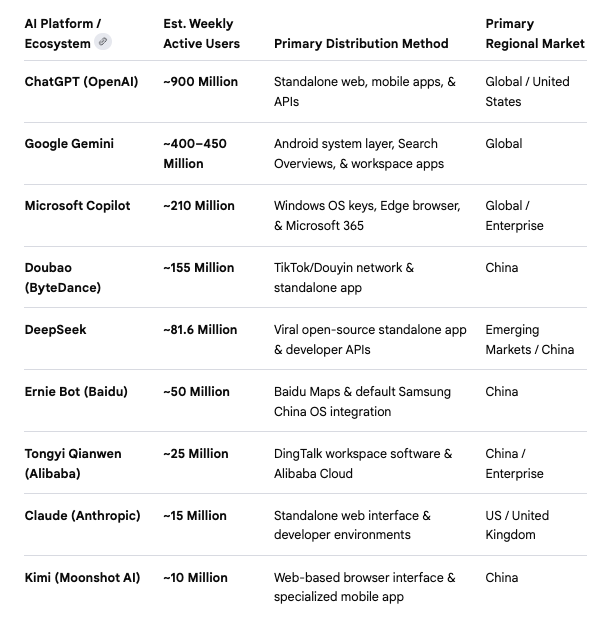
We need to understand how Generative AI works, then strategise how we use it and how we compete with it. The tools are continuing to evolve and lots of people like to use them, so we can’t ignore them.
Analysis by Steve Ahern