
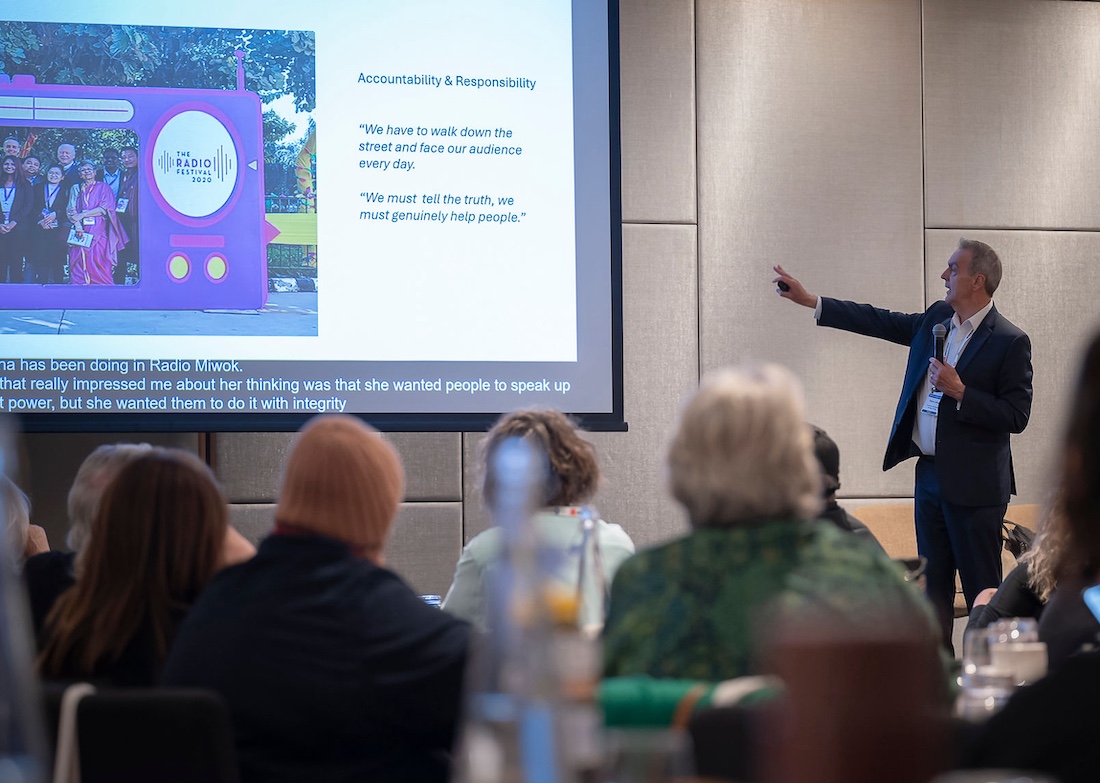
“Community broadcasting is important for empowerment, strengthening society and giving people a voice,” said Steve Ahern in a CBAA Conference session titled ‘5 Things To Learn from Community Radio Abroad.’
Drawing on his international experience, Ahern took conference delegates on a trip to India, Afghanistan, South Sudan, Ireland and other countries to give them insights into the media beyond Australia.
In India, he told the story of Archana Kapoor, the founder of Radio Mewat, a community station in the northern Indian state of Haryana. The station empowers women to develop confidence in their public voice and to use the power of radio for the benefit of their disadvantaged region.
“With power comes responsibility, take your role seriously,” said Ahern, quoting Archana’s advice to broadcasters: “We have to walk down the street and face our audience every day. We must tell the truth, we must genuinely help people.”
Fighting misinformation has become an important task for many broadcasters around the world. “Inoculating your audience against fake news is an important role that trusted broadcasters can play,” said Ahern. He gave examples of regular segments on air that correct fake news, such as a daily ‘weather forecast’ of the fake news ‘storm level’ today, fake news quizzes and a station that has a fake news ‘confession booth’ segment where people confess that they spread fake news and then publicly correct it.
In an example from his work in South Sudan, Ahern talked about the important role Eye Radio plays in countering hate speech and racial violence by telling people’s stories and educating people about the motivations behind using hate speech to divide society.
“If you can dehumanise a whole segment of society then it is easy to mobilise people against them, but if you use the radio to hear everyone’s stories and get to know people, even people who are not like you, then it is not as easy to hate them or attack them once you know them better.”
A United Nations report recently summarised thne situation in South Sudan, saying: “South Sudan has a history of mass atrocities, and despite a peace agreement in 2018 ending a brutal civil war, structural risk factors for atrocities remain. The return to fighting in January 2025 between the Sudanese People’s Liberation Movement (SPLM) and the SPLM In Opposition (SPLM-IO) and a political breakdown at the highest levels of government have created a very dangerous situation.”
Afghanistan has long been a difficult country for media. Ahern spoke about the success of media skills training at the Nai Media Institute, developing local broadcasters to bring open media broadcasts back on air. He also spoke about the situation now, where many radio stations have been closed down under the Taliban regime and restrictions are placed on broadcast content. “In media dark environments there is no voice for the people and very few ways of holding people in power to account.”
Highlighting the AI language preservation work of Peter Lucas Jones in New Zealand, he commended the innovative way Te Hiku Media is preserving Maori languages in a way that keeps them under indigenous control without unlocking them to AI scraping from international large language models that could “colonise” Maori languages.
Finally Ahern drew parallels betwene Ireland and Australia, where there is a strong local radio presence and trusted personalities are closely connected with their audiences. “In these countries media helps stabilise the political and social environment… both Australia anad Ireland had stable elections recently thanks, in part, to the role of media in supporting reasoned political arguments, factual reporting and respectful political dialog.”
“Responsible media can balance the negative divisive effects of social media, you are part of something bigger than just your own show or your own station. You play an important role in your community and Australian society,” said Ahern.

Steve Ahern is the publisher of this trade journal.