

This is the fourteenth in a series of interviews exploring the career and life journey of women in the media industry. The aim of the series is to reflect on the wisdom they have gained during their journey.
So far we have had a cross section of women in different roles and career stages: Lauren Joyce, Laura Bouchet, Cathy O’Connor, Megan Smith, Kim Napier, Amanda Lee, Jacquie Riddell, Helen Tzarimas, Rebecca Ackland, Cheryl Lee, Manpreet Kaur Singh, Justine Kelly and Lizzie Young.
This week we profile, Archana Kapoor who had a successful career as an administrator for one of India’s largest oil companies, before becoming a film maker, then Founder/ Director of NGO, SMART and Radio Mewart in India. She is a passionate advocate for the transformational power of community radio, embedded in the fabric of the community.
1. Describe your current professional life and your stage of life.
I am the Founder of SMART (Seeking Modern Applications for Real Transformation) and of Radio Mewat 90.4 FM in Haryana. My professional life today is devoted to building SMART and its vertical, Radio Mewat, into a future-centric learning platform that equips and upskills rural journalists, local influencers, frontline workers, and community-based practitioners. The aim is not only to strengthen their ability to communicate urgent issues of governance, health, education, gender, and climate change, but also to help them imagine and shape better futures.
My next five years will be devoted towards keeping Radio Mewat alive as a vibrant space for local voices — a space where concerns, fears, and achievements can find expression.
I see myself at a stage where the focus is no longer only on the work we began years ago, but on mentoring, advocating, and enabling the next generation to meet the demands of changing times without losing sight of community-centric conversations.
2. How did you come to be in this industry?
It was never a childhood dream to start a radio station. In 2007–08, when the Haryana government abruptly stopped working with NGOs, SMART’s programmes across a hundred villages in education and livelihoods collapsed overnight. The fear was immediate and real, that all the good work we had done with communities would disappear, that the fragile trust we had built would be too much to rebuild, that once again both we and the communities would be pushed into the cycle of uncertainty dictated by grants and monitoring frameworks. There had to be something more permanent, something that would not vanish when funds dried up, something the community could take ownership of and carry forward themselves.
Around that time, I discovered that the Government of India had opened the community radio licenses to non-profits. The idea of a station felt just right — a medium that could survive irrespective of donor cycles, and one that the community could truly claim as its own. I applied, and in 2008 SMART received the license for Radio Mewat. By 2010, we were on air. What began out of necessity quickly became conviction. An accident became destiny.

3. What are your core beliefs?
At the heart of my work is a simple conviction: if you invest in communities, they will stay with you, grow with you, and fight alongside you. Community radio is the medium that makes this possible. It is not a one-way broadcast; it follows a circular loop that no other medium does. It is a “here and now” tool that speaks directly to its people. Because it is credible and embedded within the community, managed and shaped by the community itself, it carries an authenticity that cannot be manufactured.
Radio is about conversations, and conversations demand listening. They allow us to accept another’s view, to dissent, and to practice tolerance — qualities essential for any democracy. Democracy cannot function if people are unheard. In India, the gap is stark. We live with deep information asymmetry. Many stories never make it into the mainstream, particularly the stories of rural communities who feed our cities but remain missing from our narratives.
This is why access to credible information, the right to speak, and the ability to participate are as vital as food and shelter. Digital media can create influencers, but community radio can influence lives and behaviours in ways that are lasting. It is the only community-owned and community-based medium that can challenge patriarchal structures, provide hope when systems fail, and give people the confidence that their voice matters.
Unlike the isolation of digital feeds, radio remains a place of belonging — where listeners gather around a set, talk back, debate cricket scores in tea shops, and solve everyday problems together. Long before the internet, it was India’s original social network. Its potential is vast, and we have only begun to tap it.
4. How did your education enrich your career and life journey?
My journey has been nothing short of a roller coaster. I trained as an economist and began my career as an administrator in one of India’s largest oil-producing public sector companies. It was secure and respectable but I walked away from it. I turned to filmmaking, and the more stories I documented, the more deeply they began to live inside me. What started as a profession became a calling, and alongside it I created my own non-profit. For years, films helped me fund this second love, until it became my first and only one.
Informally, my truest education has come from the villages of Mewat themselves — from the struggles, stories, and lived realities of the people who inhabit them. Their resilience, their resistance, and their generosity have been my textbooks.
My mentors were not just colleagues in the development sector but also the community leaders and women who, in the face of lynchings, systemic discrimination, and suffocating patriarchy, still chose courage.
Equally important were my detractors — including government officials who once threatened to pull down our antenna. They too became teachers, forcing me to stand my ground and sharpening my resolve to uphold democratic values.
The struggles continue, the battles continue, only the battlefields keep changing.
5. What were some key decision points and how did they shape your journey?
The choices that shaped my path have always come at moments of risk.
In 1986, I gave up a coveted, stable government job to pursue documentary filmmaking, believing that my camera could become a bridge to people’s realities.
In 1997, I founded SMART to give back to society in a structured way.
By 2003, I decided to fully step into the social sector, allowing films to fund my passion but letting my work be grounded in communities.
In 2008, I decided to move from donor-driven dependence to independence by starting a community radio station.
A defining moment came when the first Meo woman joined Radio Mewat after two years of operation. Supporting her through intense family opposition until she found her voice, and later seeing her contest Panchayat elections, was proof of what media empowerment truly means. The pandemic years reaffirmed radio’s centrality as a credible, local information lifeline.
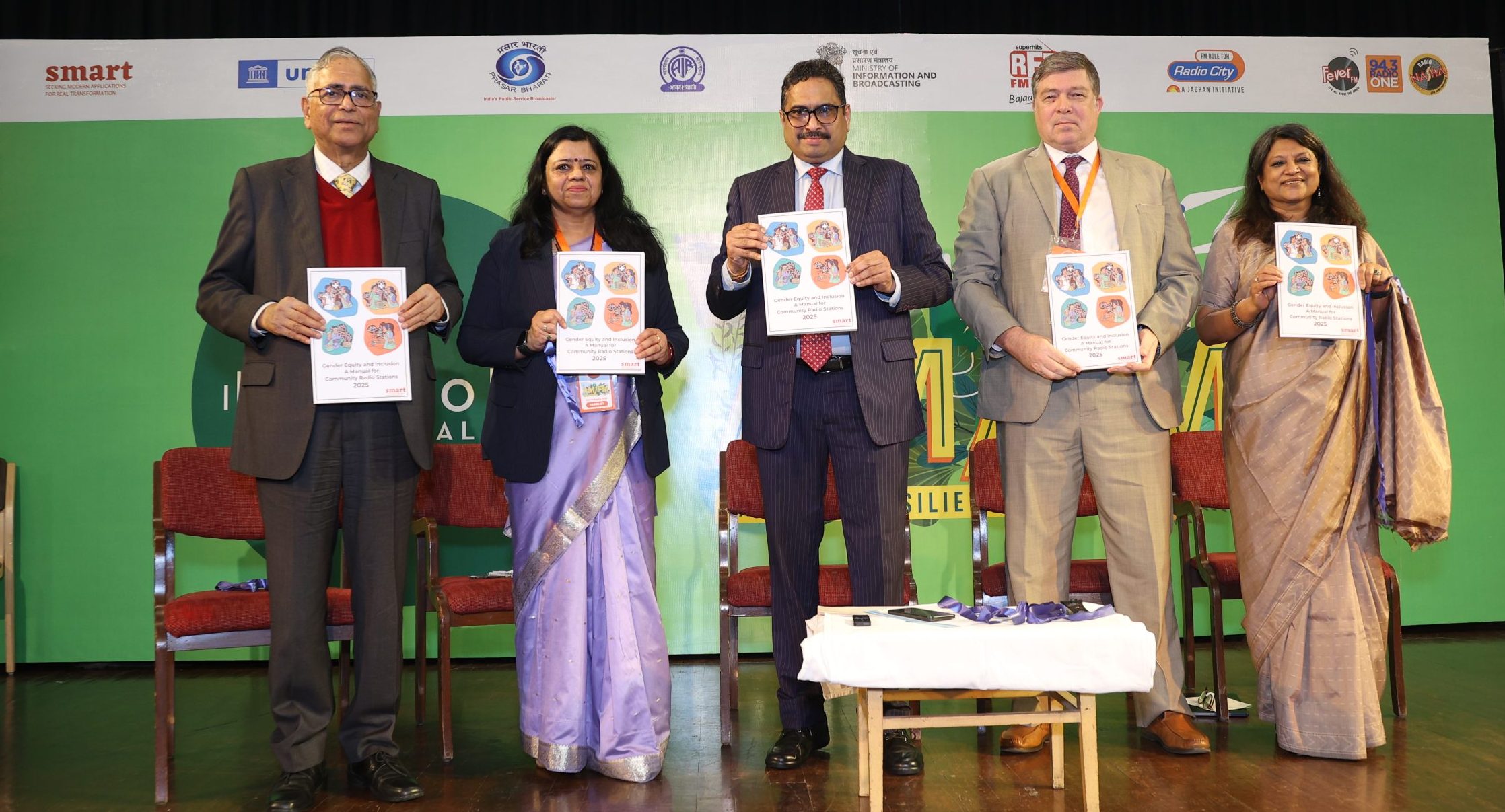
And in 2021, I shaped SMART into an umbrella organisation with a mission to support community radios across the country.
6. What makes you happy? What makes you get up in the morning?
What gives me joy are the everyday victories that radio seeds in people’s lives. It is the widow who finally receives her pension because she heard our programme, the child who learned through our radio tuition classes, the villager who realised he had been sold expired medicine, the young girl who dared to speak on air. It is these small but significant changes, the daily proof that our work makes lives better, that give me the energy to begin each day.
7. Share your words of wisdom for others in the industry.
My only advice is that community radio should never be treated as a tool for broadcast alone.
It is a tool for community engagement; it must be treated as a medium to build trust, communities and lasting relationships. It is not a medium to push your agenda- but the collective agenda of the community to serve. Technology will evolve, but trust remains timeless.
Community media does not thrive because of money; it thrives on mutual respect, on the ability to listen and allow diverse voices to be heard. In this sector, you may not see immediate results, but you must believe in the quiet unfolding of impact. Build with and for communities, because they are the ones who will stay, grow, and fight alongside you.
8. Describe your vision for the audio media industry in the near future.
The future of audio is hybrid. It lies in the intimacy of radio, the flexibility of podcasts, and the reach of digital. But podcasts and digital platforms must learn from community radio: don’t talk at people, talk with them. The feedback loop is the future.
If I speak only of radio, then I see the future in hyper-local, participatory, and credible media. Community radio is not just entertainment; it is disaster response, it is civic education, it is women’s empowerment.
I envision a day when every marginalised community has its own station, its own mic, and its own power to question, to create, and to hope; when women are at the decision making table, when they shape the narrative and when their voices and views are visible on air and off air.
9. What role would you like to play in shaping the future of the audio industry?
I see my role as larger than simply running one station or supporting a network of 300 others. My role, as I understand it, is to use the goodwill, trust, and wisdom I have built over the years to push for policy changes that strengthen the sector. This means advocating for the right of community radios to broadcast news responsibly, and resisting pressures to carry government-driven content or agendas that dilute their independence.
For me, community radio must never lose sight of its core mandate: to remain rooted in the community. I speak only for community radios, and my commitment is to ensure that the sector remains inclusive, diverse, and sustainably funded. My work will continue to be about building bridges — between communities, donors, and governments — so that community voices are not pushed to the margins but remain central to our democracy.
10. Is there anything else you’d like to add?
If there is one truth I have learned, it is this: media can either exclude, or it can empower. Community radio chooses empowerment. It really listens to those who are invisible in mainstream narratives.
Radio has never been just a medium. It has always been a movement, a social network of belonging, and a bond that carries communities forward. That is the legacy I want to leave behind.
Series compiled by Serena Ahern for radioinfo.
If you have a suggestion for someone to be considered for this series, please send a note to [email protected]
Previous articles in this series:
Wisdom of Women in Media: Justine Kelly, Manager Audio Output & Strategy, ABC International
Wisdom of Women in Media: Manpreet Kaur Singh, SBS Audio Program Manager
Wisdom of Women in Media: Cheryl Lee Co Founder and Manager Rebel Radio Network
Wisdom of Women in Media: Rebecca Ackland Chief People & Culture Officer SCA
Wisdom of Women in Media: Helen Tzarimas News Reader and Journalist Gold 101.7
Wisdom of Women in Media: Amanda Lee, Head of HIT Metro Content/Fox FM Content Director
Wisdom of Women in Media: Kim Napier, Breakfast Presenter ABC Northern Tasmania
Wisdom of Women in Media: Megan Smith, Senior Producer Gold 101.7
Wisdom of Women in Media: Laura Bouchet, Content Director Triple M
Wisdom of Women in Media: Lauren Joyce, Chief Audience & Content Officer ARN