
The 10th edition of the Digital News Report: Australia made for interesting reading.
SBS just pipped the ABC as the most trusted news provider, heavy news consumers are the most likely to be similarly invested in podcasts, people trust news less and don’t like to pay for news but online news subscriptions still increased in Australia.
When it comes to content, people are most interested in listening for local news, as you can see in the Report’s graph below.
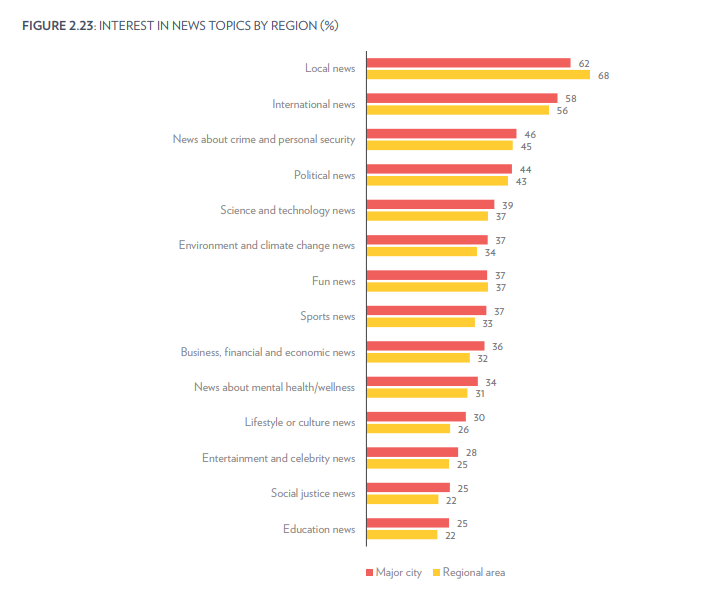
What is missing from this graph is the distinction that I think occurs in all radio newsrooms between local and national news. I would be very interested in a survey of listener interest across local, national and international news and certain stories that might straddle all three.
A current and very topical example of this is the release today of Julian Assange. An international story with its ties to the US and UK, national in that he is returning home to Australia after five years a prisoner, and then perhaps, in Townsville where he was born and attended school, or via interviews with his family, there’s a very local angle as well.
By lumping local news all in one category you are putting a car accident that blocks the Bruce Highway in Brisbane alongside MONA in Tasmania hanging Picasso in the toilets. The MONA story would catch my ear wherever I lived. As I’m nowhere near the Bruce Highway that hyper local and relevant story would not.
Living in Canberra our ‘local’ news is often headlined by the national bubble we live within, like yesterday’s announcement by Prime Minister Anthony Albanese that former NSW Liberal Matt Keen will head up the Climate Change Authority after only resigning last week. All it takes is some sort of tag that says, “the Prime Minister made the announcement from Canberra” and the story can tick political, local and national news boxes.
By contrast the CBAA posted this support of local news to Facebook today:
As the live radio reach of community stations tends to sit within the boundaries they represent, unless you are listening online or streaming, news featured on such stations will skew towards the very local. Xtra Insights surveys in the last six months of Campbelltown on the outskirts of Sydney, and Ipswich on the outskirts of Brisbane, also seem to indicate that local news, talent and community focus trumps the bells and whistles of the metro down the road (with the exception of Kyle and Jackie O in Campbelltown).
Kyle and Jackie O are making the case this year that a radio show can aspire to be national, not local. They’d look at stories, like MONA’s toilet art, that transcend Tasmania to become part of a national conversation. Sometimes the angle on local stories that go big have backfired on radio presenters (Arj Barker ejecting a mum from his comedy show immediately springs to mind). Similarly, something that starts as a local missing persons story can snowball into a national true crime exploration, like ‘missing campers’ Russell Hill and Carol Clay in the Victorian Alpine region.
Radio’s great strength in news coverage is the immediacy of local news that impacts where you live. Last weekend a man tried to abduct a woman near my home. I heard on the radio he’d been arrested before I read or saw this news anywhere else. This crime and personal security update (a separate category in the topics by interest graph above but surely also considered local news too) preceded Matt Keen’s new appointment in the bulletin.
While I get most of my hyper local news now from social media, the response, to ‘incidents’ like that recent abduction, by police, local government, members of the community, etc, I still mostly obtain from radio.
The distinction between news that is local, national, international or a combination thereof is more complicated than listeners ‘being most interested in local news’. Even when it comes to sports are you listening for your local club results? AFL results? Or who won the Euro match overnight?
I’d be very interested in an additional study of what people are most looking for when they turn on the news and whether the graph above includes how many of these genres cross over depending on where you live.
What do you listen to news for?
Jen Seyderhelm is a writer, editor and podcaster for Radioinfo.
The author makes valid claims about the mix of local, national and international news and the relevancy of local news outside the target audience's market area.
The author makes a valid claim about community radio's contribution to relevancy to a smaller area of listeners.
My observations as a consumer of media are that the news bulletins are shorter than ever.
For example, in the 1980s, 2GB and 2UE had a half hour bulletin at 1200. 2GB had a ine hour news session of local, national and international news.
In addition, 2GB had a half hour news bulletin at 1700 and a 10 minute bulletin at 0700 and 2200.
Today, that's been cut to a three to five minute bulletin on the hour.
The issue then becomes what are the relevant items to include in a three to five minute bulletin?
In addition to the news bulletins, what is the depth and breadth of news that is discussed on air in addition to the hourly news bulletins?
We are served with a variety of services on the ABC, commercial and community.
On top of that the consumer has access to views via social media that is not on the ABC, commercial networks and community.
By social media, I refer to "views" on websites, YouTube, Rumble, X and Facebook.
I stress the words "views" which are opinions made by the presenter. The same could be said that the established media have presenters who express an opinion.
The views expressed by presenters on social media are varied.
On one hand you have educated people on YouTube expressing eloquently the reasons for what is happening in the world such as "The Duran" at https://www.youtube.com/channel/UCdeMVChrumySxV9N1w0Au-w.
For conservative views and the disparity of aspirations between the government, the "rulers" and the governed, you have Dr. Steve Turley, https://www.youtube.com/channel/UCCsiAKRKcgzA_372WbXNBaw .
On the other hand, there are opinion makers on other channels on rumble whose views may make you puke, especially those with anti-semitic and other racist explanations of why the world operates.
It's like the propaganda in 1930s Nazi Germany.
One opinion maker not only is anti-semitic and a flat earther but believes he's the reincarnation if JFK!
Thankfully one can change channels or switch off!
There are also lots of crazy people on social media with non-evidenced-based treatments for ailments.
In addition, some of the products advertised on social media particularly rumble are dangerous which produces toxic carbon monoxide such as a portable indoor furnace.
In the end there is so much time that can be allocated to local, national and international views on the ABC, commercial and community stations.
The views on social media can be "sensible" and offer views not broadcast by the established broadcasters, but may make you puke.
Thanks
Anthony, of level-headed don't take everything to heart, Strathfield South, in the land of the Wangal and Darug Peoples of the Eora Nation