

With radio taking up most of the media attention of late, some significant podcast moves and developments have flown beneath the radar. Also, based on whole days of programming devoted to the craft at the final SXSW Sydney and at the recent RadioDays Europe, podcasting had passed through its infancy and teenage years to become a fully functional contributor to the audio community.
I thought it was time for a nuanced look at podcasting in Australia now, with some guidance and tips for the audio creator in 2026.
I’ve taught Podcasting Fundamentals for seven years now and remember, in the inaugural version, having to research what an RSS feed was. Now, as a tip right from the outset, if you are lucky enough to work with an agency to establish your new podcast, you will want to know who has the ownership of that RSS feed, if you ever decide to take your products elsewhere.
All the participants of my most recent introductory course were podcast enthusiasts and already well on the way to a fully formed concept of what they wanted to make. One woman, as I started running through my trusty slides, stopped me and said it was important to her that we covered certain things that weekend and could I guarantee that from the outset? One was commencing the actual build of her podcast platform. I pivoted and asked the others to give me what they wanted as an outcome and we ticked off their lists, not mine. I suspect other educators will have experienced similar. Podcasting 101 has evolved like the industry has.
Now that we have so many podcast agencies like LiSTNR (main image), iHeart, Acast and the like, a podcast creator, novice or experienced, need to approach negotiations with them similar to an artist signing a record deal.
Read the contract. Ask questions and make sure you are clear on what you want, own and have control over.
Here are some good questions to ask –
Who owns my RSS feed and episodes if I choose to go to another agency or solo?
Can I listen to and amend my produced episodes before they are released?
What happens if I’m not happy with the standard of an episode?
What happens if me or my co-host wants to end their involvement in the podcast?
Do I have a say in the advertisers or sponsorship aligned to my podcast?
Can I produce my own episodes and source my own guests?
What are your expectations of me outside of the delivery of podcast episodes?
Can I work with other networks or agencies on projects?
Can I have my own branding and website?
What are the repercussions for both of us if this contract is terminated early?
How will I be able to access listenership and streaming numbers?
The above are all issues I’ve seen pop up in one form or another over the last 12 months for podcasts big and small. It’s moved from a fun side hustle into a genuine business proposition and you, the creator, need to be prepared for that.
One of the most meaningful examples of a creator taking change of their ever expanding audio empire is Diary of a CEO host Steven Bartlett. If you are unfamiliar with Diary of a CEO, Steven chats with high profile people, influencers, thinkers and professionals for usually at least an hour an episode on topics that cover business, health and wellbeing, philosophy, politics and more. The podcast was second most popular globally on Spotify Wrapped in 2025.

DOAC doesn’t appear on the Triton Australian Podcast Ranker, despite NOVA Entertainment being FlightStory (Steven’s global media and investment company)’s exclusive Australian partner. I suspect that is because the ranker only documents the listener numbers and thus doesn’t include YouTube where many watch DOAC podcast episodes. Podtrac data from December 2025 had it at No 2 in Australia as well (see below).
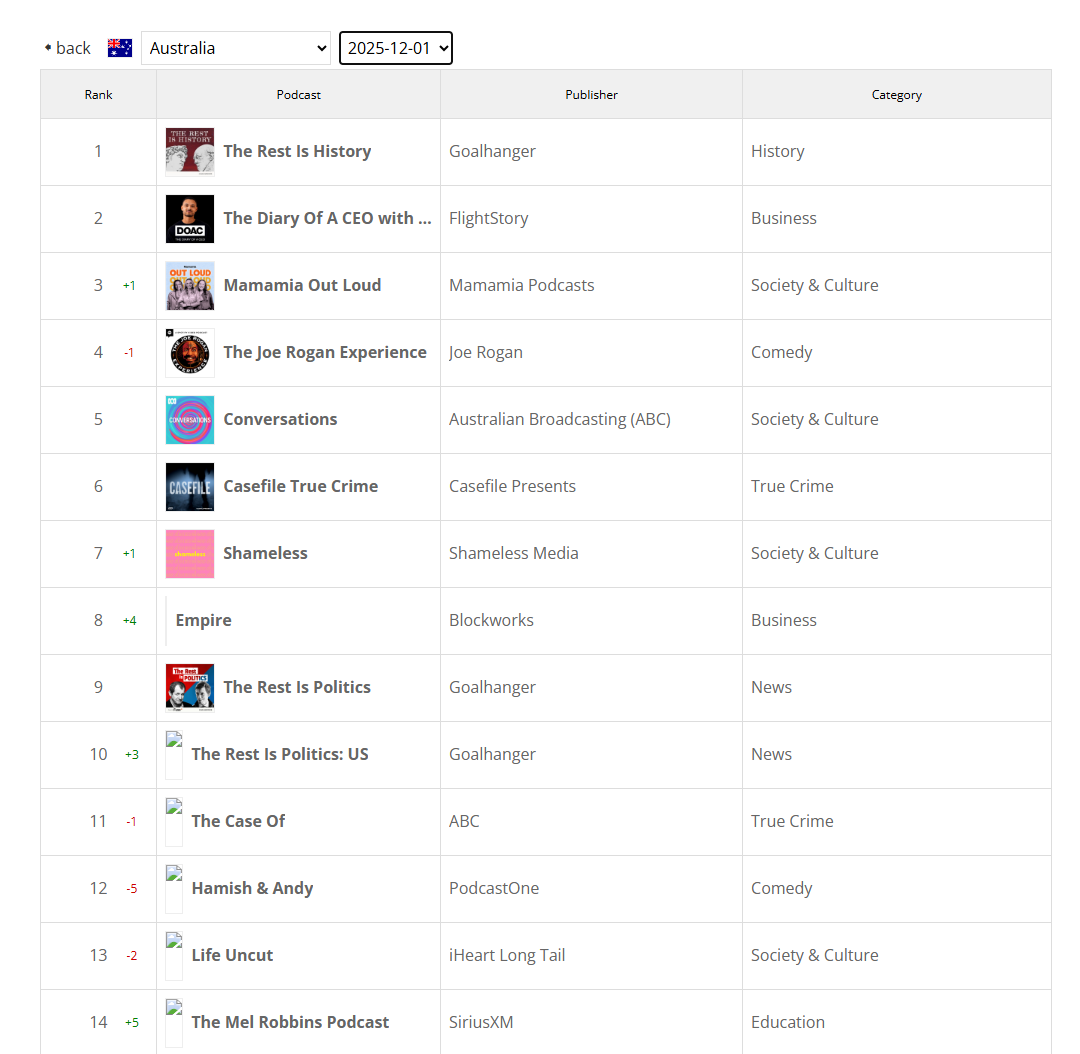
Steven recently posted to social media something from behind the scenes that is fundamental to his success, that is that if after a guest has come in and done the recording, Steven and his team don’t think the episode has ‘worked’ they will not air it. As you can imagine that has lead to some very uncomfortable follow up chats and the end of a couple of professional relationships. But, as a result, Steven provided data that showed that the trust in his brand is such that listeners will commit to discussions with guests they don’t know, and will listen for a long time.
What many podcasters are guilty of is sharing something because they have taken the time to record it, or its ‘good enough’. Also this applies to when you see a spike because you had a celebrity – listeners are tuning in for the calibre of guest, not the podcast.
The first day of Radiodays Europe 2026 in Riga, Latvia was a podcast summit where I felt inundated with ‘your podcast must have a video component’ feedback. I was at the same time listening to entries to the inaugural Australian Audio Awards which will be held on May 28 in Sydney. The shortlist of finalists is below:
I was overjoyed at the incredibly high standard of the entries to this year’s awards, none of which included video for their submission. The UK has exceptionally high production values. The US likes high profile names and entertainment. Australia’s greatest strength is our storytelling abilities. While we also prioritise production and performance, I listened to certain podcasts for the first time which inspired me, repeatedly, to keep listening and then follow the many rabbit holes available for further information on characters, cases and stories.
While video is all the rage at the moment, someone is always listening – in the car, while they’re exercising or just because they prefer the theatre of the mind. So, by all means put together social videos and record for YouTube, but if a million Australians are purely listening to Hamish and Andy every month, video does not need to be your be all and end all. Quality over quantity.
More food for thought is what happens if you and your co-host fall out? The Kyle and Jackie O podcast has long been the most successful radio catch up variety. It is an example of people listening for what Kyle Sandilands, Jackie Henderson and their team offered, not necessarily who their featured guest was. At present all 2000 plus episodes are still available on iHeart, up to March 3, which included a poignant ‘See you tomorrow!!’ message at the end.
But at some point, soon I suspect, these will all be removed. What happens to them then? Can Kyle and Jackie access them or do they, and the feed, remain the property of ARN? Preliminary hearings for K&J against ARN are set for the same day later this month,Friday 24 April. As Jackie has now made mention of previous ‘abusive, humiliating, and belittling comments to, and about, Ms Henderson while on-air’, access to this audio has significant additional value. It may even become evidence.
Sometimes relationships between a podcast and production company reach the end of their life, and like a personal relationship too, the break is rarely even in that one party might be blindsided by the other. Over the last six months there have been some major moves that have been overshadowed by other media happenings.
On April 1, and it was not a joke but was a surprise, It’s a Lot with Abbie Chatfield left LiSTNR for Acast. She began her podcasting career with the latter but shifted to SCA when she began presenting a radio program with them. The February podcast ranker had Abbie at #9 with 330,691 monthly listeners.
Abbie still featured on the LiSTNR platform up to and including last Friday the 10th of April, although the main image says Acast not LiSTNR as she speaks of now being an independent podcaster.
But I will watch with interest as to whether that continues and what happens to all the episodes she recorded with and were financially supported by LiSTNR in the past.
Rosie Waterland, who also went to Acast from LiSTNR, took the unusual step of re-recording some of her episodes again when she wasn’t able to bring the old ones with her. This last weekend I’ve also noticed that Jessica Rowe has departed LiSTNR too. You can still listen to old episodes of Jess Rowe’s Big Talk Show elsewhere, just no longer on LiSTNR (see below).

Other significant movements include Life Uncut with Brittany Hockley and Laura Byrne switching from ARN iHeart, where they also hosted a KIIS Network drive program, to LiSTNR. LiSTNR have included the pair in their branding now (that is them on the left after Hamish and Andy) but SCA have not yet found them an on air role. Life Uncut was #7 with 383,000 monthly listeners in the February ranker.
Australian True Crime, the long running podcast hosted by former radio presenter Meshel Laurie moved to ARN iHeart. It was #17 on the ranker and was with Acast.
And Jeremy Carne departed his role as Hamish and Andy’s Executive Digital Producer. He has worked with the duo for 15 years.
That may sound a small change for the consistently most listened to podcast in Australia, but when you work with someone so well and for such a long time, it takes a long while to find a replacement who gets the ins and outs of what makes that podcast resonate.
It was Marc Fennell who said, when we interviewed him in 2023, that he has surrounded himself with the best people to make his podcast and TV programs sing. Every new opportunity he makes provisions so that they can accompany him. In the audio industry you’ll find that the great people are consistently employed.
My last reflections for the modern podcaster are around advertising. I would rather never hear a gambling ad in my audio product, for personal reasons, but ones that are significant to me. Across multiple platforms, even if I am under the Acast umbrella for example, they cannot guarantee that a sneaky gambling ad won’t pop up for a listener on Spotify.
They can, and should, protect the aligned advertising sponsors however. Rosie Waterland said at SXSW that she was asked whether she would shop at Chemist Warehouse or Priceline. She replied that she would exclusively shop at which ever chemist was prepared to support her podcast.
But it’s not always quite so simple. A friend has a wine podcast. She has turned down opportunities because they wanted her to limit the scope of products she could talk about. At the Radiodays podcast summit a fellow said the same of a motoring podcast he facilitated too. He’d ended up with a far less lucrative car cleaning product sponsor rather than the high end car brand who then would not allow him totally integrity when reviewing their products and some vetting of other rival vehicle makes.
You can turn down an advertiser or sponsorship for any of the reasons above. Like Steven Bartlett and his interviews that weren’t quite good enough, you stand for something and what you align your voice and podcast to will matter to listener trust.
Jen Seyderhelm is a writer, editor and podcaster for Radioinfo. You can get in touch via [email protected]