
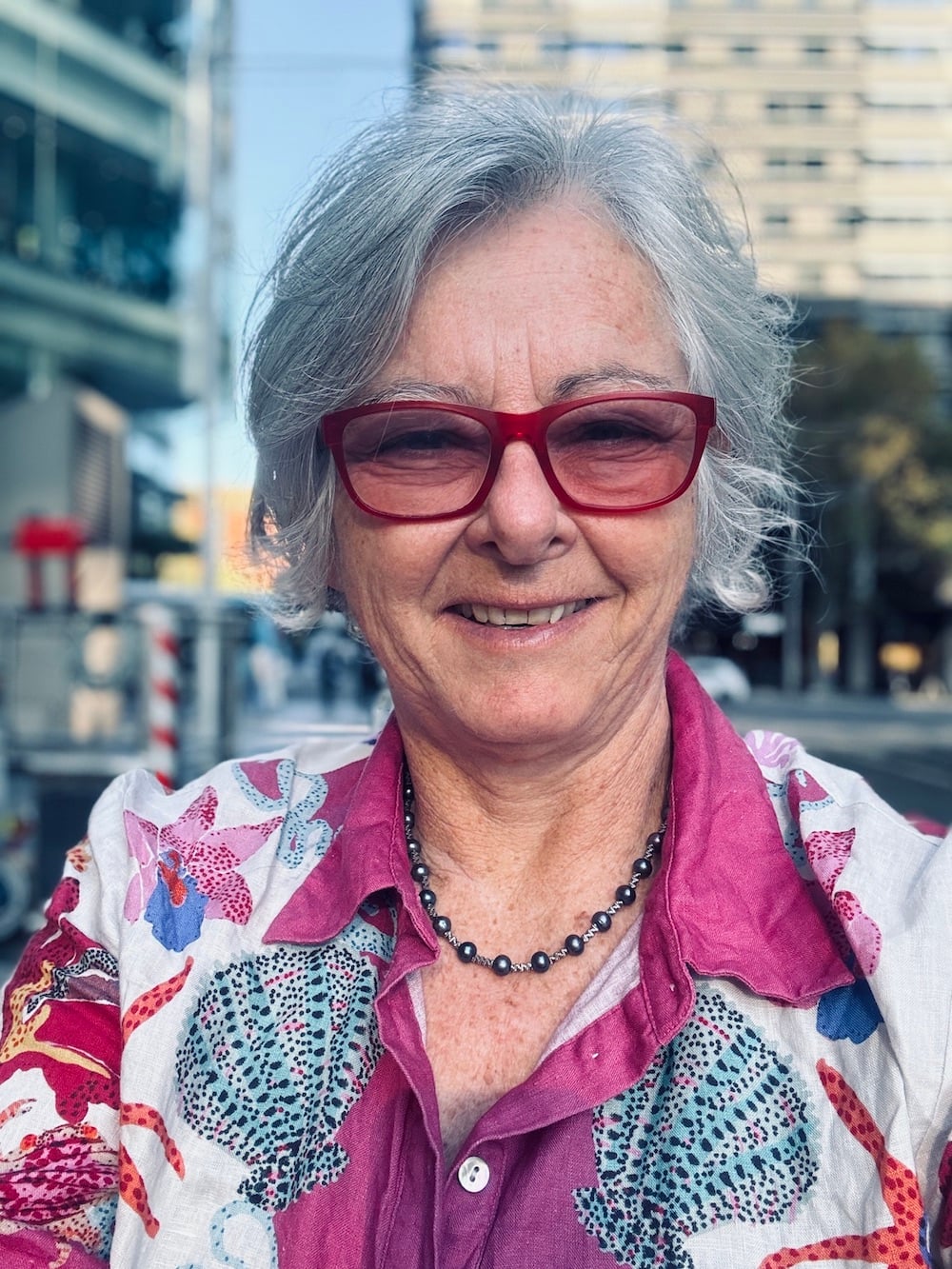
Ginny Stein, newly appointed Industry Professor of Journalism at UTS, is the seventh profile in this series. Her adventurous spirit, the desire to tell important stories and to give back to others was evident from the beginning and led to her working in over 30 countries in a variety of roles throughout her career.
The series, Wisdom of Women in Media explores the career and personal journeys of women in the audio media industry. The aim of the series is to reflect on the wisdom they have gained, to mentor and to share their hopes for the industry.
1. Describe your current professional life and your stage of life.
I’m Week Four in my new role as Industry Professor of Journalism at the University of Technology Sydney. It’s a full circle moment.
As a young student, hoping to find a way to start my career, I remember nervously walking into the same building where I now have an office. Back then, I was producing a radio program for community radio station 2SER focused on “job prospects for graduates”. And the building which now houses UTS’s School of Communications was once the headquarters for the Sydney Morning Herald. I got my first real job offer that day, as a stringer for the Herald.
2. How did you come to be in this industry?
I wanted to be a journalist, to tell people’s stories long before I had any idea of how to go about it. Growing up in a small country town, I knew no one who had ever been to university. My first step was to find a way out. I did that by becoming an exchange student to South Africa, a country marked at that time by intensifying internal resistance and growing international condemnation of its racist segregation policies. That year, my eyes were truly opened. My desire to become a journalist absolute.
Once I gained a foot in the door, there was no going back. When I started, it was a very different time. Male-dominated newsrooms were the norm. I got my first break in joining an all-male newsroom at the ABC in Darwin with these words from one of its senior journalists, “We need a woman, we think we could get along with you. Do you want a job?”
I moved around Australia a lot when I first started, seeking new opportunities and adventures. From Darwin to Sydney, to Wollongong, with a year or so in between backpacking around the world. My first foreign posting to Thailand as the ABC’s Southeast Asia correspondent was my stepping stone to almost thirty years in the field. From Thailand and the end of the Khmer Rouge to Jakarta during the overthrow of Indonesia’s dictator Suharto, and the birth of East Timor as a nation.
Technology gave me my next big chance. As the world moved from analogue to digital the first small broadcast-quality cameras emerged, and so did my new career as a video journalist, shooting my own stories and filing from the field.
More than 30 countries later, a shift into media management and leading digital transformation in one of the most remarkable organisations, Radio Free Asia, based in Washington DC. I was now where I wanted to be and where I could make a difference.
I’ve been fortunate to have an amazing career as a journalist, and now, I have the opportunity to step back, reflect and help grow a new generation.
3. What are your core beliefs? How are your values evident in the work you do or the life you lead?
I believe that journalism, at its very best, can make a difference. Reading about Britain’s Sunday Times’s pivotal role in the thalidomide scandal during the early 1970’s, led by editor Harold Evans, inspired me.
Ethical, public interest journalism stands up for those who can’t. In an era where the powerful have constantly sought to criticise the media, you just have to ask why.
From war crimes to Robodebt, to abuses in aged care, it is the work of journalists that has given voice to ordinary people.

I believe in the need to show up, bear witness, and shine a light. We are all devastated by what is happening in the Middle East. We can see it, because the media is there. But what about conflicts such in the Sudan, where civil war has raged for four years, and in Myanmar, a country on our doorstep, where a Nobel Peace Prize winner remains incommunicado. No one has seen Aung San Suu Kyi in years, not even her family. There is no verified proof of life.
But the real difference that journalism makes is in the every day. Telling stories, informing us, entertaining us and connecting us as a community.
4. How did your education, formal and informal, enrich your career/ life journey?
I was fortunate to be the first in my family to attend University. It was a privilege denied to my mother. She wanted to go to Uni, but her parents said there was only money for one. Her younger brother went to agriculture college. She left school early to work as a secretary.
I know that going to university changed my life in so many ways. Most of all, it created a pathway for a future beyond a small country town.
I was fortunate in my career to be supported by some amazing colleagues and newsroom leaders. When I was first posted overseas by the ABC, male foreign correspondents outstripped women four to one. Overseas, it was cameramen colleagues who first taught me to shoot. Mark Laban and David Leland at Asiaworks and Dave Anderson in Jakarta for the ABC. When things got tough or dangerous, colleagues and friends were the people you often turned to for help and support. MP Nunan, Nancy Collins, Catharine Munro, Jo Collins, Kate Callaghan, were my Jakarta crew.
But where it all began was with the support of one radio current affairs executive producer, Lindy Magoffin, who gave me a chance, a foreign assignment of sorts in my own backyard – regional Australia. Coming back with an eclectic mix of stories led to me being given my first posting. After three days in TV news, the ABC’s legendary first ever Foreign Editor John Tulloh, put a small digital camera in my hands as I was about to head off to Bangkok. He saw where technology was heading and the opportunities it gave for newsgathering. I was now a bi-media reporter. Mike Carey at SBS Dateline stepped it up a notch when he brought together a wonderful mix of adventurers and let them loose on the world as VJs at SBS Dateline.
Throughout my career I have continued to study. A Masters Degree, and a number of short courses targeting special skills. In journalism, you never stop learning. Soon I hope to begin a PHD.
5. What are some of your key decision change points and how did they shape your career/ life journey?
I had held off applying for overseas postings at the ABC. There were so few female foreign correspondents, I thought it was unachievable. I remember talking with male colleagues about why so few women were posted overseas. I was regularly told it was because women didn’t want to go because it was ‘tough on families’. On a trip to Thailand to visit a friend, I met several female freelance foreign correspondents, who persuaded me to apply. When I did, I was the only female candidate in a field of eight or nine men. I am not sure who was more surprised when I was chosen.
When did you stop, take a break or try something different in your career? How did this change impact you?
After being made redundant from the ABC I headed overseas, first to Harvard for a short course on the use of drones in emergency response, then to Mexico where I completed my Masters in Disaster Resilience and Sustainable Development. Taking a chance, I applied for a volunteer role under the Australian Volunteers Program working in Vanuatu.
I had no idea how significant a move this would be in my life. I thought it would be for one year. A chance to put my learning into practice in one of the most disaster prone nations on earth. But that one year turned into almost five.
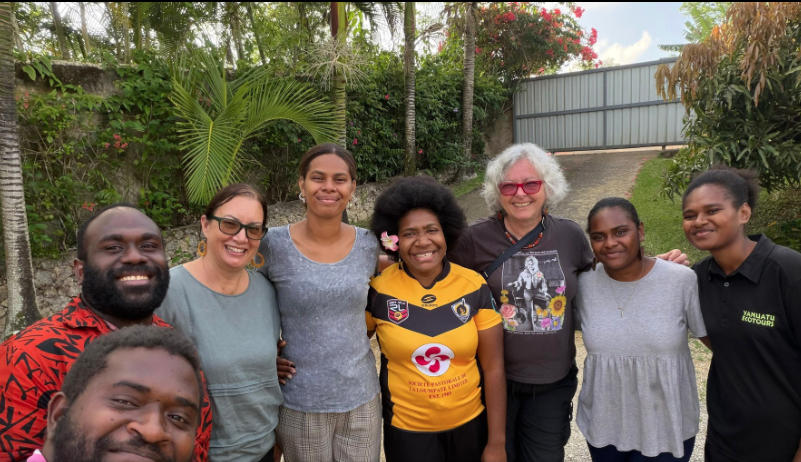
Being locked down on a tropical island amidst a global pandemic was the one disaster I had not envisaged and something I can now say I am most grateful for. I made deep connections and close friends and had the chance to recover from the stresses of decades on the road as a foreign correspondent.
6. What makes you happy? What makes you get up in the morning?
Being alive. Doing something with meaning.
7. Share your words of wisdom for others in the industry or those wishing to work in the industry?
Show up. Be intentional. Stay curious. Ask questions and enjoy it.
There is no other profession that gets you into a room to speak to people in the way that journalism does. And if you are ready when the opportunity arises, there is no other job in the world, that will pay you to travel and have adventures you never thought possible.
8. Describe your vision for the audio media industry in the near future.
The industry is going to continue to evolve. At its core it will keep doing what it has done since the beginning. Stories will be told, information will be shared, music and sound will continue to play. The method of delivery may change, as it has since the beginning, when I used to edit radio reports cut together on tape, and sent over phone lines with alligator clips connected to wires.
I hope students will continue to take that nervous first step into community radio stations where they’ll learn about audio production and overcoming ‘mic fright’ as a stepping stone to wonderful careers as podcasters, producers, journalists, and presenters.
9. What role would you like to play in shaping the audio industry of the future?
I’ll be the curious one asking ‘what’s next? And how do we get there?
Series compiled by Serena Ahern for radioinfo.
If you have a suggestion for someone to be considered for this series, please send a note to [email protected]
Previous articles in the Wisdom of Women in Media series: